CLM & CVM
From Feedback to Action: How Banks Translate Customer Voices into Lifecycle Decisions
How banks combine feedback, context, and contact rules into traceable lifecycle decisions – with human oversight.
•
acceleraid Editorial Team
7 min. read

Author: acceleraid Editorial Team | August 13, 2026
A feedback program is only useful if it enables a better next decision. For banks, this means not only capturing how customers rate an interaction, but bringing together the reason, the context, and an appropriate response. A complaint after a card freeze, a low rating after a service contact, and an abandoned digital application are different signals. Together, they can point to an unresolved problem in the lifecycle. Viewed in isolation, they often remain entries in separate systems.
The goal is not a blanket "more personalization." It is a robust process: understand feedback, check with permissible context, select a decision, deliver it in a controlled manner, and measure whether it resolved the specific problem. This protects against a logic where every negative response automatically triggers a promotional message.
Why an NPS Dashboard Doesn't Close the Loop
An NPS or satisfaction score condenses perception. It does not automatically say which customer group is affected, whether an issue has already been processed, which channel is appropriate, or whether contact may be made at all. It is therefore a good starting point for questions, but no substitute for a decision.
The gap between aspiration and actual use is real. In Accenture's global study, 72% of respondents said personalization influenced their choice of bank; at the same time, only 3% used the personalization tools offered by their primary bank. Furthermore, 51% felt overwhelmed by promotions. These findings are not a blueprint for individual European institutions, but they show why sending more communications is not a convincing response to a feedback signal. Accenture Global Banking Consumer Study 2025
An isolated dashboard also shifts responsibility. The experience team sees the rating, the contact center knows the conversation history, the product organization sees the abandoned application, and the campaign team plans the next mailing. Without a shared decision logic, the same person can receive an apology, an unsuitable offer, and another survey. This does not feel attentive, but uncoordinated.
In a US study by J.D. Power, 47% of customers recalled receiving advice from their bank at least once. However, only 20% said their bank always personalizes information. J.D. Power measures the US market here; the figures should not be mapped directly to Europe. Yet, the practical lesson is universal: remembering a communication and providing permanently helpful guidance are two different outcomes. J.D. Power, U.S. Financial Health Support and Advice Study 2026
Connecting Feedback with the Right Context
The first layer of the operating loop is a clean event file, not a massive profile. It records: What was explicitly said or rated? Via which touchpoint? On which product or process? What is the processing status? What consent, preference, and contact blocks apply? And what current behavioral signals are required for this exact decision?
Explicit feedback includes survey responses, free-text, complaints, conversation notes, and outcomes after a service case. Context can come from an abandoned process, a repeated error message, the use of a channel, or a transaction—provided the purpose, legal basis, and internal data rules permit this. Transaction data must not become an invitation for random campaigns. They should only help to test a hypothesis: Is the reported card error still unresolved? Did the frustration occur after a fee booking? Was the process aborted after an identity check?
The global Accenture study describes this exact continuity as a customer expectation: interactions from branches, apps, call centers, and other touchpoints should connect into an ongoing conversation. The report is based on 49,300 banking customers in 39 countries; it is therefore broader than a national snapshot, but does not replace local validation. Accenture Global Banking Consumer Study 2025
A useful context is lean and comprehensible. It does not contain every piece of available information, but the information that makes a decision more reliable. For instance, a case with negative feedback following suspected fraud might first lead to checking service status, not to a product pitch. Only when the case is resolved, the person wishes to be reachable, and there is a clear need, does a follow-up communication come into play.
The Feedback-to-Decision Loop
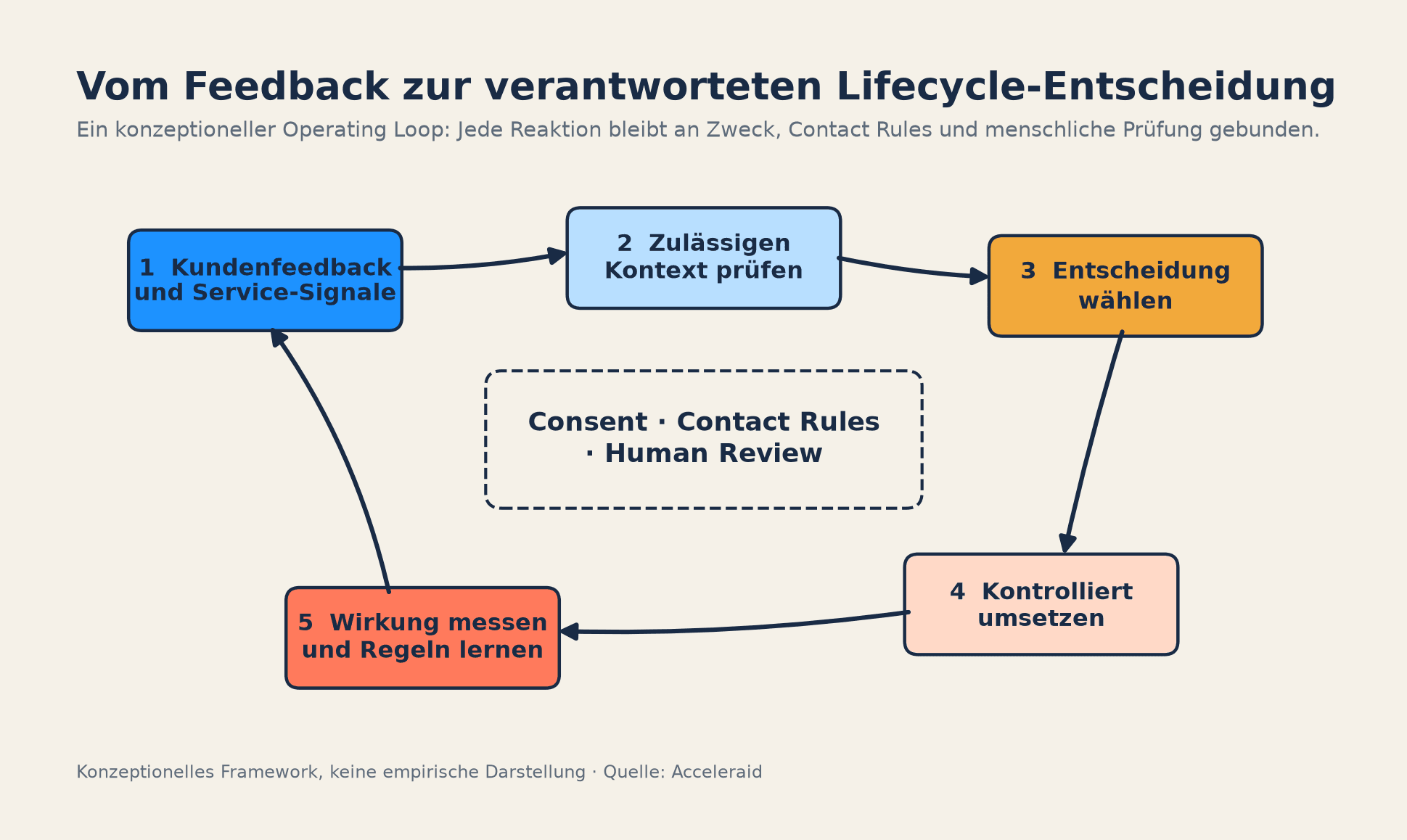
The loop requires five clearly separated steps:
Capture and structure. Feedback is saved with the trigger, channel, product, timestamp, urgency, and case reference. Free-text can be pre-sorted, but sensitive or unclear topics remain visible to humans.
Check context. A rule links only the signals needed for the query: open service case, process status, preferred channel, contact eligibility, and a limited history of similar contacts.
Select decision. The outcome can be "route case to staff," "show information in the logged-in area," "do not trigger contact," "offer call-back," or only then "offer relevant help." Doing nothing is a valid decision.
Controlled delivery. Frequency caps, priority rules, and exclusions prevent complaint, sales, and service communications from working against each other. For risks, complaints, extreme hardship, or unclear interpretations, a human must be able to confirm or take over the decision.
Feed back impact. Measurement goes beyond the next rating, tracking whether the case was resolved, a repeat contact was avoided, the assistance was accepted, and whether unwanted consequences like unsubscribes or repeat complaints occur.
This is what distinguishes a real closed loop from a list of "negative detractors." Feedback sets the direction; context limits the assumption; rules make the response permissible; humans handle exceptions.
Contact Rules and Governance Over Speed
Before the first automation, the bank needs a decision inventory. For each decision, the purpose, permitted data elements, target group, exclusions, contact channel, maximum frequency, owner, escalation path, and metric are documented. This creates an auditable catalog, rather than hiding logic inside individual campaigns.
Consent is not just a field at the end of the data stream. It determines whether and how a decision may be executed in the first place. In addition to consents, this includes channel preferences, opt-outs, quiet periods, legal or internal blocks, as well as the current status of a complaint or hardship case. If trust is low, the default action should not be "explain more via push," but "no automatic contact."
Review thresholds must also be concrete. For example, humans review new free-text categories, cases with multiple conflicting signals, negative feedback following a major financial decision, and any rules that could contribute to a credit, pricing, or risk outcome. The business unit is responsible for the customer view, compliance and legal review the guardrails, operations handles case resolution, and data/technology ensures traceability. None of these roles can run the loop alone.
Measurement: Case Quality Over Campaign Volume
A good measurement architecture has three levels. At the signal level, there are routing, completeness, processing time, and the share of unresolved cases. At the decision level, there are rates of correct routing, rule-compliant suppressions, human overrides, and contact collisions. At the impact level, metrics cover resolution at the first appropriate step, repeat contacts, complaint trends, uptake of offered help, and downstream feedback.
This also allows verification of whether a measure was actually helpful rather than just visible. The 2026 benchmark from Market Force reports that for surveyed banking customers in the US, 87% had stayed with their primary bank for at least three years, but only 48% reported complete trust. This is not a European benchmark, but a useful warning against equating retention with loyalty. Market Force 2026 Banking Benchmark Study
Teams should also treat negative metrics with equal weight: failed contacts, suppressions, unsubscribes, complaints following a communication, and overridden rules. A model that sends out many messages but violates more quiet periods does not improve the lifecycle.
A Pragmatic 90-Day Start
Days 1–30: Choose a moment and establish foundations. A sensible start is a recurring, addressable event, such as negative feedback after a digital service process. The bank maps sources, data minimization, consent, existing contact rules, escalations, and the responsible case owner. Following this, a clear goal and a counter-hypothesis are formulated: "A proactive product pitch is not appropriate at this moment."
Days 31–60: Integrate small and test with humans. The team connects feedback, case status, and a few context fields in a transparent event file. It initially builds three decisions: route to service, help at the right moment, or do not contact. Staff review samples and document when they override rules. Technical success is not a complex classification, but a verifiable process.
Days 61–90: Roll out on a limited basis and learn. A small, eligible target group receives the new treatment, complete with contact caps, exclusions, and a clear kill-switch criterion. On a weekly basis, a cross-functional committee reviews case quality, customer outcomes, and rule violations. Only when the treatment works reliably are other feedback types and lifecycle moments added.
The crucial shift in perspective is this: the customer voice is not a reporting endpoint. It is an input into a responsible decision. Banks that design this transition with context, restraint, and human responsibility can turn feedback into reliable next steps without overwhelming their customers.
Illustration: AI-generated. AI-supported content: We use AI technologies and automated agents, including those from Microsoft, Google, OpenAI, Anthropic, and other providers, to create our posts. Topics, professional orientation, and final approval remain with our team.
Further Insights
We use cookies 🍪
Strictly necessary cookies (e.g. Pipedrive forms) remain active. With your consent, we also use Google Analytics (analytics) and Leadfeeder (visitor identification). Learn more in our Privacy Policy.
Decline
Accept all