AI & Banking
AI Personalization Platform for Banks: What Matters Most When Choosing One
Selecting an AI personalization platform for banks: an overview of five capability dimensions, vendor questions, and regulatory criteria.
•
acceleraid Editorial Team
5 min read
01
Acquire
Recognize signals
02
Onboard
Control activation
03
Grow
Next Best Action
04
Retain
Reduce churn
05
Reactivate
Reclaim potential

This series complements our Next-Best-Action series with the provider perspective: anyone introducing an AI personalization platform for banks must know which capabilities really count before making a purchase decision. We described how the actual decision logic behind the delivery works in the article "How a Next-Best-Action Engine Decides" — here, it is about how this capability can actually be verified with a provider.
Why the selection is more difficult than comparing features
An AI personalization platform for banks cannot be judged on a feature list alone, because almost every provider uses the same buzzwords: real-time, AI-driven, omnichannel. The real difference lies in the depth of implementation — and this only becomes apparent when you ask specific questions. The level of maturity in the industry makes the problem visible: only 8% of banks can apply predictive ML insights to campaigns at all, only 28% integrate internal structured customer data into AI models quickly enough, and only 9% have a full ML model suite for every touchpoint (McKinsey, 19.07.2022). This gap between aspiration and practice is precisely the space in which providers with marketing claims can be distinguished from providers with robust implementation — provided the right questions are asked.
In short: a robust AI personalization platform for banks can be tested against five capability dimensions — real-time data access, model breadth across all touchpoints, decisioning depth, channel coverage according to actual usage, and regulatory auditability. Anyone who backs up these five dimensions with specific provider questions can distinguish marketing speak from real implementation.
The five dimensions of the Capability Map
A structured assessment logically follows the five MarTech dimensions described by McKinsey for banking personalization: Data, Design, Decisioning, Distribution, Measurement (McKinsey, 19.07.2022). This framework can be translated directly into a provider checklist.
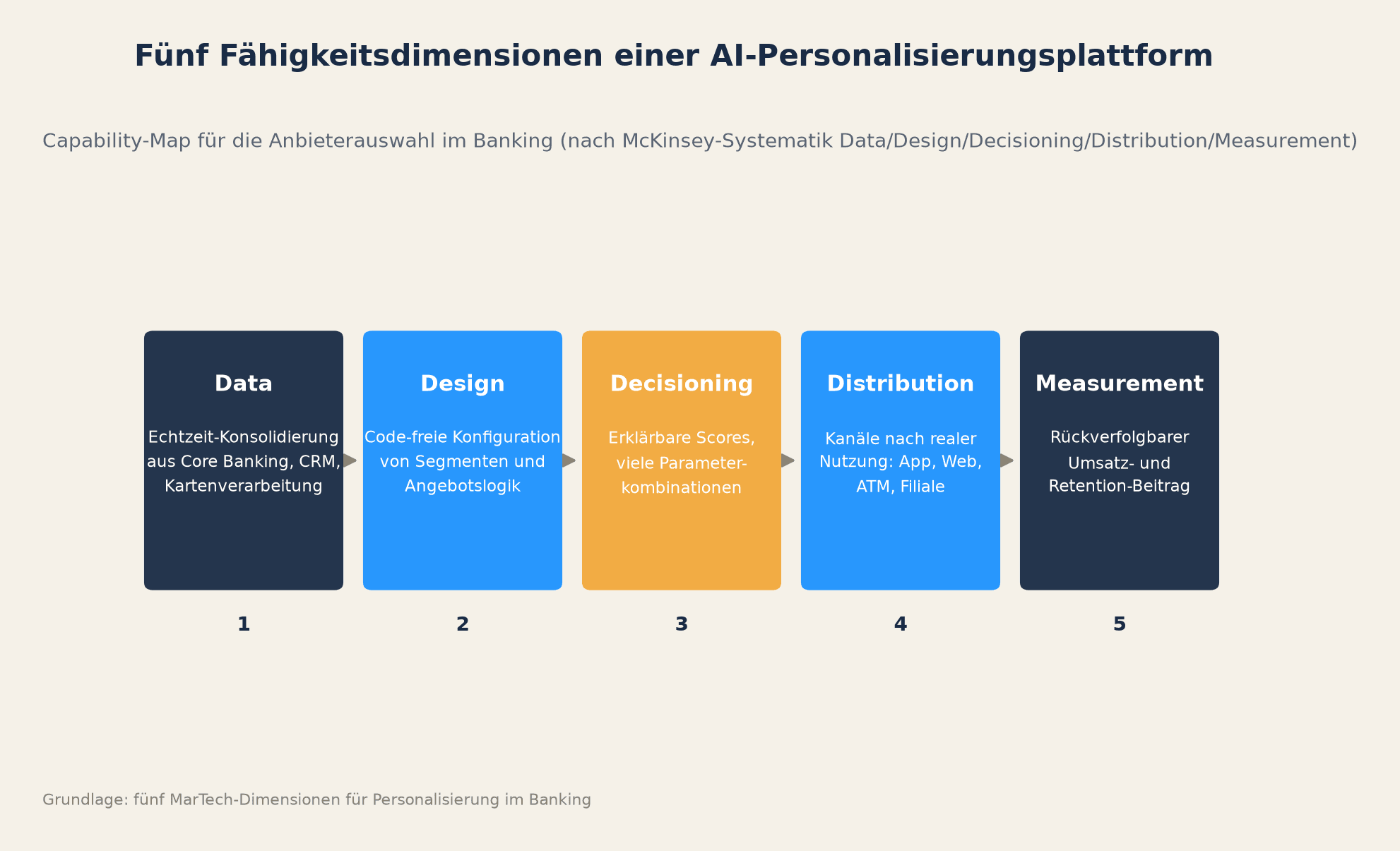
Data. Can the provider consolidate structured customer data from core banking systems, CRM, and card processing in real time, or does it remain limited to nightly batch loads? The answer determines whether subsequent decisioning promises are even technically achievable.
Design. How are segments and offer logics configured — code-free by business units or only via IT tickets? This determines the actual time-to-market of campaign changes.
Decisioning. This is the most demanding dimension. A documented example illustrates the level of requirements: a decisioning layer processed 50 billion parameter combinations and generated +20% commission revenues in the first eight months after introduction; after the first productive use case, 1,500 features were available for further models (McKinsey, 19.07.2022). A provider question that addresses exactly this: "How many parameter combinations does your decisioning layer process per recommendation, and how many features are available for the second use case after the first?" Anyone who cannot answer this question with concrete orders of magnitude probably has a rules engine, not a decisioning platform.
Distribution. Does the platform cover the channels that customers are actually using? The real channel weight per customer and year stands at 152 app interactions, 96 website interactions, 52 ATM interactions, and 8 branch interactions (Accenture, Global Banking Consumer Study 2025). Crucial here: at 21%, chatbots achieve the lowest satisfaction of all channels in the same study — an argument for evaluating not just which channels a platform technically connects to, but also the quality with which it delivers content there. A simple channel checklist is therefore not enough.
Measurement. Can the contribution of each recommendation to revenue and customer retention be clearly tracked, or does the impact remain a black box? Without robust measurement, the business case for the platform cannot be defended or optimized over time.
Why demand and trust are a separate evaluation criterion
Personalization is not perceived neutrally by customers — it has a proven influence on behavior in both directions. 72% of banking customers say personalization influences their choice of bank, but only 3% actively use personalization tools provided by their own bank; 62% are generally open to an AI-assisted financial advisor (Accenture 2025). At the same time, data privacy is not a niche topic: 84% of customers actively think about how their data is used, 53% have concrete data privacy concerns, 58% fear hacking, and only 26% are interested in an extensive AI analysis of their data (Accenture 2025). A platform that ignores this reluctance risks reputational damage, even if it is technically convincing. The question for the provider is therefore not only "what can the model do", but also "how transparent does the platform make it to the end customer why a recommendation is being shown".
Regulation as a mandatory part of the Capability Map
For automated decisions with legal or similarly significant effects, Art. 22 (1) GDPR gives data subjects the right not to be subject solely to such a decision, unless it is necessary for a contract, authorized by law with protective measures, or based on explicit consent (Art. 22 GDPR). In the permitted cases, the platform must technically and organizationally ensure at least the right to obtain human intervention, to express his or her point of view, and to contest the decision (Art. 22 (3) GDPR); furthermore, decisions must not generally be based on special categories of data under Art. 9 (1) (Art. 22 (4)) (Art. 22 GDPR). For classification as a high-risk system, the EU AI Act is precise: Annex III No. 5(b) covers AI systems intended to be used to evaluate creditworthiness or establish credit scores — excluding systems used for fraud detection —, No. 5(c) covers risk assessment and pricing in life and health insurance (EU AI Act, Annex III). A good provider question is therefore: "Which of your models fall under Annex III, and how is the architecture separated so that marketing personalization does not automatically slip into the high-risk category?"
A related but distinct selection criterion is the integration capability into the existing MarTech landscape — such as Braze, Adobe, or Salesforce Marketing Cloud —, which we explored in detail in the article "No Rip and Replace: Seamless Integration Instead of System Replacement".
In addition, the EBA guidelines on outsourcing arrangements apply to critical or important outsourced functions. Before concluding a contract, the bank must assess whether such a function is affected, review regulatory requirements, identify risks, and conduct due diligence on the service provider (para. 61) (EBA/GL/2019/02). Specifically, the guidelines require a documented exit strategy (para. 106), unrestricted audit rights for the institution and supervisory authority (para. 87), and a substitutability assessment of the provider (para. 31 h) (EBA/GL/2019/02). Further robust contract questions: Is sub-outsourcing of critical functions permitted (paras. 76–78), does the subcontractor receive the same access rights (para. 79 b), and in which countries is data processed and stored (para. 75 f) (EBA/GL/2019/02).
Why testing capacity is an underestimated selection criterion
An often overlooked criterion is the capability of a platform to test continuously rather than configure once. Leading personalizers run several hundred tests per year, and faster-growing companies generate 40% more revenue from personalization than slower-growing ones (McKinsey, 2021). A platform without a built-in testing infrastructure — such as multi-armed bandit algorithms for ongoing traffic allocation — structurally slows down this iteration cycle, regardless of how good the initial models are. Added to this is a market structure effect: the number of MarTech providers in the US has roughly doubled in five years (McKinsey, October 2024 — one reason why banks should orient themselves towards capability maps instead of provider lists.
Category Clarity: What "Real-Time Interaction Management" really means
When a provider claims to master "Real-Time Interaction Management" (RTIM), a precise definition is worthwhile as a benchmark. Forrester describes RTIM as linking personalization strategy with CX initiatives, with next-best-experience decisioning, cross-functional alignment, and optimization of customer outcomes (Forrester, "The State of Real-Time Interaction Management, 2024", 21.06.2024). This is more than "we send in real time" — it includes cross-functional alignment between marketing, service, and sales. A good follow-up: "Show us an example where the same customer interaction in real time took into account both a marketing and a service logic."
How Acceleraid covers this Capability Map
The Prediction Engine & AI Framework from Acceleraid calculates affinity, churn, propensity, and NBA scores in an explainable and auditable way; the CDP & Data Governance consolidates data in real time from CRM, core banking systems, and card processing, with consent management, lineage, PII protection, and German hosting according to GDPR-by-design (Platform). The Experience Optimisation implements AI traffic allocation via multi-armed bandit processes for personalized landing pages and application funnels, while the CLM/CVM orchestration immediately translates contact frequency limits and channel preferences into delivery — in online banking, app, email, and branch CRM (Banking). The platform is also designed to be model-agnostic: the underlying AI model can be swapped without losing knowledge, contexts, or configurations — an aspect that becomes practically relevant for the substitutability assessment under EBA guidelines. Over 250 enterprise deployments and more than 15 years of experience in the banking segment flow into the product development (Platform).
Conclusion
A robust provider selection for an AI personalization platform in banking does not begin with a feature list, but with five specific capability questions across Data, Design, Decisioning, Distribution, and Measurement — complemented by proof regarding customer demand, data privacy, regulatory auditability, and testing capacity. Anyone who asks these questions before the first demo meeting begins separates robust implementation from marketing speak. How the selected business case actually calculates will be covered in the next part of this series on the topic of AI personalization platforms for banks.
Illustration: AI-generated. AI-supported content: In creating our articles, we use AI technologies and automated agents, including those from Microsoft, Google, OpenAI, Anthropic, and other providers. Topics, technical direction, and final approval lie with our team.
Further Insights
We use cookies 🍪
Strictly necessary cookies (e.g. Pipedrive forms) remain active. With your consent, we also use Google Analytics (analytics) and Leadfeeder (visitor identification). Learn more in our Privacy Policy.