AI & Banking
The Business Case for an AI Personalization Platform in Banking
Business case for an AI personalization platform for banks: proven revenue uplifts, bottom-up model, and the cost side.
•
acceleraid Editorial Team
6 min. read
01
Acquire
Recognize signals
02
Onboard
Control activation
03
Grow
Next Best Action
04
Retain
Reduce churn
05
Reactivate
Reclaim potential

The first part of this series focused on how to select an AI personalization platform for banks based on robust criteria. This part answers the logically next question: How does the investment pay off — what revenue and cost impact can actually be proven?
The short answer first
The business case for an AI personalization platform in banking is based on three proven effects: a revenue increase in the low double-digit percentage range through personalization as a whole, concrete uplifts at the level of individual use cases, and faster time-to-value through ready-made platforms instead of in-house development. Taken together, this results in a business case that does not rely on a single key figure, but on a portfolio of effects — which also makes it more robust to the CFO than a single, vulnerable ROI figure.
The top-down anchor: What personalization in banking brings overall
BCG quantifies the annual revenue increase through personalization in banking at around 10%, with up to USD 300 million in revenue growth per USD 100 billion in assets under management (BCG, „What Does Personalization in Banking Really Mean?", 2019). McKinsey confirms this scale across industries with a range of 10–15% revenue increase through personalization, with fluctuations of 5–25% depending on the industry and implementation maturity (McKinsey, „The value of getting personalization right — or wrong — is multiplying", 2021). Together, these two independent sources provide a robust framework for the top-line expectation of a business case: not a runaway promise, but a repeatedly measured effect.
The bottom-up model: Where exactly the revenue is generated
A flat percentage is rarely sufficient for internal argumentation — decision-makers ask about the origin of the effect. BCG provides a use-case-based model for a bank with USD 100 billion in assets: Smart Engagement delivers USD 25–50 million in additional revenue on a baseline of USD 2,555 million, Smart Prospecting USD 15–25 million on a USD 450 million baseline, personalized journeys USD 45–135 million on a USD 450 million baseline, Smart Retention USD 30–90 million lower churn costs on a USD 300 million baseline, Smart Collections USD 25–35 million on a USD 90 million baseline, and marketing efficiency USD 5–10 million on a USD 45 million baseline (BCG, „The Power of Personalization", May 2018).
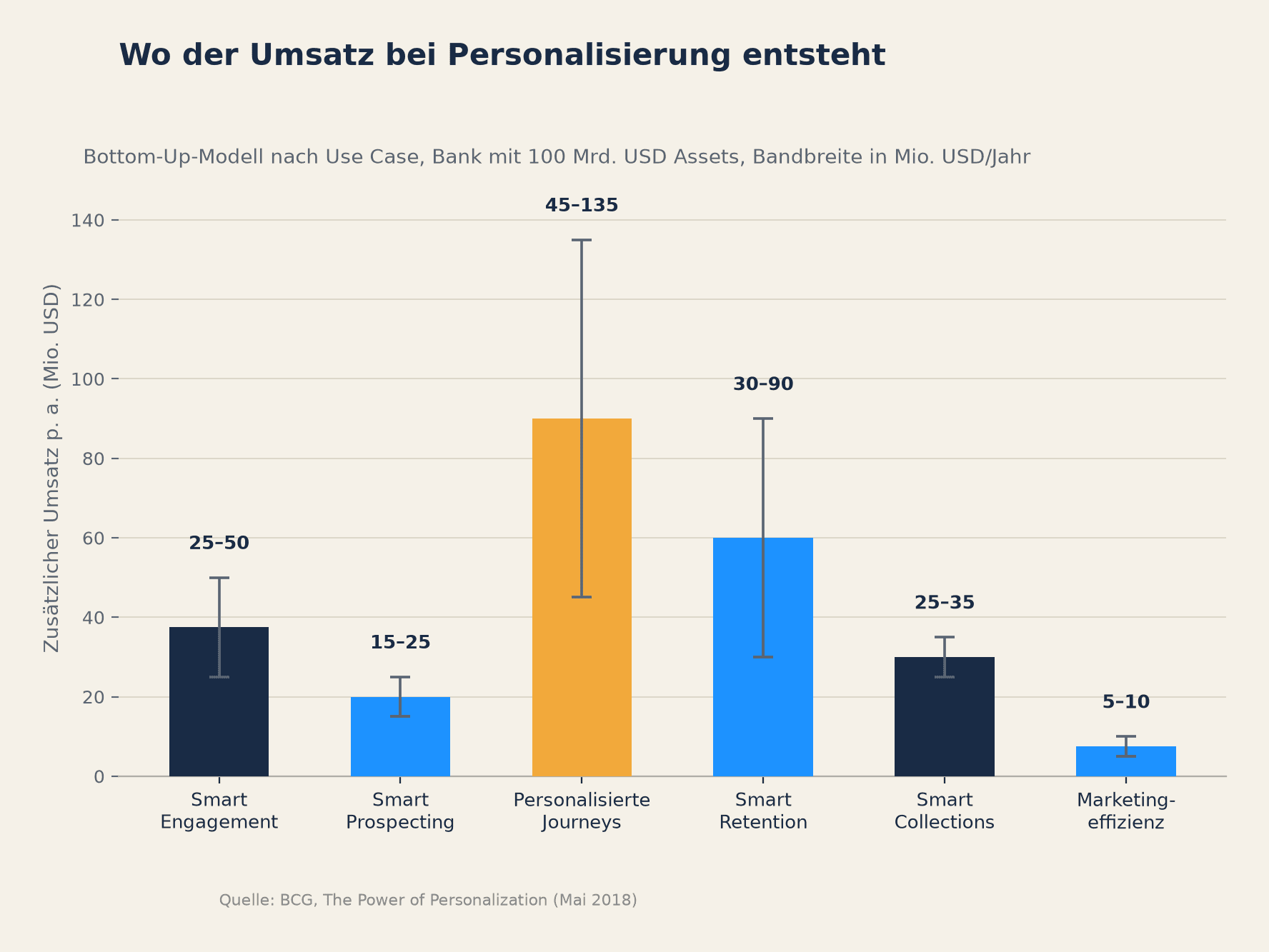
At the product level, even larger fluctuations are evident: 30–40% sales lift in individual product areas, 10–30% lower customer churn, and a 2- to 3-fold increase in engagement scores (BCG, May 2018). This range is deliberately broad — it shows that the actual uplift depends heavily on implementation quality and baseline maturity, not on the platform alone.
The demand side: Why customers write the case themselves
A business case becomes stronger when it is based not only on vendor promises but on measured customer behavior. In a BCG survey of 56,351 customer journeys, a personalized experience was a very important or the most important factor in switching to a new bank for 54% of customers; among 13,768 journeys of churned customers, 41% cited insufficient personalization as the reason for leaving; and among 18,221 journeys, 68% bought additional products from their existing bank because the approach was personalized (BCG, May 2018). The effect was particularly pronounced among customers aged 18 to 34 and those with the highest banking assets — highly relevant for the business case if these segments are a priority.
On the expectation side, this pressure is intensifying: 71% of consumers expect personalized interactions, 76% are frustrated when they don't happen, and 72% expect to be recognized as an individual — over 70% now view personalization as a basic expectation, not an added benefit (McKinsey, 2021). This shifts the business case: it is no longer just about upside, but increasingly about the risk of losing market share without personalization.
Proven individual cases as reference points
Concrete, documented cases provide additional anchor points for your own modeling. One bank increased its branch sales productivity by over 30%, another increased revenue by 20% over three years (BCG 2019). A decisioning platform processing 50 billion parameter combinations generated +20% commission income in the first eight months after launch (McKinsey, July 19, 2022). The rollout of a personalization program across six divisions of a European bank delivered a total of over USD 120 million in value with a 9-fold improvement in conversion rate (McKinsey, July 19, 2022). And RBC NOMI users showed a 2% churn rate compared to 8% in the control group — a 4-fold difference that translates directly into Customer Lifetime Value (Bain, „Customer Behavior and Loyalty in Banking", 2023). We covered this retention economy in detail in the article on 90-day churn prediction.
The cost side: Efficiency as the second component of the case
A complete business case calculates not only revenue but also efficiency gains. Agile implementation reduces marketing execution costs by 10–30% while generating 20–30% higher marketing revenues (McKinsey, „When agile marketing breaks the agency model", Sept 29, 2021); centralized, codified analytics processes deliver an additional 5–15% higher campaign revenues with 2 to 4 times faster time-to-market (McKinsey, July 19, 2022). Regarding the time-to-value assumption in the case: according to FIS, pre-built SaaS platforms achieve ROI within 3–6 months, and companies that rely on vendor partnerships instead of perfect in-house development achieve a 2.3 times faster ROI, according to a Deloitte analysis cited by FIS (FIS, „Modernizing asset finance: The build vs. buy decision", 2025).
Why the case must stand against investments already made
A business case for a new platform does not arise in a vacuum. Banks have invested over USD 2.8 trillion in digital transformation since 2011 (Accenture, Global Banking Consumer Study 2025) — so the case must not only show upside but explain why existing investments have not yet realized the described effect. Margin development provides an additional urgency argument: McKinsey expects retail banking margins to fall by 5–10% by 2026 (McKinsey, October 2024) — personalization thus becomes a compensation lever for falling margins, not a discretionary add-on project. And at the growth level, the long-term effect is visible: banks in the top advocacy quintile grow 1.7 times faster than average, and advocates hold 17% more products at their main bank (2.8 vs. 2.4) (Accenture 2025).
How Acceleraid addresses the business case building blocks
The combination of CDP & Data Governance, Prediction Engine & AI Framework, and CLM/CVM orchestration at Acceleraid is designed so that the effects described above — revenue increase through more relevant targeting, lower churn through early detection, higher marketing efficiency through centralized scores — rely on a shared data infrastructure instead of being built in silos (Platform). Documented vendor-side achievements include ROI in 6–9 months, +120% credit card applications, +50% qualified leads, and an average conversion uplift of +15% across more than 250 enterprise deployments (Banking). Churn detection 90 days in advance directly addresses the retention component of the business case, as described above using the RBC NOMI figures.
Conclusion
A robust business case for an AI personalization platform in banking combines three levels: the top-down anchor of 10–15% revenue increase, a bottom-up model with use-case-specific ranges, and a cost side that factors in efficiency gains and faster time-to-value. Presenting only one of these three levels risks making the case seem either too abstract or too easily challengeable. Combined, they create a model that can be defended both to the CFO and to the business lines — and that economically validates the reference architecture in focus in the next part of this series.
Illustration: AI-generated. AI-supported content: We use AI technologies and automated agents, including from Microsoft, Google, OpenAI, Anthropic, and other providers, in creating our articles. Topics, professional direction, and final approval remain with our team.
Further Insights
We use cookies 🍪
Strictly necessary cookies (e.g. Pipedrive forms) remain active. With your consent, we also use Google Analytics (analytics) and Leadfeeder (visitor identification). Learn more in our Privacy Policy.