AI & Banking
AI Personalization in Banking: Use Cases with Proven Value
AI personalization in banking: six use cases with proven revenue and efficiency gains, from retention to smart collections, including a CBA practical example.
•
acceleraid Editorial Team
5 min read
01
Acquire
Recognize signals
02
Onboard
Control activation
03
Grow
Next Best Action
04
Retain
Reduce churn
05
Reactivate
Reclaim potential

Part 2 of our series on AI personalization in banking. In the first part, we contextualized the architecture, maturity level, and economic efficiency of AI personalization in banking. This post goes one step further: Which concrete use cases deliver proven added value — and in what order of magnitude? AI personalization in banking pays off most clearly where models flow directly into campaigns, pricing, and customer approach: proven examples range from 20% more commission income to ninefold higher conversion rates.
AI Personalization in Banking: Six Use Cases with Modeled Value Contribution
BCG quantified six personalization use cases for a model bank with $100 billion in total assets and calculated their respective revenue contribution compared to the baseline:
Use Case | Objective | Baseline (USD million) | Revenue Impact (USD million) |
|---|---|---|---|
Smart engagement | Personalized prices and product offers | 2,555 | 25–50 |
Smart prospecting | Dynamic, targeted approach to prospects | 450 | 15–25 |
Personalized journeys | Optimized multichannel journey and delivery | 450 | 45–135 |
Smart retention | Less churn through earlier detection and intervention | 300 | 30–90 |
Smart collections | Better collections strategy (timing, offer, channel) | 90 | 25–35 |
Improved marketing efficiency | Higher ROI | 45 | 5–10 |
Source: BCG, Global Retail Banking 2018 – The Power of Personalization, Exhibit 8
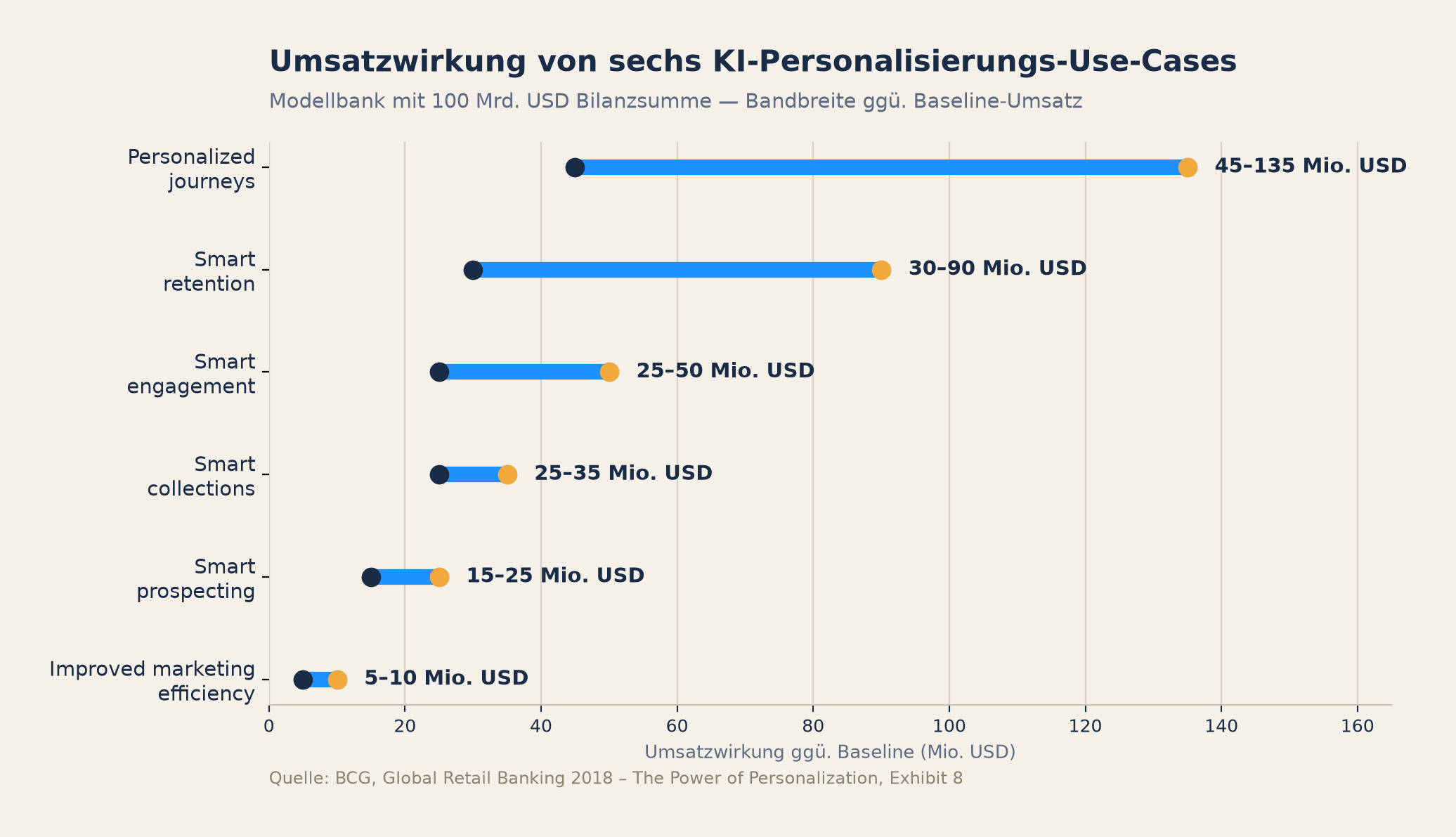
Two use cases deserve closer examination. In "Personalized journeys" — the linking of different channels into a seamless customer journey — the model bank can, according to BCG, achieve up to $135 million in additional new revenue. In "Smart retention," the leverage lies in identifying customers who are about to churn and intervening early — reducing churn costs by up to $90 million (BCG, The Power of Personalization).
Proven Case Studies from Practice
Beyond the model scenario, documented individual results are available that support these ranges:
Cross-selling based on life events: Customer-specific offers and recommendations aligned with life events increased the offer conversion rate by 30% (BCG, Personalization Consulting).
Next-Best-Action-Engine (ML-based): An ML-powered NBA engine led to a 3% volume increase and a 10% higher acceptance rate (BCG, Personalization Consulting).
Branch productivity: One bank increased sales productivity in branches by more than 30% (BCG, What does personalization in banking really mean).
Commission income: A retail bank achieved 20% higher commission income across all campaigns in the first eight months after introduction; the underlying decisioning layer processed 50 billion parameters in various combinations (McKinsey, Getting personal).
Conversion leap through scaling: A European bank developed more than 200 use cases, multiplied its conversion rates ninefold, and rolled out the model to six divisions — with a reported total value of over $120 million (McKinsey, Getting personal).
Feature store effect: After the first use case, the same bank had 1,500 features, was subsequently able to develop a sophisticated CLV forecasting model in about a week, and reduced the implementation time for more than 150 additional analytics use cases by 50% (McKinsey, Getting personal).
Gen-AI-assisted campaign personalization: In a test with around 2,000 actions, recipients of personalized messages responded 10% more frequently than recipients of non-personalized content, while content creation ran 50 times faster than with the classic manual approach (McKinsey, The next frontier of personalized marketing).
Reference Implementation: Commonwealth Bank of Australia
A particularly compelling example of scaling is provided by the Commonwealth Bank of Australia (CBA). According to its annual report as of June 30, 2024, its Customer Engagement Engine runs more than 2,000 real-time ML models and processes over 157 billion data points, including from the CommBank app (CBA Annual Report 2024). According to CBA, the platform is used to reach customers across all banking channels with "next best conversations" — including proactive support, such as when mortgage customers show early signs of financial difficulty (CBA Annual Report 2024).
The customer benefit is measurable: Since its launch, CBA's "Benefits finder" tool has connected customers with grants, discounts, and benefits of over $1.2 billion (CBA Annual Report 2024). The accompanying money management tools reach over 3 million customers monthly, with "Bill Sense" counting 1.4 million monthly users, "Money Plan" 330,000, and the "Goal Tracker" having accompanied a total of 3.3 million goals since its launch in 2018 (CBA Annual Report 2024). This example shows that, when scaled sufficiently, AI personalization in banking can also function as a proactive early warning system for financial difficulties — not just as a sales tool.
Pricing and Offer Personalization as an Independent Leverage
In addition to campaigns and retention, personalizing prices and offers is gaining importance. Research shows a 1 to 2% increase in revenue and a 1 to 3% improvement in margin through personalized prices and promotions; a major retail group generated $400 million in value within a year through initial pricing improvements and an additional $150 million through Gen-AI-assisted, targeted offers (McKinsey, The next frontier of personalized marketing). The incentive to buy is also proven: 65% of customers cite targeted promotions as one of the most important reasons to buy (McKinsey, The next frontier of personalized marketing). For banks, this principle can be directly applied to conditions, cross-selling offers, and card programs.
From Transaction Data to Use Cases: The Signal Basis
Each of these use cases thrives on the quality of the underlying signals. For this, Acceleraid's Prediction Engine & AI Framework processes rent payments, salary receipts, savings patterns, property searches, and shifts in merchant categories, combined with a lifecycle stage scoring across acquisition, growth, maturity, and retention (Acceleraid, Banking). Why transaction data provides the most meaningful signal for next-best-action decisions is described in detail in our post Why transaction data is the most important NBA signal.
Acceleraid reports comparable orders of magnitude from its own projects: 65,000 arranged consulting appointments, churn detection as early as 90 days or more in advance, and an average conversion uplift of 15% through AI-supported traffic allocation (Acceleraid, Banking). These values are in the same range as the study results cited above — an indication that the bandwidths are not limited to individual cases, but are reproducible across various institutions.
From Single Use Case to Portfolio
The examples gathered here share a common thread: The greatest value contribution is not created by a single model, but by the consistent linking of several use cases across the entire customer lifecycle — from initial contact to conversion and retention. Institutions that start with one use case and reuse the resulting feature pipelines and processes significantly reduce the cost of each subsequent use case. How these use cases can be reconciled with the regulatory framework of the EU AI Act, GDPR, and MaRisk will be covered in the next and final part of this series.
Illustration: AI-generated. AI-supported content: We use AI technologies and automated agents in the creation of our posts, including those from Microsoft, Google, OpenAI, Anthropic, and other providers. Topics, technical direction, and final approval remain with our team.
Further Insights
We use cookies 🍪
Strictly necessary cookies (e.g. Pipedrive forms) remain active. With your consent, we also use Google Analytics (analytics) and Leadfeeder (visitor identification). Learn more in our Privacy Policy.