AI & Banking
AI Personalization in Banking: The 2026 Practical Guide
The practical guide to AI personalization in banking: Architecture, maturity level, ROI, and rollout roadmap with proven figures from McKinsey and BCG studies.
•
acceleraid Editorial Team
6 min. read
01
Acquire
Recognize signals
02
Onboard
Control activation
03
Grow
Next Best Action
04
Retain
Reduce churn
05
Reactivate
Reclaim potential

AI personalization in banking refers to the use of machine learning models to tailor offers, content, and communication for individual customers in real time — based on transactional, behavioral, and lifecycle data instead of rigid segments. The value proposition is massive: according to McKinsey, AI technologies could deliver up to $1 trillion in additional value annually to the financial industry, with $624.8 billion in marketing and sales alone (McKinsey, AI-bank of the future). Yet, a wide gap lies between this potential and reality — this guide shows how banks can close it with a clear architecture, a realistic maturity model, and a robust economic calculation.
What AI Personalization in Banking Means in Concrete Terms
AI personalization in banking is more than product recommendations in online banking. It encompasses the continuous chain from data collection and modeling to delivery — driven by four building blocks that McKinsey describes as the "four Ds" of personalization: Data foundation, Decision making, Design, and Distribution (McKinsey, What is personalization?). Banks that master this end-to-end chain differentiate themselves from competitors not through individual AI models, but through their ability to rapidly translate signals into decisions, and decisions into customer contacts.
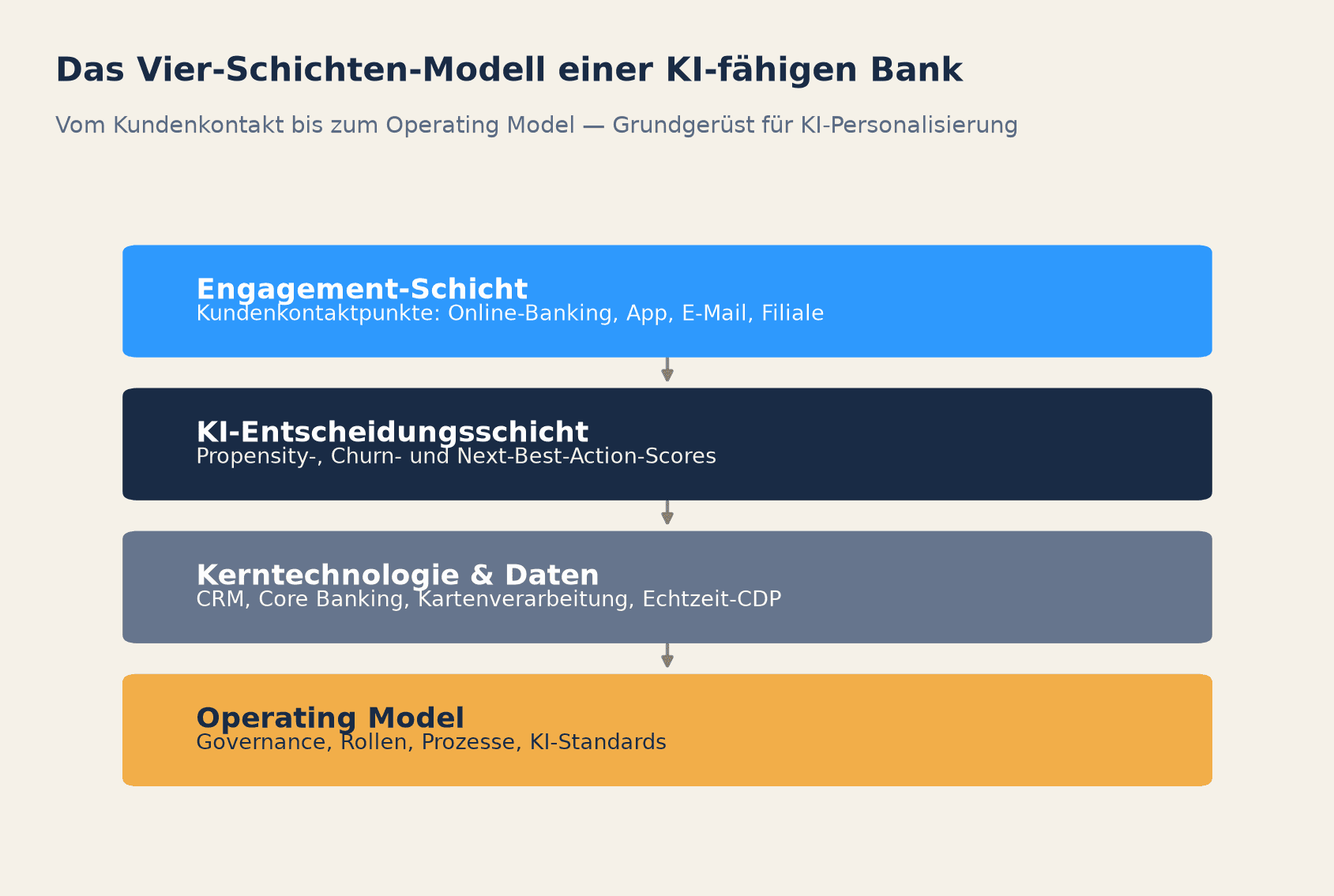
Structurally, an AI-enabled bank can be divided into four layers, according to McKinsey: the engagement layer (customer touchpoints), the AI-powered decisioning layer, the core technology and data layer, and the operating model that holds it all together (McKinsey, AI-bank of the future). If any of these layers is missing or not integrated with the others, AI personalization in banking remains a pilot project instead of a scaled operating model.
The Maturity Reality: Why Most Banks Fall Short of Potential
The discrepancy between aspiration and reality is well documented. Only 8% of banks are able to actually use predictive insights from their ML models for campaign execution and decision-making (McKinsey, Getting personal). Only around 9% have a full suite of ML models that can power personalized engagement at every touchpoint, and just 16% of data science teams follow any standard protocol for developing AI tools (McKinsey, Getting personal).
A key bottleneck lies in the data layer itself: only about 28% of banks can integrate internal structured customer data into their AI models fast enough to work with it operationally (McKinsey, Getting personal). And even when models are running, a framework for operating them responsibly is lacking in many places: only 14% of banks have a specific AI governance framework (McKinsey, Getting personal). These four figures combined paint a clear picture: the blockers for AI personalization in banks rarely lie in the model itself, but in data connectivity, activation paths, process discipline, and governance.
Maturity Indicator | Share of Banks |
|---|---|
Use ML insights operationally in campaigns | 8% |
Have a complete ML model suite for every touchpoint | 9% |
Data science teams with standard protocol | 16% |
Have specific AI governance framework | 14% |
Can quickly integrate internal data into AI models | 28% |
Source: McKinsey, Getting personal: How banks can win with consumers
On the organizational side, structural hurdles add to the challenge: 71% of brands report a siloed operating model with numerous handovers, 59% cite a limited or poorly integrated tech stack as a pain point, 41% lament missing centralized customer data, and 33% see underinvestment in data quality as the root cause (BCG, Personalization Consulting). These figures explain why many AI personalization initiatives in banks start technically but fail organizationally.
A Phased Model for Getting Started
Instead of introducing a complete AI personalization platform in one single step, an iterative approach is recommended. McKinsey explicitly advises starting with one or two simple, high-impact journey use cases — this allows organizations to roll out personalization initiatives faster while delivering value continuously (McKinsey, Getting personal). In practice, this can be structured into three phases:
Phase 1 — Secure the Data Foundation: Before a single model goes live, the bank must be able to provide transactional, behavioral, and master data in real-time and with a full history. Without this foundation, every model initiative remains stuck on a sample basis.
Phase 2 — Penetrate a Single Use Case End-to-End: A single, clearly defined use case — such as a credit card campaign or a cross-selling trigger — is fully implemented from the data layer through to channel delivery. The goal is not completeness, but a working end-to-end proof.
Phase 3 — Scale across Teams, Channels, and Product Lines: Only when the first use case is running reliably does scaling to further segments and channels follow — with standardized processes, reusable feature pipelines, and an established governance framework.
This pattern can be backed up empirically: based on such an iterative approach, a European bank developed more than 200 use cases, improved its conversion rates ninefold, and rolled out the personalization model to six divisions — with a reported total value of over $120 million (McKinsey, Getting personal).
Orchestration: From Score to Decision in the Right Channel
A model that calculates a purchase probability is not personalization yet — it only becomes effective when the score is displayed in the right channel at the right moment. This is precisely where the orchestration layer comes in: it connects propensity and churn scores with a customer's current lifecycle phase, their channel preferences, and regulatory contact frequency limits. Acceleraid's Prediction Engine & AI Framework calculates explainable, auditable affinity, churn, propensity, and Next-Best-Action scores for this, while the CLM/CVM orchestration module controls delivery across the entire customer lifecycle from acquisition to retention — including contact frequency limits and channel preferences (Acceleraid Platform).
For these scores to actually take effect in real-time, a data foundation is needed that feeds from CRM, core banking system, and card processing in real-time, documents consents and data provenance traceably, and builds in PII protection from the ground up. This is exactly what the CDP & Data Governance module does, which is also based on German hosting and GDPR-by-design principles (Acceleraid, Banking). How such a combination of propensity scores and channel orchestration works in detail is described in our article on the Next-Best-Action Engine.
Economic Viability: What is Realistically Achievable
Those who need to justify a budget for AI personalization in banking require robust ranges rather than isolated anecdotes. The most frequently cited figure is a revenue uplift of 10 to 15%, with a company-specific range of 5 to 25% (McKinsey, Next in Personalization 2021). For banks, this can be made concrete: BCG estimates an achievable annual revenue uplift of around 10% and quantifies the leverage at approximately $300 million in revenue growth per $100 billion in total assets (BCG, What does personalization in banking really mean).
Speed also changes measurably: banks with codified, centralized analytics processes achieve 5 to 15% higher revenues from their optimized campaigns and launch them two to four times faster — switching from monthly or quarterly to daily or weekly campaign releases (McKinsey, Getting personal). High-growth companies also generate 40% more of their revenue from personalization than slower-growing competitors (McKinsey, Next in Personalization 2021).
These ranges correspond to the real-world experiences Acceleraid reports from its own projects: an average conversion uplift of 15% through AI traffic allocation and personalized application flows, plus 120% more credit card applications in a co-branded card program featuring over 150 personalized card pages (Acceleraid, Banking).
The Customer Side: Expectation, but also Skepticism
Customers expect personalization — but not unconditionally. 72% of banking customers worldwide state that personalization influences their choice of bank, yet only 3% actually use the personalization tools provided by their bank (Accenture, Global Banking Consumer Study 2025). At the same time, 62% are open to an AI-powered financial assistant — but 84% are concerned about how their data is used, and only 26% want their bank to use AI extensively to analyze their data for personalized offers (Accenture, Banking Consumer Study 2025).
This ambivalence is not a contradiction, but a guardrail: 46% of customers feel pressured at least occasionally to accept products that serve the bank rather than themselves (Accenture, Banking Consumer Study 2025). Banks enjoy a structural advantage in trust — customers trust their primary bank twice as much as technology companies when it comes to product quality and advice (Accenture, Banking Consumer Study 2025). Those who want to practice AI personalization in banking sustainably must preserve this advantage in trust — through explainable models, clear contact frequency limits, and offers that are recognizably in the customer's interest. We will cover what the regulatory framework for this looks like in the third part of this series on the EU AI Act, GDPR, and MaRisk.
From Practical Guide to Implementation
AI personalization in banking is not a technology project, but an interplay of data architecture, model operations, orchestration, and trust. The maturity figures show that most institutions are still far from realizing this potential today — but also that an iterative approach with a clear focus on an initial use case delivers reliable results. In the next part of this series, we will present concrete use cases with proven value-add, ranging from cross-selling and churn prevention to personalized pricing.
Illustration: AI-generated. AI-supported content: In creating our articles, we use AI technologies and automated agents, including those from Microsoft, Google, OpenAI, Anthropic, and other providers. Topics, professional orientation, and final approval remain with our team.
Further Insights
We use cookies 🍪
Strictly necessary cookies (e.g. Pipedrive forms) remain active. With your consent, we also use Google Analytics (analytics) and Leadfeeder (visitor identification). Learn more in our Privacy Policy.