AI & Banking
The AI-Native Bank: Why Continuous Modernization is Becoming a Competitive Advantage
AI-native banking is not created by a big bang, but through an operating mode for continuous modernization.
•
acceleraid Editorial Team
5 min read
01
Acquire
Recognize signals
02
Onboard
Control activation
03
Grow
Next Best Action
04
Retain
Reduce churn
05
Reactivate
Reclaim potential

Author: acceleraid Editorial Team
The discussion about the AI-native bank is often reduced to models, assistants, or individual automations. The Bain Brief from July 22, 2026, takes a different approach: discussions with more than 30 executives of tech-savvy global banks condense there into a target vision in which AI forms a continuous modernization and innovation engine – not merely an additional software category. Bain & Company This is a more useful question for banks than "Where do we use AI?": How does a resilient operating mode for faster learning, decision-making, and execution emerge from individual initiatives?
AI-native is not a label for more tools
Bain describes the AI-native bank as an "AI-infused engine for innovation, simplification, and modernization." The target profile is ambitious: tenfold higher productivity, a hundred times more experiments, ninety percent shorter time-to-market, and a ten percentage point improvement in the cost-income ratio. These values are not a commitment for a single transformation program. They are a guiding framework that shifts the strategic priority: speed and capability to experiment count just as much as efficiency.
From this follows a more demanding definition. AI-native does not mean that every decision becomes probabilistic or autonomous. A deterministic layer remains necessary for ledger integrity, payment execution, permissions, and regulatory controls. Alongside this, a probabilistic layer can work for agentic experiences, fraud intelligence, or workflow orchestration. The critical factor is the connection of both levels: rules, data, responsibilities, and feedback must be designed in such a way that new capabilities transition into operations in a controlled manner.
The target vision therefore has at least five interconnected dimensions: customer-facing agentic products, autonomous real-time workflows, trust and security, a modern technology and data stack, as well as talent and operating model. Anyone who optimizes only one of these does not yet build an AI-native bank. Anyone who transitions them into a continuous renewal, on the other hand, creates the prerequisites for turning product ideas into measurable decisions more frequently.
The gap lies between usage and scaling
AI is by no means a marginal phenomenon in the banking sector. According to the EBA, 92 percent of EU banks use AI; 55 percent already use general-purpose or agentic AI in consumer-facing processes. EBA Factsheet The ECB Banking Supervision also reports that more than 85 percent of large European-supervised banks use AI; GenAI is primarily concentrated on IT operations, legal and document analysis, as well as frontline applications. ECB Banking Supervision
However, this is not yet proof of a new operating system. According to BCG, only 25 percent of institutions have integrated AI capabilities into strategic planning; the remaining 75 percent remain with isolated pilots and proofs of concept. BCG The relevant management task is therefore not to gather additional use cases. It is to shorten the repeatable path from a functional hypothesis through controlled testing to responsible production.
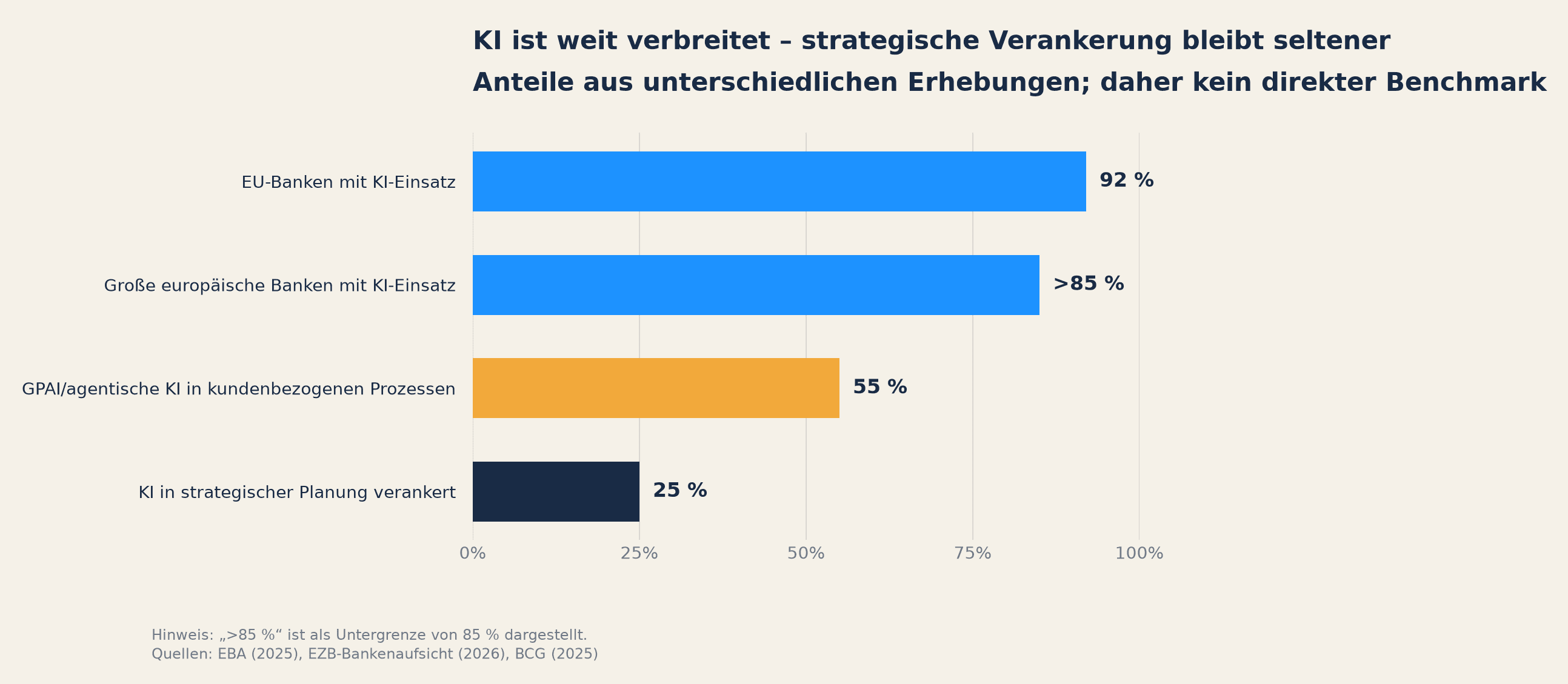
The graphic compares different populations and is therefore not a ranking. However, it makes the operational tension visible: usage is broad, customer-facing GenAI is more selective, strategic anchoring is significantly less common. This is precisely where it is decided whether AI supplements the existing banking model or increases its capacity for renewal.
Why the Big Bang is the wrong way of thinking
A comprehensive reconstruction sounds logical, but it ties the transformation to a single, long end state. The starting position is heterogeneous: Bain cites legacy landscapes, skill shortages, insufficient data foundations, capital allocation pressure, as well as talent and operating model as central constraints. At the same time, the target vision requires a "machine readable" bank with standardized data, traceable relationships, coded guidelines, and observable processes. Bain & Company
Continuous modernization accepts this reality. It does not replace every core application at once. It gradually improves the ability to provide data trustworthily, to understand decisions, and to introduce new workflows safely. The benchmark is not the architecture plan in year five. The benchmark is whether the bank can improve a high-quality decision faster, safer, and repeatedly in the next quarter.
For leadership teams, this is an important relief: not every process has to become fully autonomous first. A sensible starting point can be a narrowly defined decision where the impact, data sources, approvals, and human intervention are clearly definable. This creates a learning pattern instead of generating another pilot island.
An operating model for continuous modernization
The path begins with a data and decision layer, not with a spectacular assistant. Four work routines help to build this layer as an operating mode.
First: Prioritize decisions, not technologies. For each candidate decision, the business department, target metric, permitted data, risk, escalation path, and expected action should be explicit. This makes it visible whether a model actually improves a decision or merely formulates an existing workflow faster.
Second: Connect data products with accountability. Not only availability, but also meaning, origin, timeliness, access rights, and quality checks must be visible for the decision-relevant data. This makes it possible to understand why a result came about and when it must not be used.
Third: Organize experiments as a regulated process. An experiment needs a business owner, a security boundary, a measurement logic, and a clear stop criterion in advance. The test is followed not by an informal handover, but by a decision on adjustment, release, monitoring, or shutdown. In this way, speed is not played off against governance.
Fourth: Create reusable building blocks. Interfaces, evaluation logics, policies, monitoring, and documentation should not be created anew for each use case. The more frequently these building blocks are used, the less progress depends on individual special projects. Teams gain space to focus on the business context.
This sequence is deliberately unspectacular. It starts at the quality of decisions and makes the restructuring digestible for the organization. An additional perspective on the dependence on model providers is offered by our article on model-agnostic banks and DORA. For the basics of data work, the article Why AI projects fail at the data layer is also worth reading.
Investments must buy learning capacity
The scale of the investments underscores the pressure to act but does not replace prioritization. In the KPMG survey for the first quarter of 2026, average planned AI investments for the coming twelve months were 177 million US dollars, up from 133 million US dollars in the previous quarter – an increase of 33 percent. KPMG The decisive touchstone for any budget is therefore not just the number of projects started. It is the ability to repeatedly bring decisions from prototype into operation with clear controls.
This requires a portfolio with different horizons: a few strategic capabilities, several prioritized decision cases, and a reliable modernization routine underneath. The routine must not depend on a single model or a one-off platform decision. Otherwise, investment quickly turns into technical lock-in instead of learning capability.
From the decision layer to modular progress
For banks that do not want to wait for an overall restructuring, a modular data and decision layer is a pragmatic entry point. Acceleraid connects data governance, explainable scores, and the orchestration of lifecycle and next-best-action decisions; the platform is designed to be model-agnostic, so that knowledge, contexts, and configurations can be preserved when models are changed. Acceleraid Platform
Nevertheless, the aspiration should not be to write "AI-native" on a slide as quickly as possible. It is to design every modernization in such a way that it makes the next one easier: better data, clearer decisions, more resilient controls, and more space for qualified experiments. Only this continuity transforms AI from an initiative into a competitive advantage.
Illustration: AI-generated. AI-supported content: In creating our articles, we use AI technologies and automated agents, including those from Microsoft, Google, OpenAI, Anthropic, and other providers. Topics, specialized direction, and final approval remain with our team.
Further Insights
We use cookies 🍪
Strictly necessary cookies (e.g. Pipedrive forms) remain active. With your consent, we also use Google Analytics (analytics) and Leadfeeder (visitor identification). Learn more in our Privacy Policy.