AI & Banking
AI Model Costs 2026: Which Model for Which Task – and What It Costs
A factor of 200 between the most expensive and cheapest model: current API prices, cost traps with reasoning models, and choosing the right model.
•
acceleraid Editorial Team
5 min read
01
Acquire
Recognize signals
02
Onboard
Control activation
03
Grow
Next Best Action
04
Retain
Reduce churn
05
Reactivate
Reclaim potential

Today, there is a price factor of over 200 between the most expensive and the cheapest usable AI model. Anyone who reflexively calls up the flagship model for every task pays for it — often without a measurable gain in quality. Conversely, the wrong budget model can fail at exactly the point where precision matters. For banks and financial service providers whose AI volumes are growing, the choice of model is therefore becoming a prime cost issue. An overview of the current prices, the logic behind them, and the question of which model is suitable for what.
The Pricing Landscape in August 2026
The range of API prices is enormous. At OpenAI, the flagship GPT-5.6 Sol costs $5 per million input tokens and $30 per million output tokens according to the official price list; the small GPT-5.6 Luna is priced at $0.20 and $1.20. The pro versions for the highest demands (GPT-5.5-pro) reach $180 per million output tokens. At Anthropic, Opus 5 costs $5/$25 (input/output), Sonnet 5 is at an introductory price of $2/$10, and Haiku 4.5 as the smallest model is $1/$5. Google charges $1.50/$7.50 for Gemini 3.6 Flash, while Gemini 2.5 Flash-Lite is already available for $0.10/$0.40.
Chinese providers are even more aggressive: DeepSeek V4-Flash costs $0.14 per million input tokens ($0.0028 for cache hits) and $0.28 for output; Alibaba's Qwen-Flash is at $0.05/$0.40. Calculating across all providers, a factor of around 214 separates the most expensive frontier model (GPT-5.5-pro, $30 input) and the cheapest usable model (DeepSeek V4-Flash, $0.14 input).
In addition, there are discount mechanisms that are often missing from cost calculations: Batch processing with a 50 percent discount is offered uniformly by Anthropic, Google, Mistral, and Alibaba. Prompt caching reduces the input price for recurring contexts to 10 to 20 percent of the standard rate — with DeepSeek, even to one-fiftieth. Conversely, those who need guaranteed fast responses pay surcharges: Google's Priority rate costs 1.8 times as much, Anthropic's Fast Mode for Opus 5 costs twice as much.
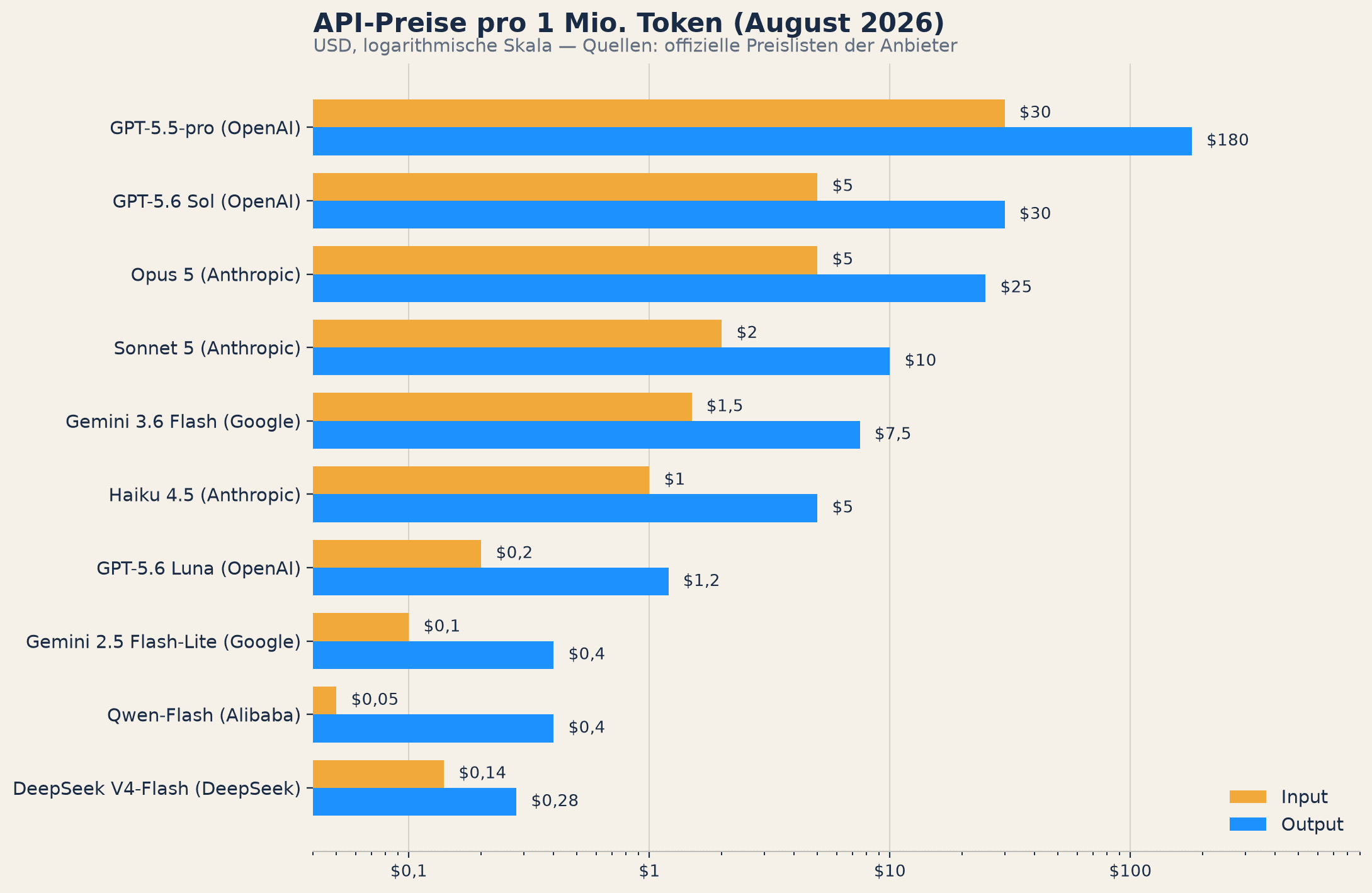
Model | Provider | Input ($ / 1M tokens) | Output ($ / 1M tokens) |
|---|---|---|---|
GPT-5.5-pro | OpenAI | 30.00 | 180.00 |
GPT-5.6 Sol | OpenAI | 5.00 | 30.00 |
Opus 5 | Anthropic | 5.00 | 25.00 |
Sonnet 5 | Anthropic | 2.00 | 10.00 |
Gemini 3.6 Flash | 1.50 | 7.50 | |
Haiku 4.5 | Anthropic | 1.00 | 5.00 |
GPT-5.6 Luna | OpenAI | 0.20 | 1.20 |
Gemini 2.5 Flash-Lite | 0.10 | 0.40 | |
DeepSeek V4-Flash | DeepSeek | 0.14 | 0.28 |
Qwen-Flash | Alibaba | 0.05 | 0.40 |
All prices according to the official price lists linked in the text (as of August 2026), excluding batch discounts and caching.
Be Careful with Reasoning Models
One cost trap deserves special attention: models with thinking mode. Reasoning models generate internal thinking tokens before the actual answer — and these are fully charged. At OpenAI, reasoning tokens run through billing as normal output tokens; at Google, the output price is explicitly shown "including thinking tokens". Alibaba makes the difference transparent like no other provider: Qwen-Plus costs $1.20 per million output tokens in non-thinking mode, and $4.00 in thinking mode — a factor of 3.3 for the same model size.
This does not mean that reasoning models are too expensive. It means they are too expensive for the wrong tasks. OpenAI's own guidelines sum up the division of labor: reasoning models are "the planners" — for multi-step, ambiguous problems where accuracy makes the difference. Standard GPT models are "the workhorses" — for clearly defined tasks where speed and cost matter. Most productive systems combine both.
Which Model for Which Task
A resilient allocation can be derived from provider recommendations and practice. Classification, data extraction, routing, and simple summaries — typical bulk tasks in banking operations — belong on small models like GPT-5.4-nano, Haiku 4.5, Gemini Flash-Lite, or DeepSeek V4-Flash. Google explicitly recommends its Flash-Lite for high-volume document extraction and structured JSON parsing. Customer dialogues and RAG applications run well on mid-range models (GPT-5.6 Terra, Sonnet, Gemini Flash). Complex analyses, code generation, and agentic workflows justify frontier models like Opus 5 or GPT-5.6 Sol. And reasoning modes are only worthwhile for strategic, ambiguous planning tasks.
How this is distributed in practice is shown by a common rule of thumb from the Anthropic ecosystem, documented in a practical guide: around 70 percent of queries via the smallest model, 20 percent via the mid-range model, 10 percent via the top model — orchestrated via a routing layer instead of a single model. The scale is confirmed by an example calculation for customer service: 1,000 support tickets cost about $1 to $3 with a budget model, and $50 to over $100 with a frontier model — for many tickets of identical result quality.
The Time Factor: Prices are Falling, but Unevenly
Anyone making a model decision today should factor in the price dynamics. a16z coined the term "LLMflation" for this effect: with constant model performance, inference costs fall by about tenfold per year. For GPT-3 level, costs fell from $60 per million tokens (2021) to $0.06 (2024) — a factor of 1,000 in three years. Epoch AI measures price declines between 9x and 900x per year, depending on performance level, with an accelerated pace since 2024.
The flip side: the price decline is unevenly distributed. Premium reasoning capacity remains expensive — at the end of 2024, OpenAI's o1 cost exactly $60 per million output tokens, just as much as GPT-3 at its launch three years earlier. Anyone optimizing their architecture for today's price structure should expect the optimal model choice to look different in twelve months.
Consequence: Choosing a Model is Not a One-Time Decision
In addition, choosing a model is no longer just a question of price and quality. Data residency, auditability, and the question of whether a provider meets European contractual standards are weighted equally in the decision-making process in regulated industries. A cheap model that does not pass the compliance check is not an option — but neither is an expensive model for tasks that a certified mid-range model solves just as well. The choice of model thus becomes a portfolio decision that the business department, IT, and compliance must make together and review regularly.
For financial institutions, this leads to an uncomfortable but clear conclusion: there is no single right model — there is only the currently correct model per task. An architecture that distributes tasks to different model classes according to complexity reduces costs by orders of magnitude compared to a single-model strategy. And because prices and performance rankings shift on a monthly basis, this allocation must remain reversible.
This is precisely why we built our Assistant at Acceleraid to be model-agnostic: the underlying model can be changed at any time — when a provider lowers prices, a new model offers a better cost curve, or a task can migrate to a cheaper model class. Knowledge, contexts, and configurations are preserved. This turns the price dynamics of the model market into an advantage instead of a risk: every price reduction in the market is a cost reduction that can be taken along without a migration project.
Illustration: AI-generated. AI-supported content: In creating our posts, we use AI technologies and automated agents, including from Microsoft, Google, OpenAI, Anthropic, and other providers. Topics, professional orientation, and final approval lie with our team.
Further Insights
We use cookies 🍪
Strictly necessary cookies (e.g. Pipedrive forms) remain active. With your consent, we also use Google Analytics (analytics) and Leadfeeder (visitor identification). Learn more in our Privacy Policy.