AI & Banking
AI Integration: Why the Operating Model Determines Success
Technology alone is not the deciding factor: Why the operating model determines whether AI investments deliver results — and what studies prove.
•
acceleraid Editorial Team
6 min. read
01
Acquire
Recognize signals
02
Onboard
Control activation
03
Grow
Next Best Action
04
Retain
Reduce churn
05
Reactivate
Reclaim potential

In July 2026, McKinsey published an analysis whose core finding is uncomfortable: AI transformations that are run primarily as technology programs fail in more than 80 percent of cases – because they optimize tools instead of changing the way the company works (McKinsey, The operating model advantage). The figure confirms what has been emerging in almost all major studies for two years: it is not the model that decides the value of AI, but the operating model – the way a company organizes processes, data, responsibility, and decisions around AI.
AI is a CEO and Board topic, not an IT project
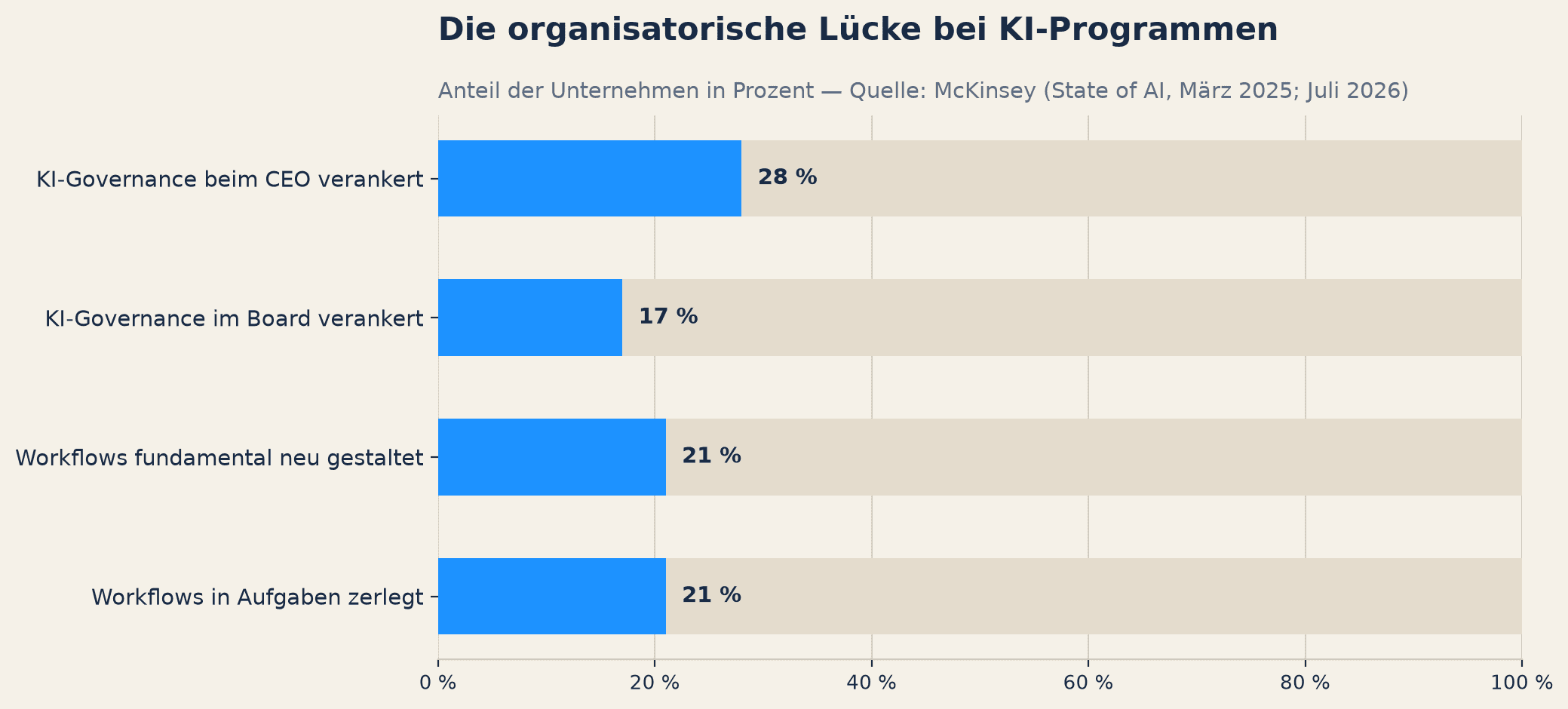
The first difference between winners and the rest lies in the anchoring. In the McKinsey survey from March 2025, the CEO's oversight of AI governance is the factor most strongly correlated with a measurable bottom-line impact – in large companies, it is even the factor with the greatest influence on AI-attributable EBIT. Nevertheless, responsibility lies with the CEO in only 28 percent of companies, and only 17 percent anchor it in the board (McKinsey State of AI, March 2025).
BCG reaches the same conclusion in a study of over 1,250 companies, only formulated more sharply: nearly 100 percent of companies that achieve AI value at scale have a deeply involved C-level – among the laggards, it is 8 percent. And: exclusive IT ownership is, according to BCG, a key indicator of stagnant companies (BCG, The Widening AI Value Gap). Those who delegate AI to IT treat it as infrastructure. Those who anchor it on the executive board treat it as what it is: a question of the business model.
Few use cases, consistently built to completion
The second difference is focus. An MIT study from the NANDA project in 2025 concluded that around 95 percent of GenAI pilots deliver no measurable return – not because of model quality, but because generic tools do not learn from the workflows into which they are placed (Fortune on the MIT study). S&P Global Market Intelligence measured in the same year that the share of companies abandoning the majority of their AI initiatives rose from 17 to 42 percent.
The winners do the opposite of breadth: they concentrate their AI investments on one to three economically relevant domains. McKinsey calls the common counter-design the "peanut butter approach" – a thin layer of AI spread across many areas that brings incremental improvements but no strategic differentiation. In contrast, companies that set ambitious performance targets in their priority domains achieved around three US dollars of additional EBITDA per invested dollar, with break-even within one to two years (McKinsey, July 2026).
The process must run with AI – not alongside it
The third and most important difference concerns the processes themselves. Out of 25 tested factors, redesigning workflows has the greatest effect on whether a company achieves an EBIT impact from generative AI. Yet only 21 percent of companies have fundamentally redesigned their processes. Around 79 percent even skip the most basic step: breaking down existing workflows into individual tasks and consciously deciding what is transferred to AI and what remains with humans.
McKinsey describes the pattern behind this precisely: most organizations bolt AI onto existing structures – the complexity remains intact, the value remains trapped at the task level. Measurement is then in licenses, pilots, and deployments instead of faster decision cycles or lower coordination costs. The recommended order is the reverse of common practice: first redesign the workflows, then build the talent model, and finally select the technology. BCG summarizes the same logic in the 10-20-70 rule: 70 percent of strategic focus belongs on people and processes, 20 percent on technology, 10 percent on algorithms.
This is precisely where it is decided whether AI remains an additional tool or becomes part of the operating system. A process that basically runs cleanly with AI – with defined handoff points, controls, and responsibilities – produces usable data with every run. A process to which AI has merely been tacked on produces primarily exceptions.
The Flywheel: Every productive use strengthens the next
Only on this basis does the effect arise that makes the lead permanent. Every productive AI application generates new data, new experience in dealing with AI-supported decisions, and new organizational knowledge. McKinsey describes this as a cumulative effect: every transformation makes the next one faster, cheaper, and more likely to succeed – leading to "proprietary data flywheels" that competitors cannot easily copy, even if they use the same tools. PwC observes the same mechanism on the data side: with reusable building blocks, each new deployment builds on the previous one, execution accelerates, and the data environment improves itself (PwC, AI Data Strategy). The result is a massive concentration: the top 20 percent of companies capture 74 percent of AI-driven value, according to PwC.
Conversely, the flywheel also explains the 95 percent rate of failed pilots: where AI is not integrated into productive processes, no learning effect occurs – and without a learning effect, the flywheel never starts spinning.
The study landscape at a glance
Finding | Value | Source |
|---|---|---|
AI transformations run purely as technology programs fail | over 80% | |
AI governance anchored with the CEO | only 28% of companies | |
Deeply involved C-level in companies with AI value at scale | nearly 100% (laggards: 8%) | |
GenAI pilots with no measurable return | around 95% | |
Companies abandoning the majority of their AI initiatives | Increase from 17% to 42% | S&P Global Market Intelligence, 2025 |
Additional EBITDA per dollar invested in focus domains | around 3 US dollars | |
Share of AI-driven value captured by the top 20% of companies | 74% |
As of August 2026; values from the linked studies.
The competition is between operating models, not between models
McKinsey explicitly formulates the strategic consequence: companies with comparable technology are already achieving very different results today – the competitive advantage is shifting from the tools to the organizations that use them. Model capabilities that differentiate a platform today often become standard within months. An operating model, on the other hand, cannot be bought and cannot be copied overnight – it emerges from accumulated decisions about workflows, governance, people, and data.
For banks, this calculation is particularly concrete: AI pioneers could achieve a four percentage points higher ROTE than laggards, according to the Global Banking Annual Review – for a bank with $100 billion in total assets, this means up to $250 million in additional annual profit. Without adapting the business model, the industry also risks losing $170 billion, or 9 percent of global profit pools (McKinsey Global Banking Annual Review 2025). Here, too, McKinsey identifies one of the main causes of the lack of impact as the business side leaving leadership to IT.
What this means for the architecture
If the lead lies in the operating model and not in the model, an architectural principle follows: organizational knowledge – data, contexts, workflows, configurations – must be built and maintained independently of the specific AI model used. This is precisely what Acceleraid is designed for: the Assistant is model-agnostic, the underlying model can be changed at any time, while knowledge, contexts, and configurations are preserved. In this way, the flywheel effect becomes the property of the company rather than the byproduct of a single provider – and every model advancement builds on the existing operating model instead of replacing it.
The audit questions for the board
Whether a company treats AI as a tool or as an operating model can be seen from a few questions: Is responsibility for AI governance with the CEO and is the topic regularly on the board's agenda? Are AI investments concentrated on a few, economically relevant domains – with performance goals instead of a pilot count? Were the affected processes redesigned from scratch before the technology was selected? Does every productive use generate data and knowledge that accelerate the next use? And: is this knowledge preserved when the model is changed? Those who can answer these questions with yes are already competing where the competition of the coming years will be decided – between operating models, not between models.
Illustration: AI-generated. AI-supported content: We use AI technologies and automated agents, including those from Microsoft, Google, OpenAI, Anthropic, and other providers, in creating our posts. Topics, technical direction, and final approval remain with our team.
Further Insights
We use cookies 🍪
Strictly necessary cookies (e.g. Pipedrive forms) remain active. With your consent, we also use Google Analytics (analytics) and Leadfeeder (visitor identification). Learn more in our Privacy Policy.