AI & Banking
How much does AI cost per developer? Copilot, Claude Code, Cursor & Co. cost comparison
Copilot, Claude Code, Cursor, Codex: What AI-assisted coding costs per developer – from completion to agent, with figures from official sources.
•
acceleraid Editorial Team
6 min. read
01
Acquire
Recognize signals
02
Onboard
Control activation
03
Grow
Next Best Action
04
Retain
Reduce churn
05
Reactivate
Reclaim potential

Since July 10, 2025, GitHub no longer bills the Copilot Coding Agent based on token consumption, but instead at a flat rate of one Premium Request per session — a small detail with a major impact on engineering teams' budget planning. This is because the price difference between a single line of code completion and an agent autonomously working through an entire ticket is not a factor of 2 or 3, but closer to a factor of 20. Anyone planning IT budgets for 2026 must calculate these three modes of use — Completion, Chat, Agent — separately. An overview with figures from the providers' official pricing and usage documentation, as of August 2026.
Three Modes of Use, Three Cost Orders of Magnitude
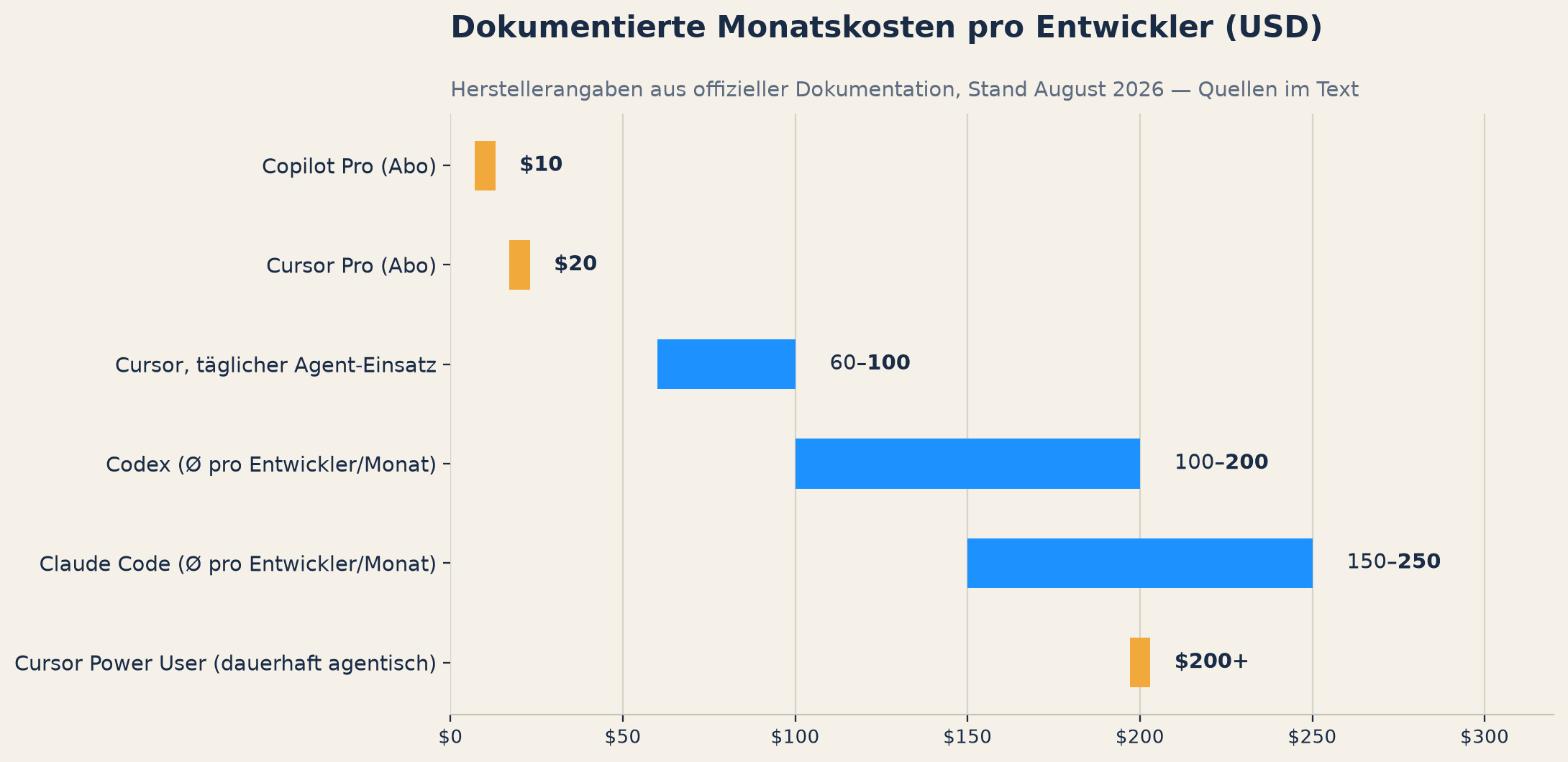
Pure code completion is the cheapest level: inline suggestions are already included in GitHub Copilot Free — 2,000 completions and 50 Premium Requests per month, at no cost. Chat-assisted coding, where developers ask questions and generate code snippets, falls within the range of simple subscription prices starting at $10 for Copilot Pro or $20 for Cursor Pro. Fully agentic coding — agents that autonomously implement tickets, test them, and create pull requests — on the other hand, consumes a multiple of computing power and results in significantly higher, usage-dependent costs. According to Anthropic, the costs for Claude Code average 150 to 250 US dollars per developer per month, while OpenAI estimates Codex at an average of 100 to 200 US dollars per developer per month. Cursor documents 60 to 100 US dollars monthly for daily agent use, and 200 US dollars or more for power users. We have already covered a general overview of model costs in “AI Model Costs 2026: Which Model for Which Task?” — here we are specifically looking at the cost structure per software engineer.
Subscription Overview: What the Popular Tools Cost
The following table shows the officially documented entry-level and standard prices of the most important coding assistants. Enterprise prices are partly negotiated individually and are therefore not fully disclosed everywhere.
Tool | Tier | Price/Month | Source |
|---|---|---|---|
GitHub Copilot | Free | $0 | |
GitHub Copilot | Pro | $10 | |
GitHub Copilot | Pro+ | $39 | |
GitHub Copilot | Business | $19/seat | |
GitHub Copilot | Enterprise | $39/seat | |
Claude Code | Pro | $17 | |
Claude Code | Max 5× | $100 | |
Claude Code | Max 20× | $200 | |
Cursor | Pro | $20 | |
Cursor | Teams | $40/user | |
Windsurf | Pro | $20 | |
Windsurf | Team | $80 + $40/seat | |
Gemini Code Assist | Standard | $19/user (annual contract) | |
Gemini Code Assist | Enterprise | $45/user (annual contract) | |
GLM Coding Plan | Entry | from $18 |
Noticeable: The entry-level prices for the subscriptions are close to each other — between $10 and $20 per user per month. The decisive cost driver is not the subscription itself, but what is consumed within this subscription in terms of model usage.
The Mechanics Behind Premium Requests
The difference between a $10 subscription and a bill of several hundred dollars arises from model multipliers. GitHub Copilot bills Chat and Agent mode usage as 1 request per prompt, multiplied by a model-specific factor. This multiplier fluctuates significantly: Claude Haiku 4.5 and Gemini 3 Flash are set at factor 0.33, while Claude Opus 4.7 is billed at factor 7.5 — and even with particularly fast Opus 4.6 configurations, at factor 30.
In practice, this means: A Copilot Pro subscription with its 300 included Premium Requests is sufficient for around 900 to 1,200 prompts per month with a cheaper model with a multiplier of 0.33 — whereas with Opus 4.7 with factor 7.5, it is only enough for about 40 prompts before additional costs of $0.04 per additional request apply. Between the cheapest and most expensive model choices in the same subscription, there is thus a factor of about 22 in the number of possible prompts. Anyone who sets their team to the most powerful available model as a flat rate, without differentiating the task, pays extra unnecessarily for many routine tasks.
This pattern is also evident with Cursor: In the Pro subscription, around 225 requests with Sonnet 4, but around 550 with Gemini and around 500 with GPT-5 are realistic — depending on the model choice, the usable volume varies by more than factor 2 at an identical subscription price. For Claude Code itself, a different adjustment screw dominates: Cache reads with Opus 5 cost only $0.50 instead of $5.00 per 1 million tokens — factor 10 compared to un-cached input. Since according to Anthropic, in a sample session, 940,000 of the total consumed tokens are attributed to cache reads, compared to only 1,200 of original input, a tool's caching configuration determines the bill at least as heavily as the choice of model itself.
When is the Cheap Model Enough?
The key question for any engineering budget is: How much quality do you actually lose by choosing the cheaper model? According to the manufacturers, the gap is often surprisingly small. According to Anthropic, Claude Haiku 4.5 achieves 73.3 percent on SWE-bench Verified and is described by the manufacturer itself as a model with “one-third the cost of Sonnet 4 with similar coding performance.” Google states 78 percent on SWE-bench Verified for Gemini 3 Flash — according to these figures, the cheaper Flash model even outperforms its own Pro version — at “less than a quarter of the cost of Gemini 3 Pro.” DeepSeek reports 79.0 percent on SWE-bench Verified for V4-Flash in Max mode, compared to 80.6 percent for the larger V4-Pro Max — a difference of less than two percentage points.
Important: These values are entirely self-reported by the manufacturers and have not been independently verified. Nevertheless, the order of magnitude is remarkable: while the benchmark values of the cheap models are only a few percentage points behind the frontier models, token prices differ by a factor of 3 to 35 — about $0.50 for Gemini 3 Flash compared to $2.00 for Gemini 3.1 Pro on input, $1 for Haiku 4.5 compared to $5 for Opus 5, or $0.14 for DeepSeek V4-Flash compared to $5.00 for OpenAI's gpt-5.6-sol. For standard tasks such as boilerplate code, simple refactorings, test coverage, or documentation, the cheap model is sufficient in most cases according to these numbers. The expensive frontier model is justified where errors are costly: complex architectural decisions, safety-critical logic, or tasks with high ambiguity.
What This Means for Budget Planning
A rough planning framework can be derived from the manufacturer figures (own classification, no source figure): pure completion and chat usage ranges between $10 and $20 per developer per month, but as soon as serious agentic work is done, according to consistent data from Anthropic, OpenAI, and Cursor, it is closer to $100 to $250. Anthropic also indicates that 90 percent of users stay under $30 per active day — so the distribution is heavily right-skewed, with individual power users driving the average. Those planning budgets should therefore not calculate with a flat-rate value per head, but rather with usage profiles: how many developers work predominantly with completion, and how many use agents daily for entire tickets?
For financial service providers and other regulated industries, a second dimension comes into play: being locked into a single model or a single provider. If the price for a frontier model increases, or if a provider changes its multipliers as in the Copilot example, the budget changes without any action on your part. This is precisely why we built the Acceleraid Assistant to be model-agnostic: the underlying model can be changed at any time without losing knowledge, contexts, or configurations. Teams can thus use a cheap model for routine tasks and specifically switch to a more powerful one for critical cases, without changing the platform or the accumulated knowledge base.
Four questions help to contextualize your own situation:
What percentage of our engineering tasks are pure completion or chat, and how much is genuine agent usage with ticket autonomy?
Are we currently using the most expensive model available as a flat rate for all tasks, or are we differentiating by task type?
Do we know our model multipliers and their impact on the monthly quota before the bill arrives?
What happens to our budget if a provider changes its prices or multipliers — and how quickly could we switch the model?
Illustration: AI-generated. AI-supported content: In creating our articles, we use AI technologies and automated agents, including those from Microsoft, Google, OpenAI, Anthropic, and other providers. Topics, technical direction, and final approval remain with our team.
Further Insights
We use cookies 🍪
Strictly necessary cookies (e.g. Pipedrive forms) remain active. With your consent, we also use Google Analytics (analytics) and Leadfeeder (visitor identification). Learn more in our Privacy Policy.