AI & Banking
AI Personalization in Banking: The 2026 Practical Guide
A practical guide to AI personalization in banking: architecture, maturity, ROI, and a rollout roadmap backed by McKinsey and BCG research.
•
acceleraid Redaktion
6 min read
01
Acquire
Signale erkennen
02
Onboard
Aktivierung steuern
03
Grow
Next Best Action
04
Retain
Churn reduzieren
05
Reactivate
Potenziale zurückholen

AI personalization in banking means using machine learning models to tailor offers, content, and communications to individual customers in real time — driven by transaction, behavioral, and lifecycle data rather than static segments. The upside is substantial: McKinsey estimates that AI technologies could deliver up to $1 trillion in additional value annually across financial services, with $624.8 billion of that in marketing and sales alone (McKinsey, AI-bank of the future). But there's a wide gap between that potential and current practice — this guide lays out the architecture, a realistic maturity model, and a defensible business case for closing it.
What AI personalization in banking actually involves
AI personalization in banking goes well beyond product recommendations in online banking. It spans the full chain from data capture through modeling to activation — built on what McKinsey calls the "four Ds" of personalization: data foundation, decision making, design, and distribution (McKinsey, What is personalization?). Banks that master this chain end to end don't win on having a better model — they win on translating signals into decisions, and decisions into customer moments, faster than competitors.
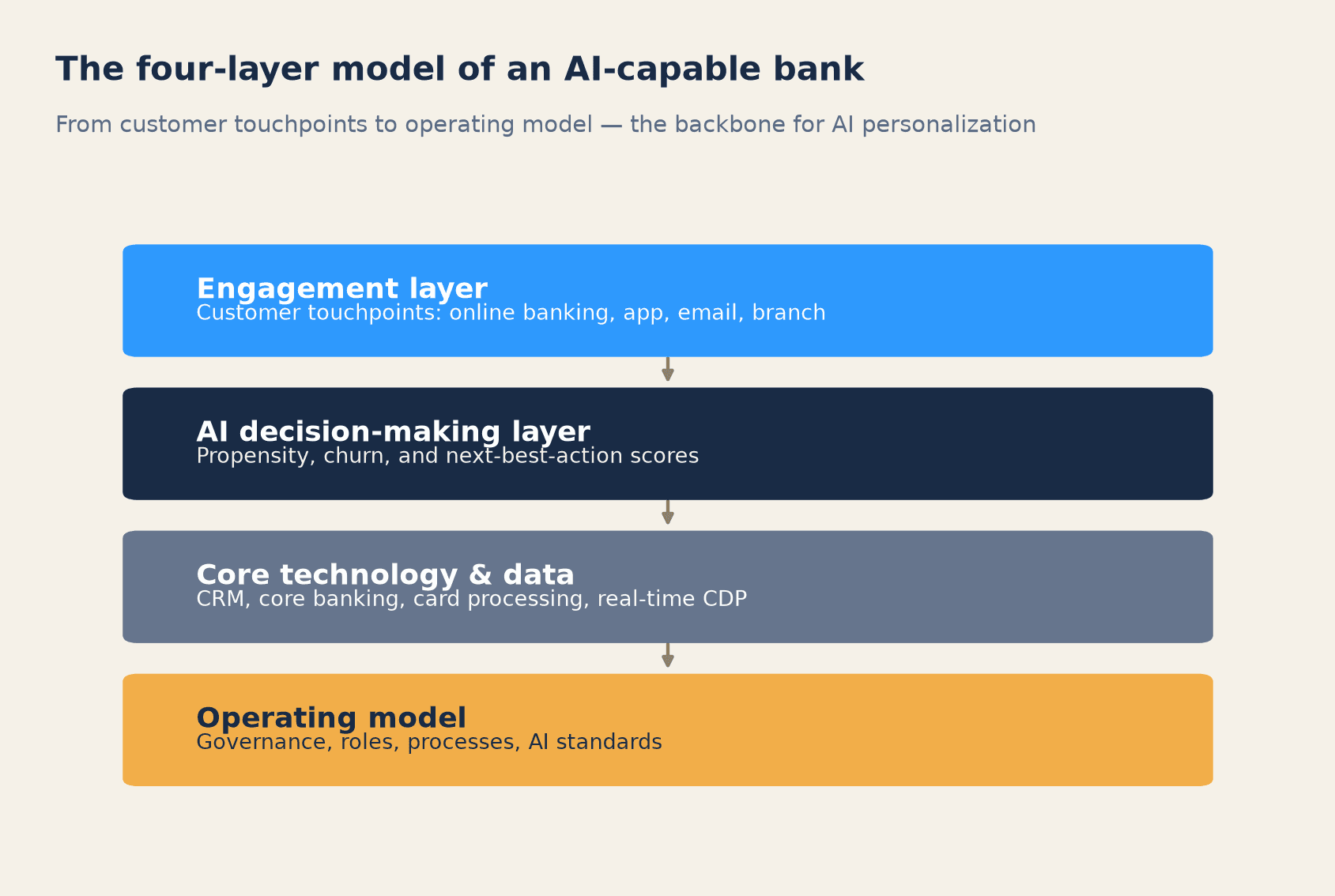
Structurally, McKinsey frames an AI-capable bank as four layers: the engagement layer (customer touchpoints), the AI-powered decision-making layer, the core technology and data layer, and the operating model that ties it all together (McKinsey, AI-bank of the future). Miss one of these layers, or fail to connect it to the others, and AI personalization in banking stays a pilot rather than becoming an operating capability.
The maturity reality: why most banks fall short of the potential
The gap between ambition and reality is well documented. Only 8% of banks can actually apply predictive insights from their ML models to campaign execution and decision making (McKinsey, Getting personal). Roughly 9% have a full suite of ML models capable of driving personalized engagement at every touchpoint, and only 16% of data science teams follow any standard protocol for developing AI tools (McKinsey, Getting personal).
A core bottleneck sits in the data layer itself: only about 28% of banks can rapidly integrate internal structured customer data into their AI models well enough to operationalize it (McKinsey, Getting personal). And even where models are running, most institutions lack a framework for running them responsibly: only 14% of banks have a specific AI governance framework (McKinsey, Getting personal). Together, these four figures point to the same conclusion: the blockers for AI personalization in banking rarely sit with the model itself — they sit in data connectivity, activation pathways, process discipline, and governance.
Maturity indicator | Share of banks |
|---|---|
Operationalize ML insights in campaigns | 8% |
Have a full ML model suite for every touchpoint | 9% |
Data science teams with a standard protocol | 16% |
Have a specific AI governance framework | 14% |
Can rapidly integrate internal data into AI models | 28% |
Source: McKinsey, Getting personal: How banks can win with consumers
Organizational friction compounds the technical gap: 71% of brands cite a siloed operating model requiring numerous handoffs, 59% cite a limited or poorly integrated tech stack, 41% cite a lack of centralized customer data, and 33% cite underinvestment in data quality (BCG, Personalization Consulting). These numbers explain why so many AI personalization initiatives in banking start as a technology project and stall as an organizational one.
A phased model for getting started
Rather than launching a complete AI personalization platform in one step, an iterative approach performs better in practice. McKinsey explicitly recommends starting with one or two simple, high-impact journey use cases, which lets organizations roll out personalization initiatives faster while delivering value along the way (McKinsey, Getting personal). In practice, this breaks into three phases:
Phase 1 — Secure the data foundation: Before a single model goes live, the bank needs to deliver transaction, behavioral, and reference data in real time and with full history. Without this foundation, every model initiative gets stuck running on samples rather than production data.
Phase 2 — Push one use case all the way through to activation: A single, well-scoped use case — a credit card campaign or a cross-sell trigger, for example — is implemented end to end, from the data layer through to channel delivery. The goal isn't comprehensiveness; it's a working proof that the full chain functions.
Phase 3 — Scale across teams, channels, and product lines: Only once the first use case is running reliably does the bank extend the model to further segments and channels, backed by standardized processes, reusable feature pipelines, and an established governance framework.
This pattern holds up empirically: one European bank, following exactly this iterative approach, developed more than 200 use cases, improved conversion rates ninefold, and rolled the personalization model out across six divisions — for a reported total value of over $120 million (McKinsey, Getting personal).
Orchestration: from score to decision in the right channel
A model that outputs a purchase propensity isn't personalization yet — it only becomes effective once that score gets delivered in the right channel at the right moment. That's exactly where the orchestration layer comes in: it links propensity and churn scores to a customer's current lifecycle stage, their channel preferences, and regulatory contact-frequency limits. Acceleraid's Prediction Engine & AI Framework computes explainable, auditable affinity, churn, propensity, and next-best-action scores, while its CLM/CVM orchestration module governs delivery across the full customer lifecycle from acquisition through retention — including contact-frequency limits and channel preferences (Acceleraid Platform).
For those scores to actually work in real time, they need a data foundation that streams from CRM, core banking, and card processing in real time, documents consent and data lineage transparently, and treats PII protection as a design principle rather than an afterthought. That's the role of the CDP & Data Governance module, built on German hosting and GDPR-by-design principles (Acceleraid, Banking). We've covered how this combination of propensity scoring and channel orchestration works in detail in our piece on how a next-best-action engine decides.
The economics: what's realistically achievable
Anyone building a budget case for AI personalization in banking needs defensible ranges, not anecdotes. The most commonly cited figure is a revenue lift of 10 to 15%, with a company-specific range of 5 to 25% (McKinsey, Next in Personalization 2021). For banks specifically, BCG puts the achievable annual revenue uplift at around 10%, translating into roughly $300 million in revenue growth for every $100 billion in assets (BCG, What does personalization in banking really mean).
Speed changes measurably too: banks with codified, centralized analytics generate 5 to 15% higher revenues from their enhanced campaigns and launch them two to four times faster — shifting from monthly or quarterly campaign releases to daily or weekly ones (McKinsey, Getting personal). Faster-growing companies also generate 40% more of their revenue from personalization than their slower-growing peers (McKinsey, Next in Personalization 2021).
These ranges line up with what Acceleraid reports from its own deployments: an average conversion uplift of 15% from AI traffic allocation and personalized application journeys, plus a 120% increase in credit card applications for one co-brand card program spanning more than 150 personalized card pages (Acceleraid, Banking).
The customer side: expectation, tempered by skepticism
Customers expect personalization — but not unconditionally. 72% of bank customers worldwide say personalization influences their choice of bank, yet only 3% actually use the personalization tools their bank provides (Accenture, Global Banking Consumer Study 2025). At the same time, 62% are open to using an AI-powered financial assistant — but 84% worry about how their data is used, and only 26% want their bank to extensively use AI to analyze their data for more personalized offers (Accenture, Banking Consumer Study 2025).
That ambivalence isn't a contradiction — it's a guardrail: 46% of customers feel pressured at least some of the time to accept products that serve the bank more than themselves (Accenture, Banking Consumer Study 2025). Banks still hold a structural trust advantage — customers trust their primary bank twice as much as tech companies when it comes to product quality and advice (Accenture, Banking Consumer Study 2025). Sustaining AI personalization in banking means protecting that trust advantage — through explainable models, clear contact-frequency limits, and offers that visibly serve the customer's interest. We cover the regulatory framework behind this in the third part of this series, on the EU AI Act, GDPR, and MaRisk.
From practical guide to implementation
AI personalization in banking isn't a technology project — it's the interplay of data architecture, model operations, orchestration, and trust. The maturity figures show that most institutions are still far from the potential on offer, but they also show that an iterative approach, focused on one strong first use case, delivers defensible results. In the next part of this series, we walk through concrete use cases with proven impact, from cross-selling to churn prevention to personalized pricing.
Illustration: AI-generated. AI-assisted content: We use AI technologies and automated agents in the creation of our articles, including from Microsoft, Google, OpenAI, Anthropic and other providers. Topics, editorial direction and final approval remain with our team.
We use Cookies 🍪
Strictly necessary cookies (e.g. Pipedrive forms) remain active. With your consent we also use Google Analytics (analytics) and Leadfeeder (visitor identification). More in our Privacy Policy.