CLM & CVM
Digital Euro 2027: Why Banks Must Test the Customer Journey Now
The 2027 digital euro pilot makes the customer journey a bank responsibility—from explanation and activation to offline payment and service.
•
acceleraid Redaktion
7 min read
01
Acquire
Signale erkennen
02
Onboard
Aktivierung steuern
03
Grow
Next Best Action
04
Retain
Churn reduzieren
05
Reactivate
Potenziale zurückholen

A possible digital euro launch is not a technical event that can be completed with an interface and a go-live date. For banks and other payment service providers, the decisive work is the customer experience: how a new payment instrument is explained, activated, funded, used for the first time, used without connectivity, supported when something goes wrong and then used again. That end-to-end path is what banks should start testing now.
The context is clear, but it is not yet law. The European Central Bank’s (ECB) FAQ was updated on 17 August 2026. Following the European Parliament’s position of 9 July 2026, trilogue negotiations between Parliament, the Council and the Commission are under way. The ECB Governing Council will decide whether to issue only after the regulation has been adopted. A potential first issuance during 2029 depends on the necessary regulation being adopted by the end of 2026. ECB FAQs on the digital euro
The pilot is a customer-journey test, not only an infrastructure test
The Eurosystem plans a 12-month pilot beginning in the second half of 2027. Thirty-six selected payment service providers—banks and non-bank providers—will supply the services needed to support payments. Participants will use a beta version in real-life situations to validate technical functionality, operational processes and user experience. The beta is for the pilot only; it is neither an issued digital euro nor a promise of the final product. ECB FAQs on the digital euro
That changes the question bank leaders should ask. It is not merely, “Does the connection work?” It is, “Can a customer understand and complete the entire journey safely on their own?” A successful first payment matters, but it does not prove that a service will be used. Customers remember the points where they cannot proceed: an unclear term, an insufficient balance, an interrupted transaction, an unfamiliar entry or a support channel that does not help.
The ECB’s blog expressly presents the pilot as a chance to test and validate digital euro infrastructure under real-life conditions and to gather evidence for later implementation decisions. Participating banks can help shape integration approaches, the use of existing components, partners and choices between internal and external development. Those choices affect more than IT cost: they also affect compliance, capacity and the flow of customer contact. ECB blog: Digital euro: an opportunity for banks
From the first explanation to repeat use
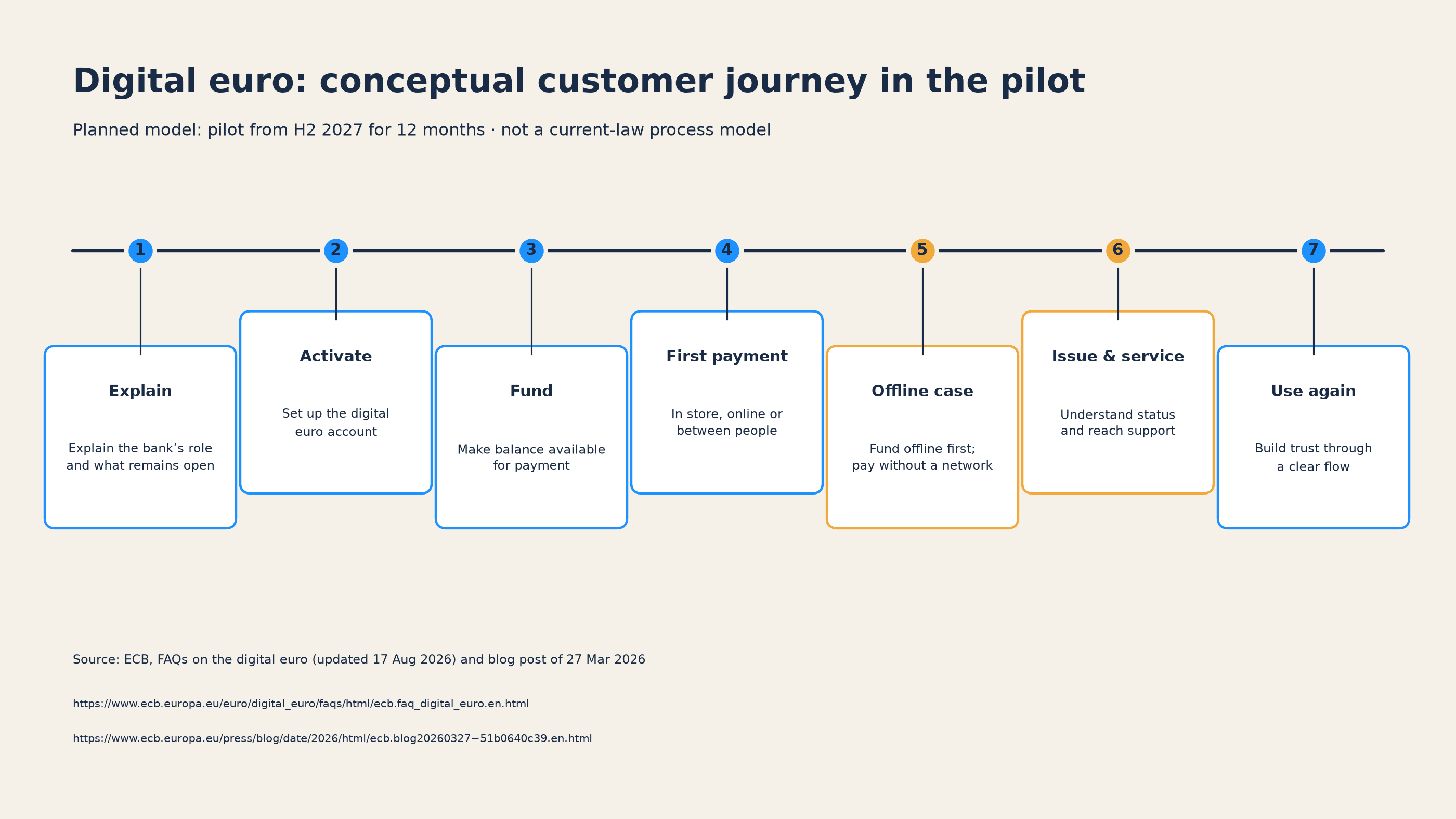
A dependable journey starts before account setup. Customers need a concise, consistent explanation: what is the digital euro in the currently proposed model? What remains undecided? What role will their bank play? The ECB envisages supervised payment service providers as the main point of contact for individuals, merchants and businesses; they would perform all end-user services. That is part of a proposed design and regulation, not today’s legal position. ECB FAQs on the digital euro
Activation is the second critical moment. In the envisaged design, a user would set up a digital euro account through their own bank or an EU payment service provider. This is followed by consent, information about data and security, and choices about how access appears in an app, card or service channel. In the pilot, teams should test more than completion. They should ask whether participants can explain what they have set up and who will help them if they have a question.
Funding comes next: making balance available for a payment. This is where a separate balance beside a familiar current account can create confusion. The ECB blog also describes a possible “reverse waterfall”: if a customer’s digital euro balance is insufficient, the shortfall could be automatically taken from a linked commercial bank account or card. The source does not specify whether it would be mandatory, how consent would work or how it would be set up. Those gaps are not reasons to wait; they are precise hypotheses for the pilot. ECB blog: Digital euro: an opportunity for banks
The first payment must cover more than one situation
The envisaged design covers payments in stores, online and between people. At online checkout, users could select the digital euro and authorise the payment instantly through their banking app. A single demonstration case is therefore not enough for a first-use test. A pilot plan should connect at least a person-to-person transfer, a point-of-sale payment and an online purchase into one coherent set of journeys. ECB FAQs on the digital euro
The offline case deserves particular attention. The planned digital euro would offer online and offline functionality, enabling use with poor or no network reception. A user would first need to fund an offline digital euro account; they could then tap their phone against another person’s phone or a shop terminal. This is a planned feature. For that reason, pilot and service teams need language and operations that distinguish “no signal”, “not funded enough” and “payment not completed”. ECB FAQs on the digital euro
Privacy belongs in the same journey, not in a separate compliance appendix. Offline payments are envisaged to offer a cash-like level of privacy; only payer and payee would know the personal transaction details. For online payments, the Eurosystem would not be able to identify the payer or payee, while payment service providers could identify users for anti-money-laundering compliance as they do today. This too describes a future design to be governed by regulation. Clear customer language must distinguish these layers rather than promising blanket anonymity. ECB FAQs on the digital euro
Service is part of the payment, not an afterthought
A customer journey does not end at authorisation. During the pilot, banks should test whether customers understand status, balance, error messages and the route to help. Relevant questions include: what is visible after an interrupted offline payment? When is a transaction retried? What information can support safely request? What explanation is given when a payment does not appear when expected? The primary sources do not prescribe finished support processes. They do, however, position payment service providers as the main contact for all digital-euro matters. ECB FAQs on the digital euro
A potential conditional payment also belongs in a controlled test scenario. Under the proposal, the digital euro would not be programmable money, but it could facilitate conditional payments—for example, transferring funds after delivery is confirmed. The ECB blog gives a train-ticket example in which payment would be taken only if the train actually runs. These are possible future services, not capabilities available today or promises for a specific use case. For the journey, the key is still clear: conditions, triggers, status and reversal must be understandable. ECB FAQs on the digital euro ECB blog: Digital euro: an opportunity for banks
Test now to prepare decisions in time
The scale of investment makes early learning more important, not less. Based on analysis provided by some banks, the ECB estimates total bank investment costs at €4 billion to €5.8 billion, or €1 billion to €1.44 billion a year over four years. This is not a binding cost commitment. According to the ECB, the estimate does not yet account for banks’ internal synergies and could change with standards, legislation and implementation choices. ECB blog: Digital euro: an opportunity for banks
The practical priority is straightforward: treat the customer journey as a managed object. Product, operations, compliance, service and technology should define plain customer language, an accountable role, an exception case and an observable test objective for every step. The aim is not to build a premature final solution. It is to expose assumptions. The pilot can then answer more than integration questions: it can show whether a planned payment feature can become a trusted bank service that customers will use again.
Illustration: AI-generated. AI-assisted content: We use AI technologies and automated agents in the creation of our articles, including from Microsoft, Google, OpenAI, Anthropic and other providers. Topics, editorial direction and final approval remain with our team.
We use Cookies 🍪
Strictly necessary cookies (e.g. Pipedrive forms) remain active. With your consent we also use Google Analytics (analytics) and Leadfeeder (visitor identification). More in our Privacy Policy.