AI & Banking
The Right to Talk to a Human: What the Chatbot Backlash Means for Bank Service
Citizens Advice demands a right to talk to a human. Bank chatbots resolve blocked payments in 11.4% of cases. Three design decisions that matter.
•
acceleraid Redaktion
5 min read
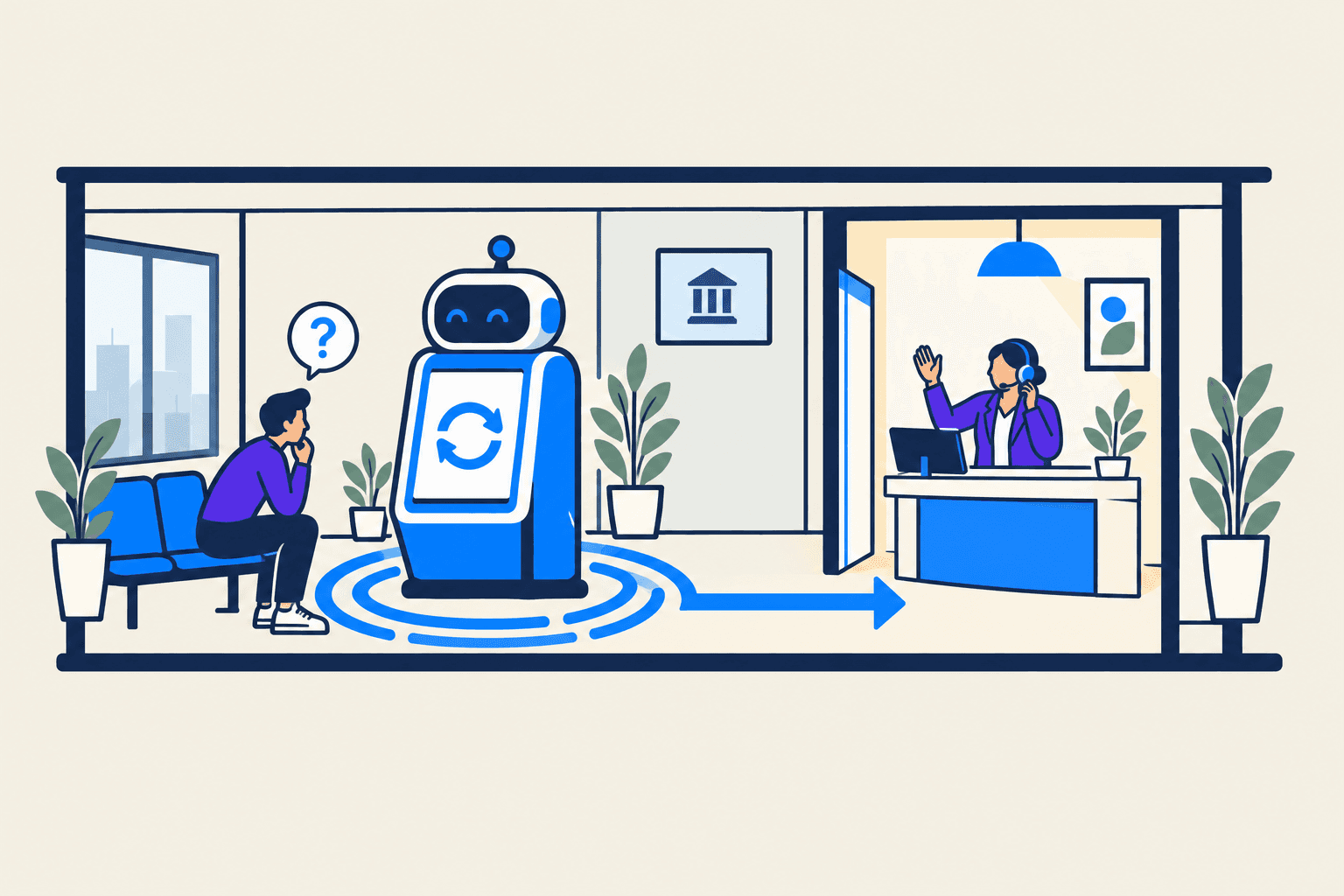
On 21 September 2026, the UK consumer charity Citizens Advice called on banks, energy suppliers and telecoms providers to guarantee their customers a "right to talk to a human". The call rests on research covered by the Guardian: for more than half of users, chatbots wasted time, caused stress and delayed the resolution of their issue. Almost half of those who had to use a chatbot found it unhelpful; some felt it was designed to make them give up. Only 20 percent of UK adults name chatbots as their preferred way to get in touch.
The demand is aimed at the UK; the problem is European. For banks automating service at pace, the numbers point less to a technology problem than to a design problem.
What the numbers say about bank chatbots
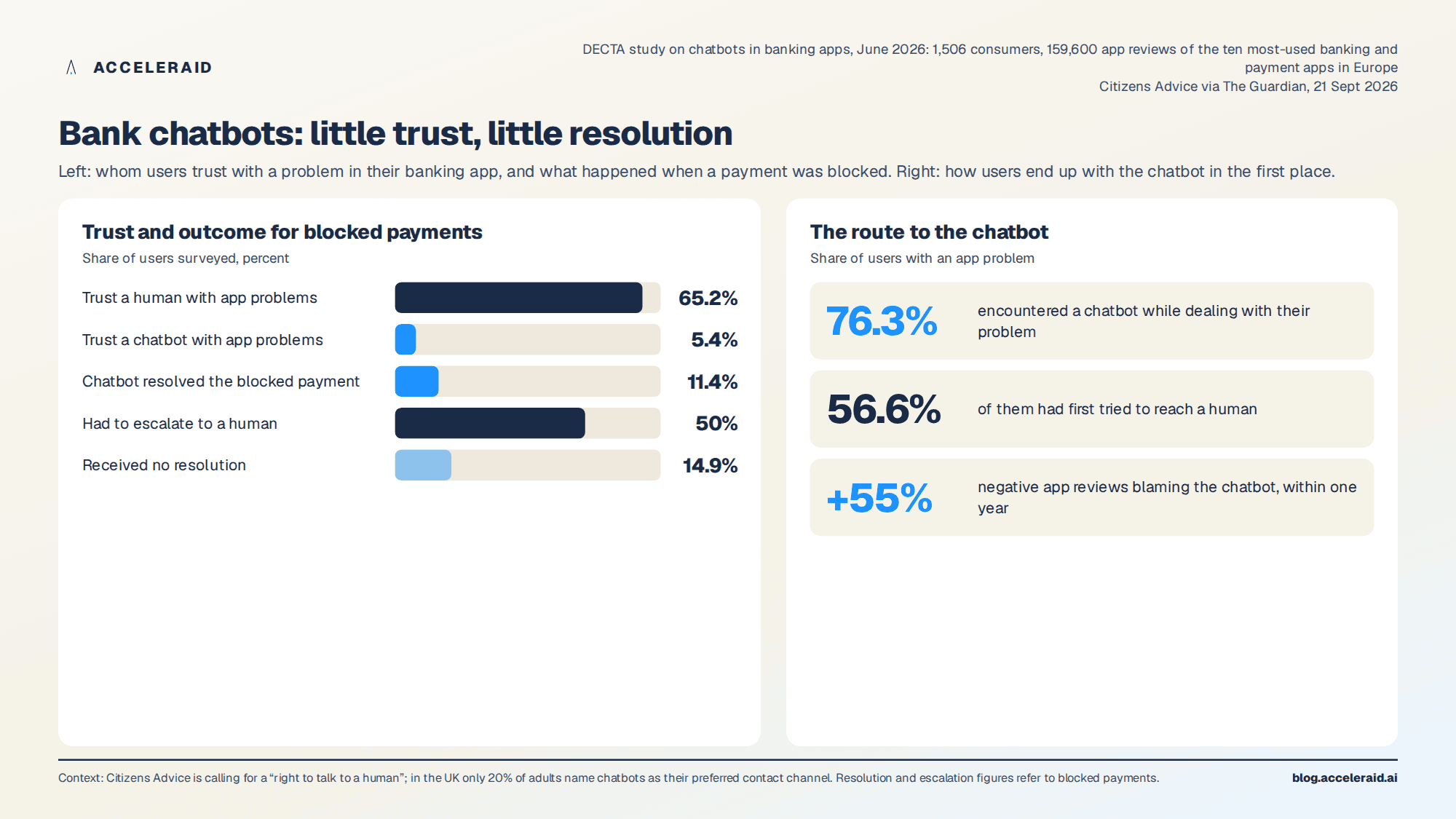
A study by payment infrastructure provider DECTA, published in June 2026, surveyed 1,506 consumers and analysed 159,600 app store reviews of the ten most-used banking and payment apps in Europe, including Revolut, N26, Monzo, Wise and Starling. The result is unambiguous: for blocked payments, chatbots resolved the issue in 11.4 percent of cases. Half of users had to escalate to a human agent, and 14.9 percent received no resolution at all. Only 5.4 percent of respondents trust a chatbot with a problem in their banking app; 65.2 percent trust a human.
The route there is revealing: 76.3 percent of users encountered a chatbot while dealing with their problem, even though 56.6 percent of them had first tried to reach a human. The chatbot was not the customer's choice but the hurdle in front of the human. The number of negative app reviews blaming the chatbot rose by 55 percent within a year.
Complaints cluster around four topics: identity verification (16.9 percent), declined transactions (16.1 percent), login and access problems (12.7 percent) and account suspensions (11.2 percent). These are the situations in which a customer cannot spend money, cannot reach their account or fears for their funds, and the moments in which the relationship with the bank is decided.
Why this is not an argument against automation
The obvious lesson would be to scrap chatbots, and it would be the wrong one. The same data show that customers are not against digital help, only against help that does not help. The EPAM survey of the German market, analysed by Der Bank Blog in early September, fits the picture: between 33 and 45 percent of customers are comfortable with AI recommendations from their own bank, depending on the type of institution. Between 79 and 91 percent are comfortable with human financial advice. Customers draw a line, and it runs not between digital and analogue but between routine and exception.
A chatbot that reads out a balance, blocks a card or changes an address handles routine faster than any hotline. A chatbot that offers a customer with a suspended account the same three help articles three times handles nothing; it administers waiting time. The difference lies not in the model but in three design decisions.
First: recognise what the chatbot cannot resolve. Identity verification, account suspension and declined transactions are decisions of the bank that a chatbot can neither explain nor overturn as long as it has no access to the case. If the customer's intent falls into one of these categories, the right response after at most one exchange is a handover to a human, together with the conversation so far.
Second: do not hide the path to a human. That 56.6 percent of users looked for a human first and still ended up with the chatbot is not an accident but product design. A bank that keeps contact with a member of staff visible and reachable at all times does not lose efficiency. It wins back the cases in which the customer would otherwise move to a competitor: according to DECTA, 10 percent of users with a blocked payment tried to complete the same transaction through another app.
Third: measure resolution, not deflection. The common chatbot metric is the deflection rate, the share of requests that never reach a human. It rewards exactly the behaviour Citizens Advice describes: sending customers in circles until they give up. The right metric is the resolution rate from the customer's perspective, complemented by repeat contact within 48 hours and the complaint rate per issue type.
What banks should examine now
A "right to talk to a human" is being debated in the UK; whether it arrives as a rule in the EU is open. Banks that adopt it as a design principle without waiting have a simple advantage: at any moment they know which requests the chatbot resolves reliably, and they can route the rest deliberately to people who already know the context. That is less automation than today, but more cases closed.
Five takeaways
Citizens Advice is calling for a "right to talk to a human": for more than half of users, chatbots wasted time and delayed resolution; only 20 percent prefer them as a contact channel.
Bank chatbots resolved blocked payments in 11.4 percent of cases, according to DECTA; 5.4 percent of users trust them, 65.2 percent trust a human.
Three quarters of users encountered the chatbot even though more than half had looked for a human first; the chatbot acts as a hurdle, not a choice.
Identity verification, declined transactions, access and account suspension account for 57 percent of complaints; that is exactly where a handover to a human with the conversation history belongs.
The right metric is the resolution rate from the customer's perspective, not the deflection rate.
Illustration: AI-generated. AI-assisted content: We use AI technologies and automated agents in the creation of our articles, including from Microsoft, Google, OpenAI, Anthropic and other providers. Topics, editorial direction and final approval remain with our team.
