Data & Technology
“Headless CDP” Is a Pseudo-Term: What Really Matters in Bank Customer Data
CDPs have always been headless. What matters is the data layer: event schema, identity resolution, consent, real time. Seven questions for banks.
•
acceleraid Redaktion
9 min read
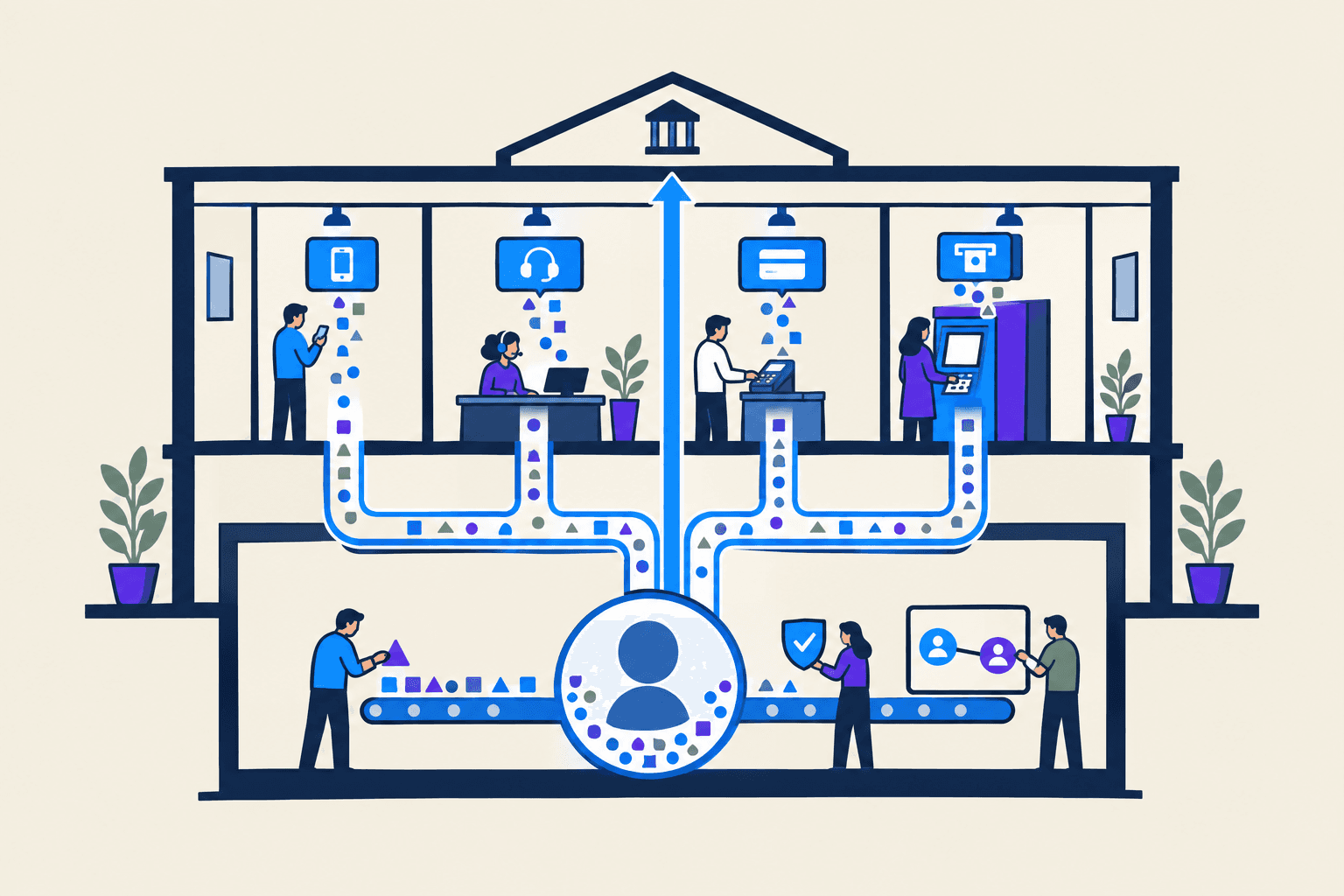
Anyone selecting a Customer Data Platform (CDP) for a bank in 2026 will run into a new label: "headless". It sounds like architectural progress, a platform without a user interface that slots neatly into any landscape. On closer inspection, it describes something CDPs have always been by definition. The question that matters for banks is not whether a platform is "headless", but how robust its data layer is: the event schema, identity resolution, consent management and real-time activation. This article puts the term in context and derives evaluation criteria that actually separate one platform from another.
Where the term comes from
"Headless" originates in the world of content management systems (CMS). A headless CMS separates the management of content from its presentation and exposes it through an API (Application Programming Interface). The idea was first applied to customer data in 2022, when RudderStack described a "headless customer data platform" as the connective tissue between the cloud data warehouse and the channels. Even then, the specialist site Stacktonic noted that "there is no exact definition and probably never will be".
The market has since adopted other names for the same idea. According to CDP.com, the term "composable CDP" was popularised around 2020 by Hightouch and Census; the CDP Institute defines it as "an architecture where customer profiles are built in a company's enterprise data warehouse, rather than a separate CDP database". "Warehouse-native", "zero-copy" and "headless" describe, as Datawhistl puts it, the same architectural core: customer data stays in the warehouse or lakehouse, and identity, activation and orchestration sit on top. In 2026 a further stage arrived, the "agentic CDP", which CDP.com describes as "headless infrastructure for autonomous AI agents", exposing profiles and decisions through MCP (Model Context Protocol, a standard for tool access by AI agents), APIs and command-line interfaces.
Four labels in six years, each with its own camp of vendors. That is a strong hint that these terms are doing positioning work rather than differentiation.
What a CDP is by definition
The CDP Institute has defined the category for years in its basic form as "packaged software that builds a persistent, unified customer database that is accessible to other systems". It lists "APIs, database queries, and file extracts" as typical access methods. The updated 2026 wording makes the point explicit: what distinguishes a CDP is "not where these services execute, but that the CDP serves as the system responsible for customer context, consistency, and downstream usability across analytics, engagement, and operational systems".
Accessibility to other systems is therefore not an add-on feature but the core of the category. A CDP that does not expose its profiles through an interface would not be a CDP. The segment builder, the audience editor and the dashboard are conveniences, not the product. In that sense, "headless" describes a property every serious offering has had since 2013.
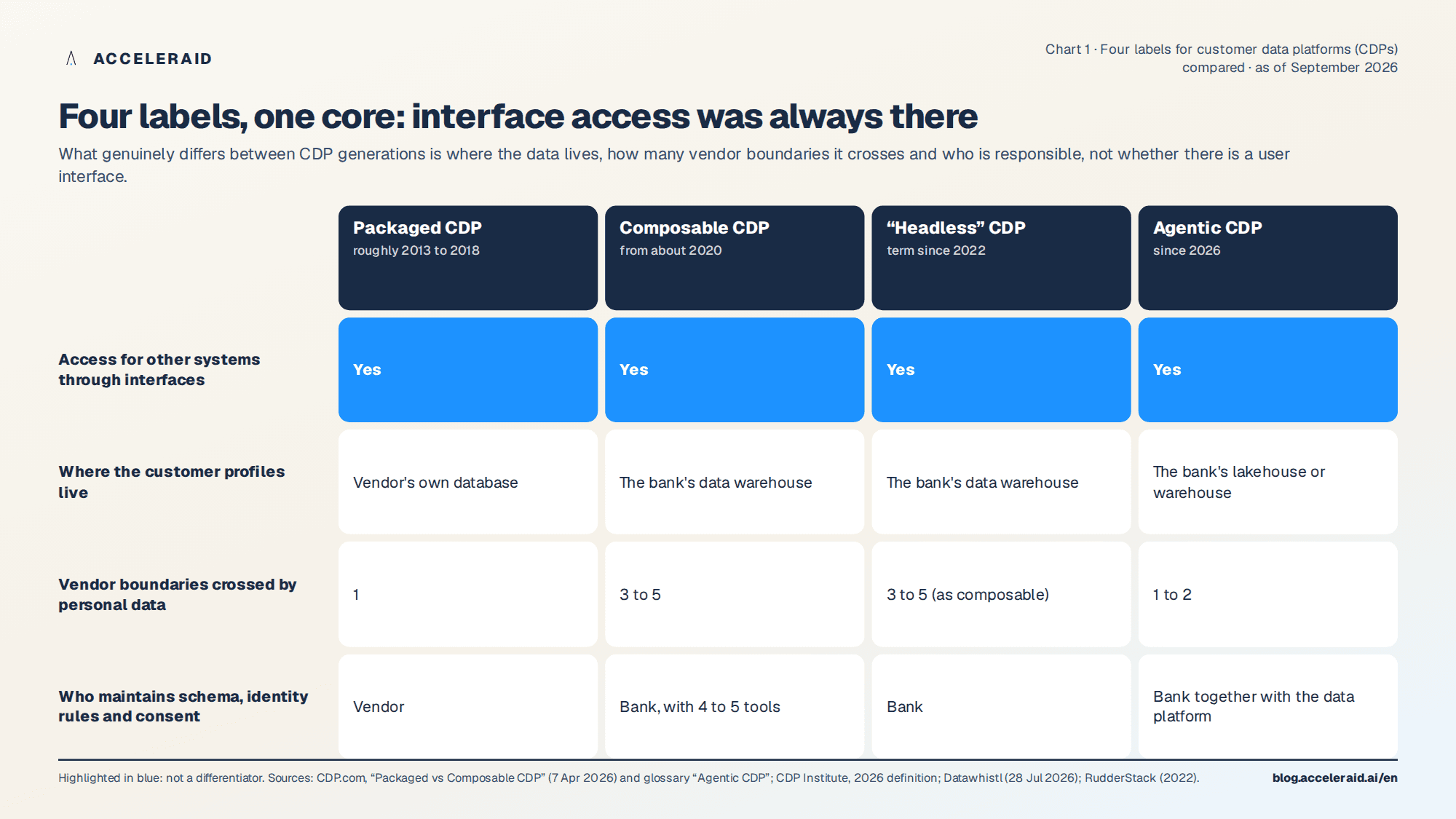
What genuinely differs between the generations, according to CDP.com, is something else: first-generation platforms (roughly 2013 to 2018) relied on batch ingestion, proprietary storage and rule-based segmentation; composable stacks often require "4 to 5 tools", and personally identifiable information (PII) crosses "3 to 5" vendor boundaries instead of one. Those figures determine operating cost, data protection and auditability. Whether or not there is a user interface determines none of them.
The four building blocks that make the difference
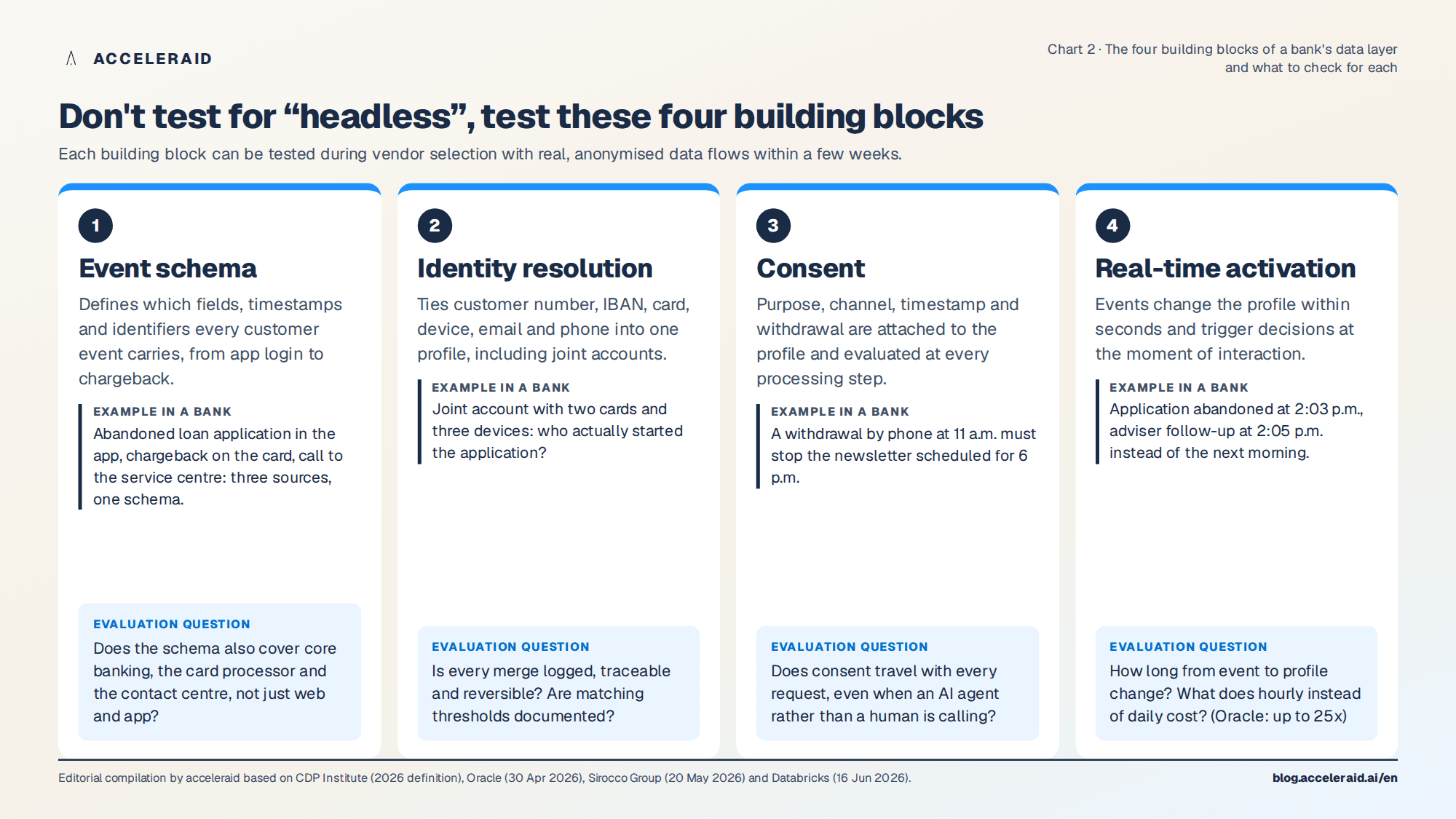
If not the interface, then what? From a bank's perspective, what counts is whether the data layer reliably handles four jobs. Each of them can be tested concretely during vendor selection.
1. Event schema
Customer data is born as events: a login in the app, an abandoned loan application, a chargeback, a call to the service centre. Without a shared schema that defines which fields an event carries, which timestamps apply and which identifiers travel with it, no consistent picture emerges. Vendors such as RudderStack advertise "standardised events from every channel" via web, mobile and server SDKs (Software Development Kits). For a bank, however, the decisive point is whether the schema also covers events from the core banking system, the card processor and the contact centre, none of which ever pass through a web SDK. A schema that only knows digital touchpoints is incomplete for a universal bank.
2. Identity resolution
A person shows up in a bank under many identifiers: customer number, IBAN, card number, app device ID, email address, phone number, possibly as part of a joint account or a household. Identity resolution ties these identifiers into one profile. The CDP Institute explicitly assigns the CDP "primary responsibility for defining and maintaining customer identity". In banking, deterministic matching on verified identifiers is the norm; probabilistic methods that rely on likelihoods are defensible only with documented thresholds, given the consequences for advice, fraud checks and contact rules. Anyone now offering "agentic identity resolution", as Databricks describes it for CustomerLake, must be able to explain how an AI-assisted merge remains traceable and reversible.
3. Consent
For a bank, consent is not metadata at the margin but a precondition for every activation. Purpose, channel, timestamp and withdrawal must be attached to the profile and evaluated at every processing step, regardless of whether a human, a campaign or an AI agent is accessing the data. This is precisely where a new challenge arises, as Sirocco points out with respect to Salesforce Headless 360: once agents read, write and execute processes without a user interface, "authentication, authorization and consent for non-human callers" need to be resolved. Consent has to travel with the request through the entire chain.
4. Real-time activation
A profile that is only refreshed the next morning is of no use for an application abandoned this afternoon. Real-time activation means events can change the profile and trigger decisions within seconds. This is where the price of zero-copy architectures becomes visible. Oracle calculates that moving from daily to hourly audience refreshes can increase warehouse compute cost "by 25x", and that near real time adds "50% or more" on top. The conclusion from that perspective: zero-copy suits reference and analytical data, streaming suits behavioural events, and a pre-computed, persistent profile suits identity resolution, scoring and instant activation.
What is genuinely shifting in 2026
Whatever the label, 2026 is a year in which the location of customer data is moving. On 16 June 2026, Databricks embedded a CDP directly into its lakehouse with CustomerLake, including identity resolution, segmentation and activation; the product is in private preview. In April 2026, Salesforce committed with Headless 360 to making "every object, flow, permission boundary and decisioning capability" available through APIs, MCP tools and command-line interfaces. Adobe and Salesforce, according to Datawhistl, now federate audiences against Snowflake, Databricks and BigQuery without importing records.
Part of the headless promise therefore holds: the data layer is moving into the bank's own data platform, and the CDP vendors' offering narrows to identity, activation, channels and agent access. For banks, that is attractive in principle, because the access controls, encryption and data residency of their own platform apply automatically. But it shifts responsibility: the event schema, the identity rules and the consent model are then maintained by the bank itself, not by the vendor. A label does not replace that work.
What this means for banks in practice
Three consequences follow for the selection process.
First, "headless" does not belong in the requirements list. Every CDP is accessible through interfaces by definition. What belongs there instead are the four building blocks with measurable criteria: the number of vendor boundaries PII crosses; the latency from event to profile change; traceability of every merge; propagation of consent to every caller.
Second, "warehouse or CDP" is the wrong question. The two systems have different jobs. The warehouse holds history and the analytical truth; the activation layer holds the operational profile with the rules that apply at the moment of interaction. Which data is copied and which is not should be decided per use case. Oracle recommends defining the "5 to 10 activation scenarios" that truly matter and aligning the integration method with them.
Third, agent access changes the evaluation criteria, not the architecture. When an AI agent in service or advisory reads customer data and triggers actions, the data layer must enforce permissions, purpose limitation and logging for machines exactly as it does for humans. Sirocco advises testing APIs and MCP servers "under realistic load" and examining rate limits, latency and concurrency under agent traffic. For a bank, agent access to customer data also belongs in the information register required by DORA (Digital Operational Resilience Act, the EU regulation on digital operational resilience).

Seven evaluation questions for the selection process
The table below summarises the questions that reveal real differences during vendor selection and the answers a bank can rely on.
Evaluation question | Robust answer |
|---|---|
How many vendor boundaries does personal data cross? | One or two, documented per data flow |
Does the event schema cover core banking, cards and the contact centre? | Yes, with server-side integration and shared identifiers |
Is every merge of identifiers traceable and reversible? | Yes, with a log per match and documented thresholds |
Does consent travel with every call, including from agents? | Yes, purpose and channel are checked on every request |
How long from event to profile change? | Seconds for behavioural events, hours for reference data |
What does an hourly rather than daily refresh cost? | Calculated per scenario, with a ceiling |
Which agent calls are logged? | All reads and writes, stored immutably |
None of these questions can be answered with "headless". All of them can be tested in a proof of concept with real, anonymised data flows within a few weeks.
Five takeaways
"Headless" describes a property CDPs have had by definition since the category emerged: accessibility to other systems through interfaces. As a selection criterion, the term has no discriminating value.
The differences between platforms lie in the data layer: event schema, identity resolution, consent management and real-time activation. These four building blocks can be tested.
Zero-copy and warehouse-native architectures move the data layer into the bank's platform, and with it the responsibility for schema, identity rules and consent model.
Real time has a price: hourly refreshes in the warehouse can raise compute cost by 25x, according to Oracle. Which data is copied should be decided per use case.
Access by AI agents changes the evaluation criteria: permissions, purpose limitation, logging and load tests must apply to machines exactly as to humans, including registration under DORA.
In client projects, Acceleraid works on the banks' existing data platforms and connects identity, consent and activation with the decision rules of customer lifecycle management. Which building blocks are missing in a given landscape can be established quickly with the seven evaluation questions.
Illustration: AI-generated. AI-assisted content: We use AI technologies and automated agents in the creation of our articles, including from Microsoft, Google, OpenAI, Anthropic and other providers. Topics, editorial direction and final approval remain with our team.
