CLM & CVM
AI Agents in the Customer Lifecycle: 15 Campaigns from Acquisition to Win-back
15 campaign types show how AI agents connect acquisition, activation, growth, retention, and win-back into a lifecycle system.
•
acceleraid Editorial Team
5 min read
From Calendar to Lifecycle Logic
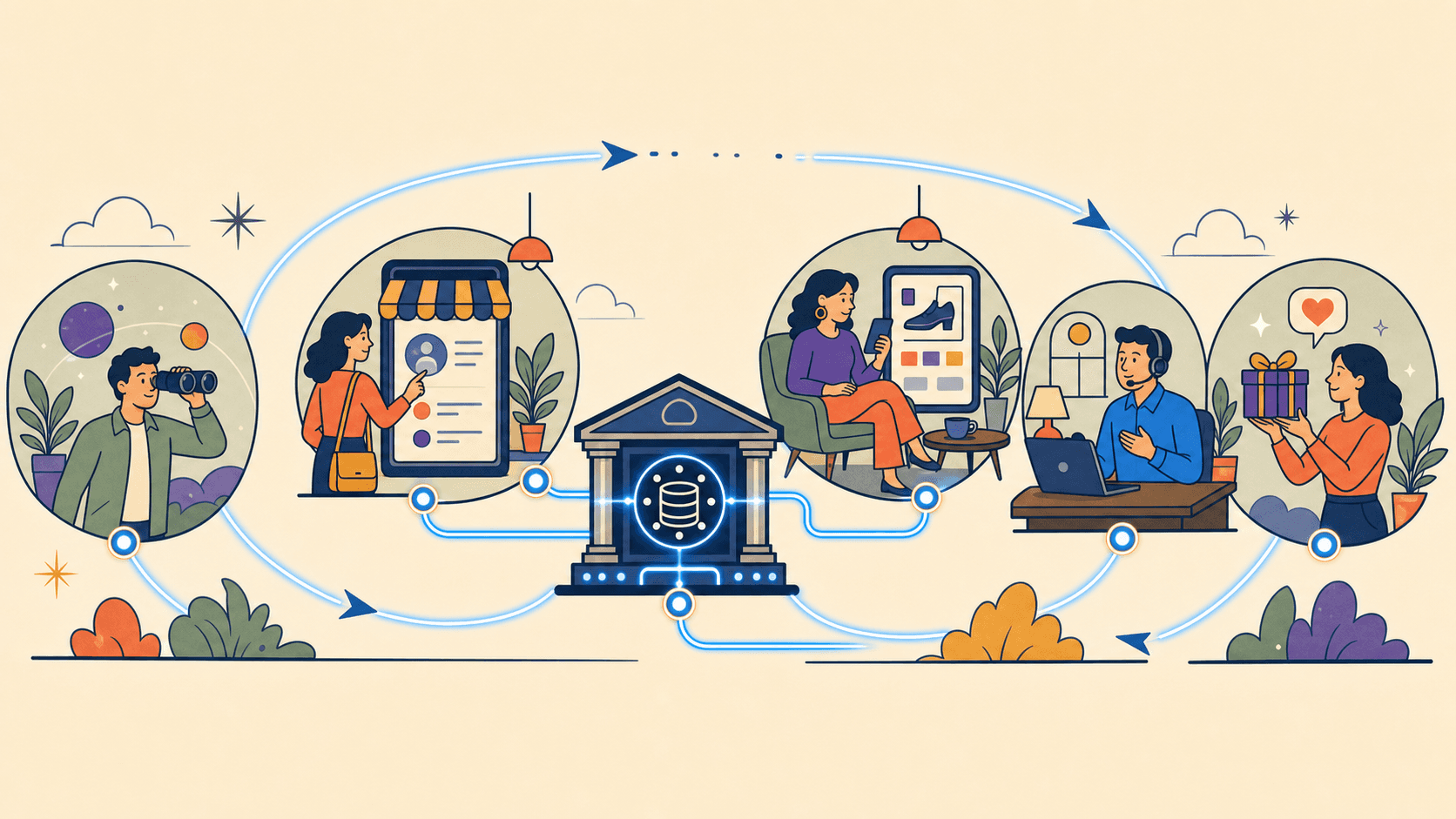
Part 3 of 5 in the "AI Agents in the Customer Lifecycle" series. The previous posts explain the closed loop and the Intelligence Layer; this post translates both into a resilient campaign architecture. Instead of filling an annual calendar with isolated actions, a lifecycle program connects acquisition, activation, growth, retention, and win-back. The decisive shift: a response begins with an active signal and only ends when its result flows back into the next decision.
Author: acceleraid Editorial Team
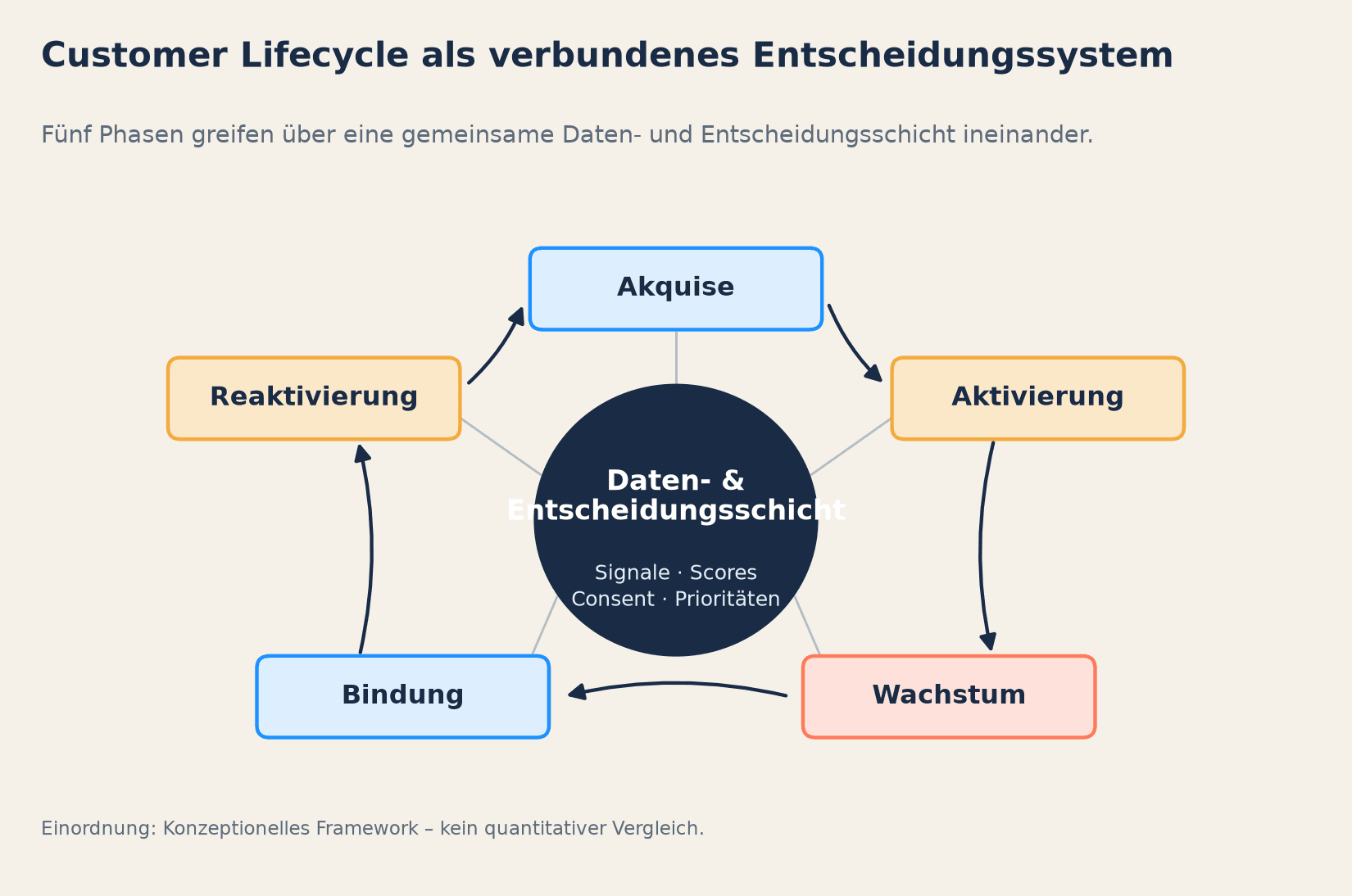
For financial service providers, this is more than just a matter of timing. In Acceleraid's public product logic, five connected lifecycle stages are planned: Acquire, Activate, Grow, Retain, and Reactivate. They combine signals, scores, orchestration, and outcome feedback into a platform logic (CLM/CVM Orchestration). However, this does not automatically prevent inappropriate targeting. Every program needs clear starting segments, an explicit handoff between phases, and firm guardrails for consent, contact frequency, and channel preference.
The following three practical blocks contain exactly 15 campaign types from three whitepaper practical lists. They are a starting portfolio, not a template for a fully automated decision on credit, pricing, or risk. Which targeting is actually approved remains a business and regulatory decision of the institution.
Practical Block 1: Attract & Acquire
Acquisition does not begin with the largest possible target group, but with a plausible hypothesis about which signal and which entry point fit together. Suitable starter segments include similarity groups based on existing customer data, source channels, recognizable intent signals, product interest, and regional catchment areas. These categories are not replacement personas: they merely define which signals may be checked and in which context an offer could be relevant.
Campaign Type | Operational Function |
|---|---|
Look-alike Prospecting Campaign | Reaches external target groups that statistically match high-value existing customers. |
Co-Branded Acquisition Push | Guides prospects from a partner campaign to registration via a dedicated landing page. |
Life-Event Pre-Qualification Flow | Responds to an eligible intent signal and structures a pre-qualification before the application. |
Multi-Channel Retargeting Sequence | Resumes an incomplete application funnel and manages its continuation across channels. |
Referral & Lookalike Seeding | Uses suitable groups of existing customers as a starting point for similar target groups and referral incentives. |
The five types follow the practical list for Attract & Acquire described in the whitepaper (CLM/CVM Orchestration). The handoff is crucial: only when a registration, a qualified lead, or another defined entry point exists does the steering switch to activation. Acquisition signals must not be passed along unchecked as product recommendations. They are first transferred to a customer profile, checked against consent and duplicates, and documented as the starting point for the next phase.
A proof point does not replace this architecture, but it can put its relevance into perspective: Acceleraid reports a +120% increase in card applications for a major European card issuer and 65,000 generated mortgage advice appointments for a major German retail bank customer (Banking). For a new program, these are not targets. It is more sensible to first define metrics such as fully handed-over leads, qualified appointments, and cleanly attributable application progress.
Practical Block 2: Activate, Cross- & Upsell
After entering the customer relationship, the task shifts: an initial contact should turn into a usable, suitable relationship. A logical start separates cohorts by duration since onboarding, product gaps, usage intensity, preferred contact channel, and proximity to a loyalty status. These segments should be regularly updated with current scores; they are not permanent lists.
Campaign Type | Operational Function |
|---|---|
Guides the early relationship with nudges toward first use, first login, and habit formation. | |
Next-Best-Category Cross-Sell | Prioritizes a single matching product category instead of a generic product bundle. |
Usage-Triggered Upsell | Responds to a usage signal that indicates interest in a higher tier of service. |
Life-Event Cross-Sell (branch-routed) | Passes a digital notification with context to the preferred advisory channel. |
Loyalty Tier Progression Campaign | Supports a clearly understandable next step in a loyalty program. |
These five campaign types come from the Activate, Cross- & Upsell block of the whitepaper. Their common rule is: a score is not an action. Only the combination of score, lifecycle status, eligible channel, and contact frequency determines whether communication, advisory routing, or deliberately no contact follows. This ensures, for example, that a usage nudge does not automatically become a generic upsell message.
The handoff to the next phase is also a business process. Confirmed activity can trigger the check of a product gap; a lack of activity, on the other hand, is a monitoring signal, not necessarily an escalation. For each type, the program should document a hypothesis, an exclusion criterion, a desired next step, and an evaluation against a suitable control group. This keeps it visible whether a relevance hypothesis holds up or if interactions were merely triggered.
Practical Block 3: Cultivate, Retain & Win Back
Retention and win-back are most effective when they address observable changes rather than rigid calendar dates. Suitable starting segments include risk levels, combinations of tenure and value, inactivity groups, payment signals, as well as documented negative service contacts. The segment definition only determines the check pool. It does not legitimize a financial decision or a communication without valid consent.
Campaign Type | Operational Function |
|---|---|
Early-Warning Save Offer | Triggers on a rising risk or activity change score prior to a potential departure. |
Payment-Risk Outreach | Schedules a proactive, empathetic outreach for predicted payment difficulties. |
Dormant Reactivation Wave | Reactivates inactive customers based on a logical inactivity framework. |
Complaint-Triggered Save Journey | Starts with a prioritized review following a documented complaint or negative signal. |
Loyalty Redemption Reminder | Reminds of unredeemed points when their expiration is imminent. |
The five types correspond to the retention and win-back block in the whitepaper (CLM/CVM Orchestration). Early warning is not a promise here, but a window of opportunity for a verifiable decision: The banking side describes the detection of customers at risk 90+ days before account closure or inactivity based on transaction patterns (Banking). A retention playbook should therefore always define who approves a proposal, how contact limits apply, and what outcome flows back into the model feedback.
There is a clearly defined reference value for reactivation: According to Acceleraid, a program with 175,000 contacted customers led to a +30.3% uplift compared to a control group. The metric describes campaign resonance, not revenue or a general success rate (Data Quality). This is precisely why it is a good example of correct evaluation: control group, target metric, and triggers must be set before launch.
The Handoffs are the Real Operating System
The five lifecycle phases are not a linear assembly line. A prospect can leave a path and re-enter later; an active customer can simultaneously show a retention signal. Therefore, every handoff needs four pieces of information: the triggering signal, the current score, the eligible action space, and the expected feedback channel. A conflict resolution rule is also essential. It prevents, for example, a reactivation campaign and a growth campaign from competing for the same person at the same time.
A pragmatic start includes only selected types per practical block, clearly limited segments, and a joint decision-making body comprising marketing, business units, data owners, and compliance. Only when handoffs, contact rules, and outcome measurement are working should the portfolio be expanded. Each expansion requires another documented hypothesis and sign-off. This ensures that 15 campaign types do not turn into 15 isolated automations, but into an adaptable lifecycle system.
Series: AI Agents in the Customer Lifecycle
Part 1: From Campaign Calendar to AI Agent: How CLM Becomes a Closed Loop
Part 2: The Intelligence Layer: Why CDP, Predictions, and AI Agents Belong Together
Part 3: AI Agents in the Customer Lifecycle: 15 Campaigns from Acquisition to Win-Back (current post: /blog/customer-lifecycle-ai-agents-campaigns-financial-services)
Part 4: One Framework, Three Industries: AI Agents for Banking, Cards, and Insurance
Part 5: Operationalizing AI Agents: Roadmap, Governance, and KPIs for Financial Service Providers
Illustration: AI-generated. AI-supported content: In creating our posts, we use AI technologies and automated agents, including those from Microsoft, Google, OpenAI, Anthropic, and other providers. Topics, professional direction, and final approval remain with our team.
