CLM & CVM
Customer Journey Analytics in Banking: From a Mature Analytical Tool to Lifecycle Management
How Customer Journey Analytics connects signals, friction, and rules for responsible lifecycle management in banking.
•
acceleraid Editorial Team
6 min. read

Author: acceleraid Editorial Team | August 17, 2026
From Analytical Image to Managed Customer Relationship
Customer Journey Analytics (CJA) in banking is no longer just a means to evaluate digital journeys in retrospect. When used correctly, CJA combines signals from sales, service, digital channels, and transactions with clear decision rules. In this way, the observation of a journey becomes an ability to manage the next logical step of a customer relationship.
This is not an invitation for more outreach. On the contrary: lifecycle management is intended to prevent unnecessary contacts, make friction between channels visible, and offer timely support in critical situations. The benchmark is not the number of actions deployed, but whether a person can complete their request reliably and comprehensibly.
The discussion surrounding the maturity of CJA shows why this distinction is now important. CSGI reports, with reference to the Gartner Hype Cycle 2026, that Customer Journey Analytics in banking has been upgraded from "early mainstream" to "mature mainstream"; at the same time, the article describes CJA as a cross-channel view of friction and context. (CSGI on the Gartner Discussion) However, maturity does not mean that every bank is already deriving consistent decisions from its insights.
Four Terms, Four Different Tasks
A journey map describes an ideal or researched process: goal, phases, contact points, expectations, and pain points. It is valuable for shared language and service design. However, it does not reliably answer whether a specific customer is stuck in a process today or what help would be appropriate.
A dashboard visualizes key performance indicators. It can show drop-offs in account opening, processing times, or contact reasons. It thus supports management and prioritization. However, it remains focused on the question of what happened if no logic is established to turn observation into responsible action.
Campaign attribution evaluates which contacts preceded or contributed to a measurable response. This is important for evaluating marketing budgets and channels. However, attribution often looks at an action and its outcome. It is not built to understand the entire course of an inquiry, rule out contradictory contacts, or determine the best service option in a critical moment.
CJA connects these levels. It reconstructs actual paths from events, associates them with a person or a case, and checks where patterns, waiting times, switches, or repetitions occur. The difference is crucial: the analysis does not end with the diagram but provides the verifiable context for a decision. CSGI summarizes this as the cross-channel evaluation of interactions across human, automated, and physical touchpoints. (CSGI on the Gartner Discussion)
From Signals to a Resilient Context
A good CJA implementation does not start with a model, but with a precise question. Example: Why do people switch from the mobile channel to the phone during a credit card application, and what needs to happen so they can complete their request without repetition?
For this purpose, signals that are permissible and necessary for this question are merged: application steps, error messages, interrupted identification, scheduled callbacks, service contacts, consents, preferred channels, and, if applicable, relevant transaction patterns. A single event rarely explains anything. It is the chronological sequence and the known status that create context.
Transaction data can provide clues but should never be treated as supposed certainty about a personal event. The ABA Banking Journal describes how cleaned and categorized transaction data can become behavioral signals, for instance to detect changes in usage or outflows; the article is sponsored content and should therefore be read as a practical impulse, not as an independent efficacy study. (ABA Banking Journal)
For everyday banking, a simple rule follows from this: a signal is an occasion for review, not a diagnosis. A repeated login error can be a usability issue. A call after an interrupted process can indicate a lack of clarity. A changed flow of money can have various causes. CJA is meant to bring these contexts together, not to assign a premature meaning to them.
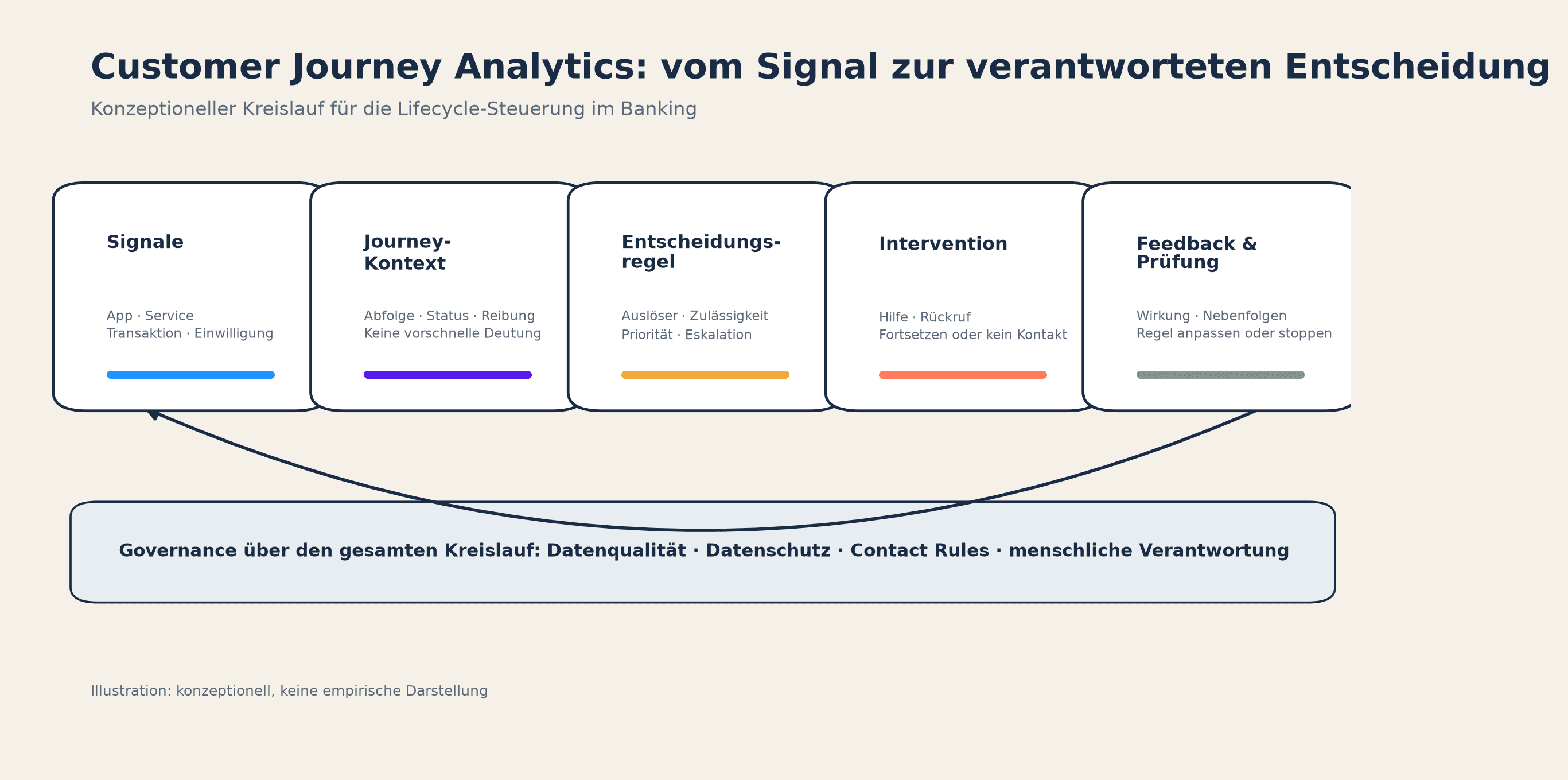
Detecting Friction Across Channels
Cross-channel friction often shows up at transitions, not within a single system. A customer starts an address change in the app, receives a generic email afterwards, calls with a query, and has to explain the same issue all over again. Each system can function correctly on its own. Yet the journey is incomplete.
CJA makes such patterns measurable by connecting events along a functionally defined journey: start, progress, interruption, contact, decision, completion, and follow-up inquiry. A common event semantics is important. "Application submitted" must not mean just the click in one system and successful validation in another.
Negative signals also deserve the same status as conversion. Repeated document requests, long pauses after an error page, multiple authentications, or a switch to the service channel can indicate friction. The correct response is not automatically a sales message. It can be a clearer explanation, a callback offer, the resumption of a process, or the elimination of a technical error.
In its Banking Trends 2026, Accenture recommends first piloting one or two complete journeys where mobile and contact centers access a shared context of identity, consent, history, and intent. (Accenture Banking Top Trends 2026) This is a sensible scope: a manageable journey forces concrete clarification of data, responsibilities, and operational boundaries.
From Insights to Decision Rules
Lifecycle management arises when a bank consciously constructs the bridge from detection to action. This bridge consists of rules, not a general promise of personalization.
A rule needs at least five components:
Trigger: Which event pattern triggers a review?
Context: What additional information must be available to understand the situation?
Permissibility: Are consent, contact frequency, and professional authorization present?
Intervention: What help or next step is planned for this situation?
Abortion and Measurement: When is no action taken, when does a case escalate, and how is the impact evaluated?
A hypothetical example: A person starts an application online, cancels after an error message, and contacts service within a short time. The rule can display the already known step and the error message to the service staff. It can suppress a generic advertising contact. However, it should neither derive a credit decision nor assume a sensitive cause. The intervention improves continuity without bypassing the role of the human and the specialized process.
To prevent CJA from becoming an uncontrolled contact engine, the bank must apply contact rules across journey boundaries. This includes priorities between service, risk, and sales, blocking periods after complaints, frequency caps, and a clear owner role for every decision. Without these rules, a locally sensible campaign can be globally harmful.
Governance: Responsibility Remains Human
The closer a decision is to financial consequences, protection needs, or a complex life situation, the clearer human responsibility and escalation paths must be. A model can provide a probability; it must not replace the professional reasoning, discretionary power, or accountability.
In practice, CJA governance needs a data owner for definitions and quality, a journey owner for customer experience and business goal, representatives from compliance and data protection for permitted use, and functional owners for the respective intervention. Product, service, and technology should jointly determine which interventions are automated, subject to review, or excluded.
Internal transparency is also a prerequisite. Employees need understandable indications of why a case was suggested, what data categories were involved, and what they can override. For AI-supported interactions, Accenture emphasizes clear guardrails as well as options to exit, pause, override, and reconsider. (Accenture Banking Top Trends 2026) These principles are equally useful for rule-based lifecycle decisions.
Closing the Loop, Not Just Deploying
An intervention is not the end of the journey. After each action, the bank must check whether it helped, whether new friction arose, and whether the rule was unsuitable for certain groups. Success is not just completion or a click. Depending on the journey, fewer repeat contacts, faster resolution, reduced escalation, or better comprehensibility can be the more appropriate impact metrics.
This includes controlled tests, documented hypotheses, and the willingness to withdraw a rule. Anyone who only optimizes for short-term response overlooks the costs to trust and service. On the other hand, those who feed feedback from customer contact, complaints, process data, and professional reviews back into the journey create a learning, yet controlled, loop.
CJA is therefore not just another report in the MarTech stack. It is the analytical foundation for responsible lifecycle management: signals become context, context becomes comprehensible rules, rules become appropriate interventions, and their consequences feed back into better design. Technology can accelerate this cycle. Responsibility for purpose, boundaries, and customer impact remains with the bank.
Illustration: AI-generated. AI-supported content: In creating our articles, we utilize AI technologies and automated agents, including those from Microsoft, Google, OpenAI, Anthropic, and other providers. Topics, editorial direction, and final approval remain with our team.
