Data & Technology
The Intelligence Layer: Why CDPs, Predictions, and AI Agents Belong Together
Why a resilient intelligence layer brings together data governance, predictions, agents, GenAI, and human control.
•
acceleraid Editorial Team
5 min read

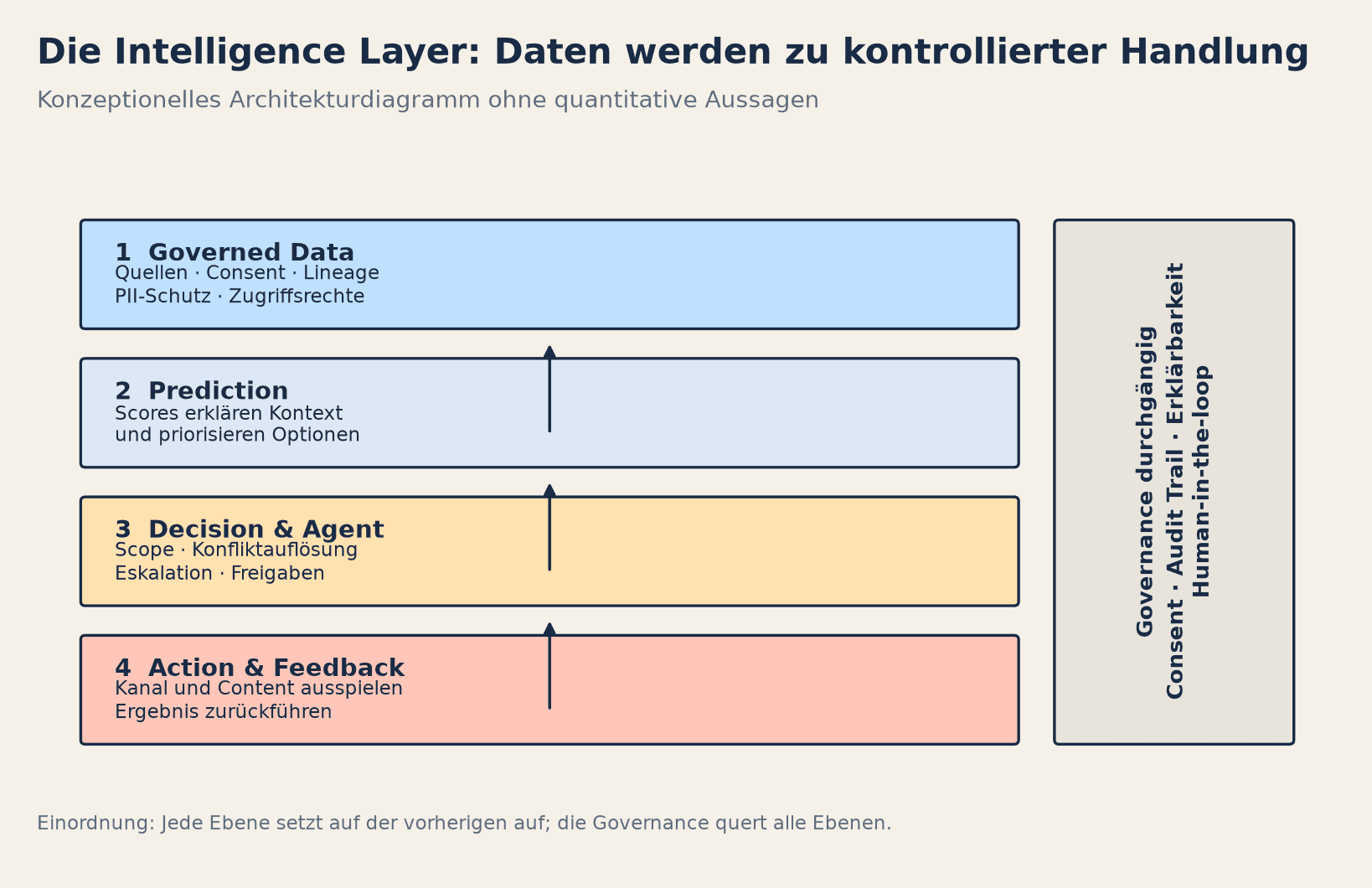
Part 2 of 5 in our series "AI Agents in the Customer Lifecycle for Financial Service Providers": An AI Agent can only make decisions as reliable as the data, rules, and feedback available to it. The Intelligence Layer therefore connects institutional memory, predictions, decision logic, and controlled execution—not as a loose collection of tools, but as a cohesive architecture.
Author: acceleraid Editorial Team
The CDP is the Institutional Memory
For financial service providers, a customer profile is more than just a marketing list. It must bring data from CRM, core banking, card processing, and digital interactions into a usable context without losing origin, consent, or purpose limitation. Acceleraid describes its data layer as a managed System of Record with consent, lineage, quality, and access controls for regulated environments (CDP & Data Governance).
This is the reason why the CDP comes before any AI feature. If a model cannot trace where an attribute comes from or whether it is allowed to be used for the intended purpose, a precise score is not a sufficient reason to act. Data governance is therefore not a subsequent compliance check, but part of the data model: consent history, granular preferences, permissions, and traceable data paths must be available before the decision is made.
Raw data also requires a professional translation. For card information, more than 1,000 MCC merchant codes can be automatically consolidated into 50 usable marketing categories (Data Quality). The category does not replace the transaction; however, it enables consistent, auditable use in segmentation and analysis.
A Score is Not Yet an Action
The platform features 18 pre-built, explainable prediction scores for financial services, including churn, Next Best Action, revenue forecasting, and customer lifetime value. In the whitepaper, these scores are structured into four clusters with five, four, five, and four models respectively: Acquisition and Growth, Engagement and Value, Retention and Risk, and Loyalty and Engagement Operations. The clusters help make an important distinction visible: some scores describe opportunity or need, while others describe contact load, risk, or the appropriate execution timing.
However, a score only answers a limited question. A high product affinity may indicate that an offer could be relevant. It does not answer whether contacting the customer is permitted, whether a service case currently takes priority, or which channel respects the customer's preference. This is precisely where model operation turns into a decision architecture.
A robust program therefore documents three things for each score: its business purpose, its permissible role in a decision, and the conditions under which it is not used. The publicly described Prediction Engine provides feature importance as well as model registries and version history for each prediction; the 18 scores are described as pre-built and explainable scores (AI Prediction Engine). This facilitates the business review but does not replace it.
Agents Work on a Limited Mandate
The next layer translates signals and scores into a coordinated action. Scattered trigger rules are not enough for this when multiple journeys access the same customer relationship at the same time. Orchestration must prioritize goals, detect contact conflicts, and log suppressed decisions just as it logs executed ones.
The central pattern consists of defined agents with a shared database. Acceleraid describes agents for Acquisition, Engagement, and Retention that work on a CDP and are coordinated via an orchestration engine to prevent conflicting journeys from contacting the same person twice (CLM/CVM Orchestration). This limitation is not a disadvantage, but a control mechanism: an agent's mandate contains its area of responsibility, permitted actions, escalations, and the rules for conflict resolution.
In practice, this means: scoring can suggest an action, but the decision logic first checks consent, contact frequency, channel preference, competing goals, and required approvals. An agent then only decides within the remaining space for action. Where the consequences are significant or the context is ambiguous, the process should be handed over to humans—not after a message or decision has already taken effect.
Governance Must Apply Before the Prompt
Generative AI extends this architecture with language, not with an exception rule for data. A PII filter must remove or redact personal or account-related details before the prompt. An agent's content also requires approved tonalities, product boundaries, and disclosure requirements.
Consent, audit trail, and human-in-the-loop must also be established before execution. There is no formal all-clear for marketing decisions: the higher the intervention, the clearer the control, override, and documentation must be.
Legally, differentiation is important. Article 22 of the GDPR solely concerns automated individual decision-making with legal or similarly significant effects; among the safeguarding measures, it specifically mentions human intervention, the expression of one's point of view, and the right to contest (GDPR Art. 22). A blanket "right to an explanation of the algorithm" cannot be derived from this. For creditworthiness assessments as well as risk and pricing in life and health insurance, Annex III of the EU AI Act identifies high-risk applications (EU AI Act, Annex III). This is a reason to build logging, data quality, and human oversight into the architecture early on.
Model Independence Protects Long-Term Context
GenAI models change quickly. Customer data, approvals, knowledge sources, and decision rules must therefore not disappear into a single model. Acceleraid positions its GenAI layer as model-agnostic: models from OpenAI via Microsoft Azure and Google Gemini via Google Cloud are listed as EU-hosted; for high sovereignty, open-source models on own infrastructure are also described (GenAI Enablement).
The architectural point is more important than the choice of model. The CDP remains the institutional memory. A retrieval and decision layer only pulls approved knowledge into the respective context, the prediction evaluates the next option, and an agent executes within its guardrails. If a model is replaced, the data structure, approvals, knowledge sources, and audit history remain intact.
An Implementation Order
Instead of first procuring a chatbot or a single score, decision-makers should review the layers from the bottom up. First, sources, purpose limitation, identity resolution, and data quality must be clarified. This is followed by the business description and validation of the scores. Only then are agents with clear responsibility, conflict logic, and escalation points defined. GenAI is the building-block capability to provide content or assistance within these boundaries.
This sequence does not slow down innovation. It prevents a convincing prototype from accessing data whose use cannot be justified later. An intelligence layer becomes resilient when it not only generates good answers but can also prove which data, rules, and humans were behind an action.
The Series "AI Agents in the Customer Lifecycle for Financial Service Providers"
Part 1: From Campaign Calendar to AI Agent: How CLM Becomes a Closed Loop
Part 2: The Intelligence Layer: Why CDP, Predictions, and AI Agents Belong Together URL: https://blog.acceleraid.ai/blog/ai-agents-intelligence-layer-cdp-prediction-genai
Part 3: AI Agents in the Customer Lifecycle: 15 Campaigns from Acquisition to Win-Back
Part 4: One Framework, Three Industries: AI Agents for Banking, Cards, and Insurance
Part 5: Operationalizing AI Agents: Roadmap, Governance, and KPIs for Financial Service Providers
Illustration: AI-generated. AI-supported content: We use AI technologies and automated agents, including those from Microsoft, Google, OpenAI, Anthropic, and other providers, to create our posts. Topics, professional direction, and final approval remain with our team.
