Automation
Operationalizing AI Agents: Roadmap, Governance, and KPIs for Financial Service Providers
A practical 1–9 week roadmap for AI Agents: featuring governance gates, clear KPIs, and the correct regulatory framework.
•
acceleraid Editorial Team
6 min. read

Author: acceleraid Editorial Team
Part five of the "AI Agents in the Customer Lifecycle" series translates the strategic aspiration into a controllable start. After the basics, the data and decision layer, the lifecycle campaigns, and the industry playbooks, the focus is now on implementation: not a big bang, but an initial productive trigger with verifiable governance.
The goal is a resilient first trigger – not the perfect target architecture
In the financial services environment, AI agents will rarely fail because a model cannot generate a recommendation. Rather, the critical question is: is it clear for each recommendation which data was used, which purpose is permitted, who is responsible for the decision, and how a result is subsequently reconstructed? This is precisely why the introduction should not be managed as a software roll-out, but as a controlled operational setup.
The white paper sets a clear target for this: from connecting the data to the first live campaign trigger takes six to nine weeks. This period is not an ROI promise, nor is it a blank check for an incomplete review. It describes a limited, measurable start: a defined use case, a controlled data flow, a documented decision template, and active monitoring.
For the steering team, this results in a useful inversion. Do not plan all channels, data sources, and use cases first. First, choose the smallest use case that meets three properties: it has a clear business purpose, verifiable decision logic, and traceable outcome measurement. A reactivation impulse or an onboarding reminder may be more suitable for this than a complex, customer-facing offer with many exceptions.
The roadmap: four phases, four releases
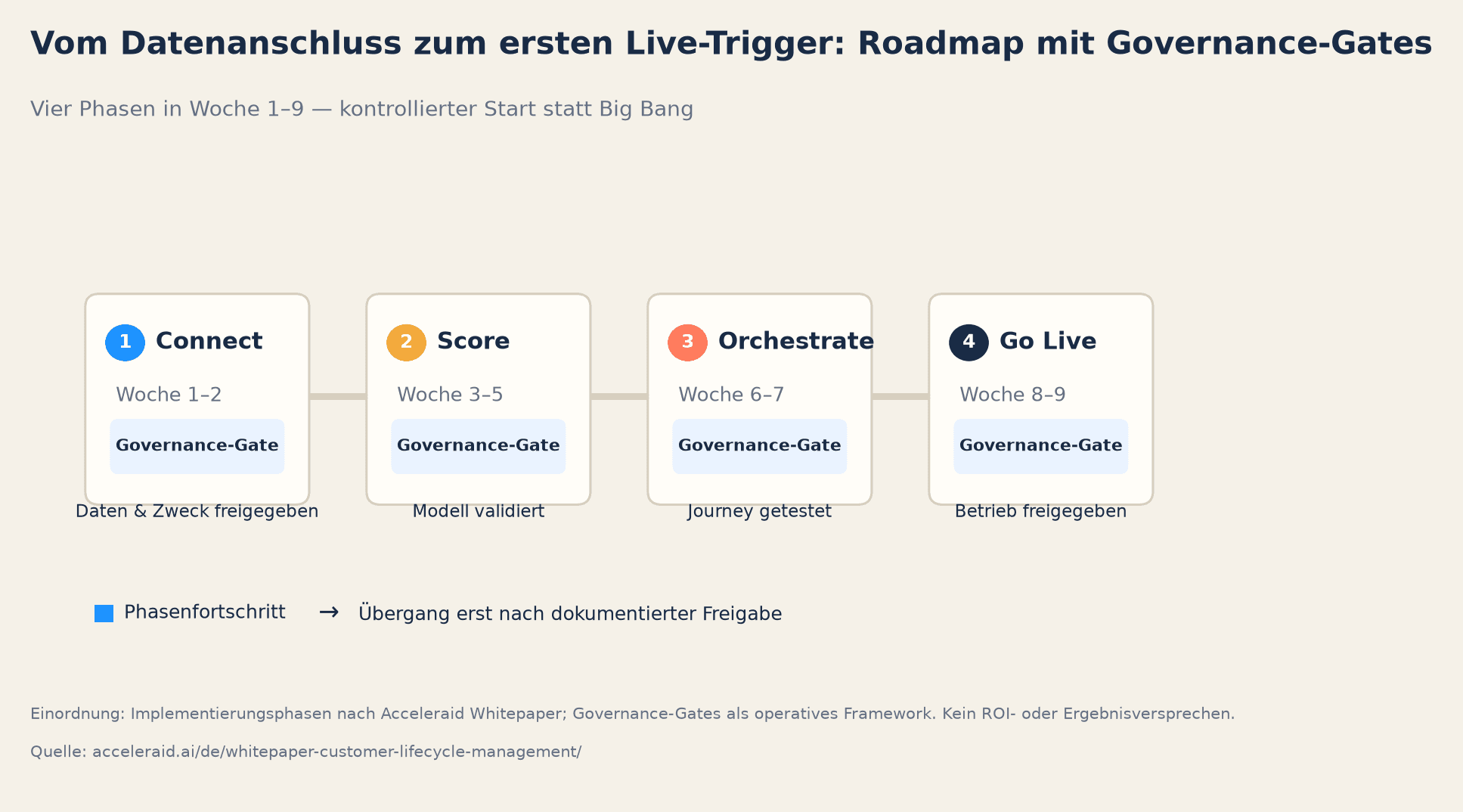
The roadmap structures the start into Connect, Score, Orchestrate, and Go Live. What is crucial is not just the sequence, but the governance gate at the end of each phase. A gate is a formal decision: the team reviews evidence, identifies open risks, and explicitly decides whether to approve the next step.
Phase | Focus | Governance Gate | Proof for Release |
|---|---|---|---|
Connect | Data sources, purpose, consent, roles | Data and Purpose Release | Data flow, access rights, retention, and responsible owners documented |
Score | Target variable, baseline, validation | Model Release | Test protocol, version, limitations, and business sign-off available |
Orchestrate | Trigger, channel, contact rules, escalation | Journey Release | Conflicts, opt-out, frequency limit, and test cases reviewed |
Go Live | Limited launch and monitoring | Operational Release | Monitoring, incident path, stop criterion, and reporting active |
Connect: Week One to Two
In weeks one and two, it is not about connecting as many data sources as possible. The team defines which source is genuinely required for the first use case and which fields are not needed for it. This results in a data flow diagram, a purpose description, and a role matrix. The business department, data protection, information security, and operations should sign off on these documents together; retroactive approval is no substitute for a clearly defined data usage.
The first gate is therefore: Is this data flow permitted to operate for this purpose? Only when consent status, purpose limitation, access rights, retention, and the responsible entity are documented should the scoring phase begin. PII protection belongs in the data flow before the model and prompt, not in a downstream campaign review.
Score: Week Three to Five
In weeks three to five, the prioritized signal becomes a limited decision model. Before the business discussion about model quality, a baseline is needed: what behavior is the score intended to support, which group serves as a comparison, and what threshold triggers an action in the first place? A score is not an action; it is a documented input for a subsequent decision.
The model gate therefore demands more than a plausible metric. It encompasses data quality, model version, assumed limitations, test cases, and a business sign-off. The ninth MaRisk amendment summarizes these requirements in AT 4.3.4 "Use of Models": Institutions must justify assumptions traceably, assess suitability prior to deployment, ensure data quality, validate models regularly, and ensure sufficient explainability for AI models. A metric without a version, scope of validity, and responsible owner is thus not a controllable score.
Orchestrate: Week Six to Seven
In weeks six and seven, it is determined how an approved score translates into a specific journey. This includes channel, time window, contact frequency, exceptions, escalation, and the point where a human intervenes. The rule "do not send" is just as important as the rule "send".
This gate separates determinism and optimization. Consent, opt-out, blocklists, and frequency limits are bindingly enforced. Timing, sequence, or text variants may be tested within these guardrails. For a limited pilot scenario, every decision should be traceable back to the signal, score version, rule, and triggered action. This creates an auditable process rather than a black-box journey builder.
Go Live: Week Eight to Nine
Weeks eight and nine mean a controlled start, not the broad automation of all journeys. The operational release should specify a limited target group, a responsible owner, a stop criterion, an incident procedure, and a fixed rhythm for reviewing results. Monitoring begins before sending: it checks data flow, consent, delivery, anomalies, and the ability to quickly reconstruct an individual decision.
The most important effect of this sequence is organizational. The business team and the control function do not work sequentially, but on the same decision object. This reduces handovers and prevents compliance from having to ask for an explanation only after the productive launch.
Compliance as a Design Principle
The roadmap does not replace an individual legal assessment. However, it makes visible where this assessment must take place. In the case of an exclusively automated decision with legal or similarly significant effects, Art. 22 GDPR protects in particular the right to human intervention, to express one's point of view, and to contest the decision. This does not result in a general right to disclosure of an algorithm. Rather, the information obligations under Art. 13 to 15 require meaningful information about the logic involved; full technical disclosure is not required, as explained in EDPB Guideline WP251rev.01. This checkpoint belongs in Connect and Score, not at the end of the journey.
The EU AI Act requires a second, separate analysis. Systems for assessing creditworthiness of natural persons as well as for risk assessment and pricing in life and health insurance fall into the high-risk categories of Annex III. For these Annex III systems, the relevant Chapter III obligations under Regulation (EU) 2026/1744 apply as of December 2, 2027. The general date of application of the AI Act and the transparency obligations remain unaffected by this.
For deployers of such high-risk systems, Art. 26 concretizes the operational side: human oversight must be assigned to competent persons, input data must be relevant to the purpose and sufficiently representative, and logs must be kept for at least six months. These requirements can be managed as gate evidence: naming of oversight, data verification, log concept, and data subject information. This makes governance verifiable instead of just being documented as a principle.
A KPI System that Connects Learning and Control
Campaign metrics remain important but are not sufficient for agents. For each lifecycle phase, the team needs a primary metric and a few diagnostics: Acquisition monitors conversion and cost per acquisition; Activation looks at activation rate, time to first use, and adoption; Retention tracks churn and retention rates as well as reactivation responses. Each metric is read against a predefined baseline or control group, not in isolation as a success message.
Above this lies a program scorecard with four perspectives. First, impact: improvement over baseline. Second, efficiency: contacts per desired outcome and cycle time. Third, model quality: stability, drift, and lift compared to the previous process. Fourth, governance: percentage of traceable decisions, time to audit response, open exceptions, and aborted journeys. This perspective prevents a short-term improvement in conversion from masking weaker control capabilities.
A proven reactivation case can serve as a reference for measurement discipline: 175,000 contacted customers and an uplift of 30.3% compared to the control group. This value is not a target value for other programs. However, it shows why a comparison group, a clear trigger, and a precise outcome definition are part of the implementation.
The Operational Core Question
A good start does not answer "How many agents can we roll out?" but "Can we take responsibility for, explain, monitor, and, if necessary, stop this one trigger?" Anyone who completes each phase with a resilient gate gains speed without losing control. The next usecase will then not be built on slides, but on a demonstrably functioning operating model.
The Series at a Glance
From Campaign Calendar to AI Agent: How CLM Becomes a Closed Loop
The Intelligence Layer: Why CDP, Predictions, and AI Agents Belong Together
AI Agents in the Customer Lifecycle: Fifteen Campaigns from Acquisition to Win-back
One Framework, Three Industries: AI Agents for Banks, Cards, and Insurances
Operationalizing AI Agents: Roadmap, Governance, and KPIs for Financial Service Providers (current post: /blog/ai-agents-financial-services-implementation-kpis)
Illustration: AI-generated. AI-supported content: In creating our posts, we use AI technologies and automated agents, including those from Microsoft, Google, OpenAI, Anthropic, and other providers. Topics, professional alignment, and final approval remain with our team.
