AI & Banking
One framework, three industries: AI Agents for banking, cards, and insurance
A unified decision-making framework makes AI agents manageable across banking, cards, and insurance—without losing industry context.
•
acceleraid Editorial Team
6 min. read

Author: acceleraid Editorial Team
One Core, Three Distinct Decision Spaces
Part 4 of 5 of our series on AI Agents in Customer Lifecycle Management for financial service providers. Following our look at data, predictions, and agents and at lifecycle practice, we now focus on transferring this to three industries: retail banking, cards, and insurance. The central thesis: it is not a uniform campaign plan that creates reusability, but rather a shared decision-making framework that clearly separates industry-specific signals, permissible actions, and success criteria.
This sounds like a technical question, but it is primarily an operational one. All three industries require a robust data foundation, predictions, orchestration, and governance. Yet, a relevant event means something different in each: in banking, it might be a change in payment or savings patterns; in the card business, a modified merchant category or an abandoned application path; in insurance, a renewal risk or a claim inquiry. Treating these differences merely as segments within the same journey loses context. Building them as separate platforms, however, multiplies data and governance efforts.
The practical middle ground is a shared core with clear industry playbooks. The core decides which data can be used, which score is plausible, which contact rules apply, and how results are fed back. The playbook, by contrast, defines the signal library, offer logic, responsible business role, and KPIs. This keeps control consistent without flattening the professional context.
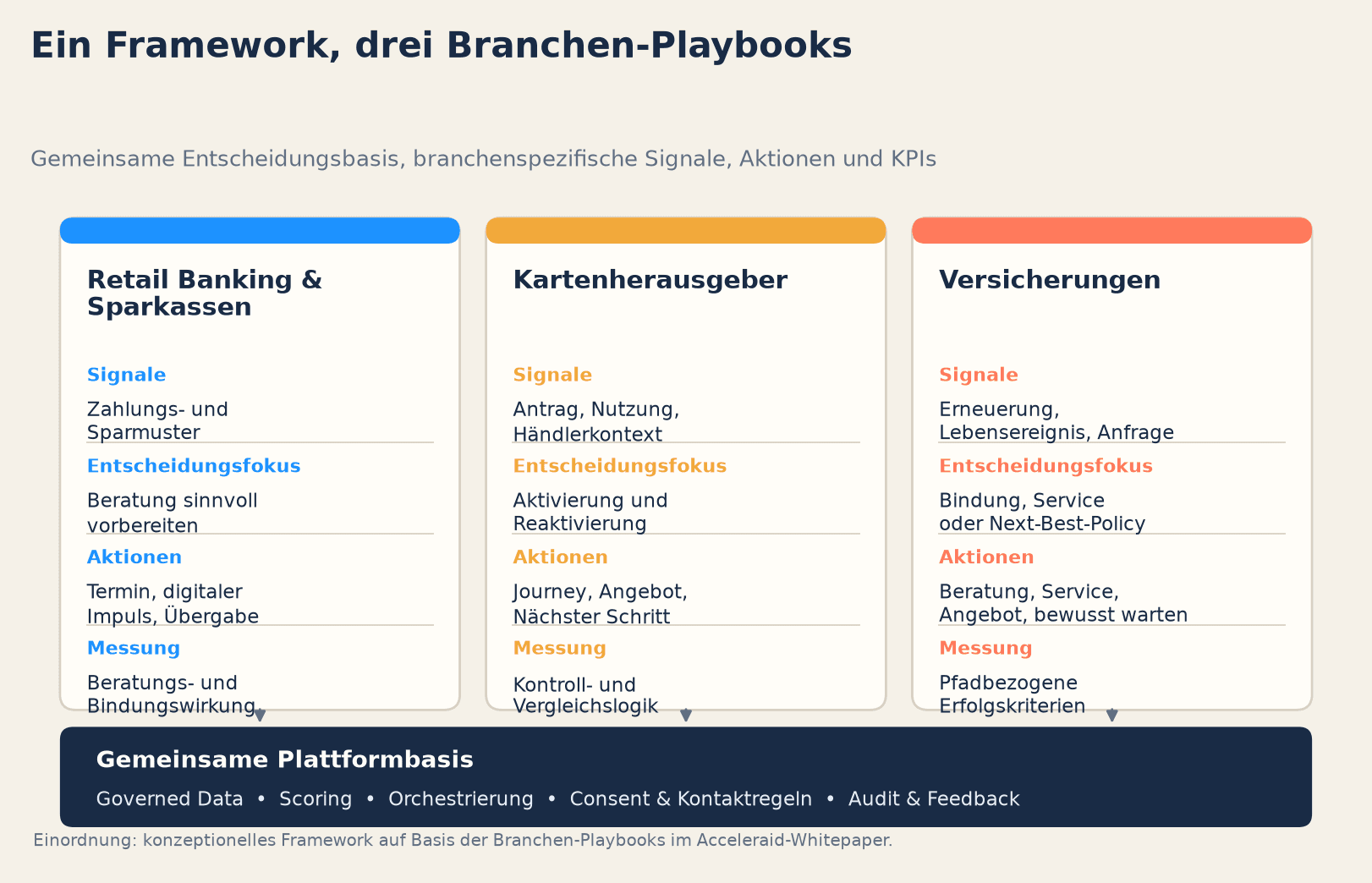
The Platform Foundation: Not Every Data Source is an Immediate Action
A shared framework begins with a simple sequence: data is first classified from a business perspective, then evaluated for a clearly defined goal, and only after that translated into an action. A CDP can merge CRM, core banking, card, and digital data into a controlled system of record; consent, lineage, quality, and access controls belong to the data model, not to its periphery (Acceleraid CDP & Data Governance).
This is followed by a score, but not yet by communication. A score describes a probability or priority; it does not automatically answer whether a contact is appropriate, permitted, or sensible in the current context. Orchestration must therefore check rules such as consent, contact frequency, channel preference, exclusions, and competing journeys before delivery. It is precisely this separation that makes it possible to refine models and content without renegotiating governance every single time.
For practical implementation, a small, repeatable decision protocol is recommended: First, document the signal with its source and timeliness. Second, define the score along with its target metric and scope of validity. Third, check the action against consent, channel, and frequency rules. Fourth, log the outcome, context, and any possible override. The final stage is crucial: without a traceable outcome, a playbook remains a campaign, not a learning system.
Playbook Retail Banking: Signals Turn into Advisory Preparation
In retail banking, the high-value moment is often not sending a message, but preparing for a high-quality advisory session. Transaction flows, recurring savings, salary deposits, or changes in merchant categories can provide an occasion to check a need. However, such an indicator must not turn into an automated product decision. A good banking playbook therefore formulates a next best action for advisors or digital channels and leaves the conversation, review, and closing to the responsible humans.
An example of scaling this logic is the publicly documented generation of 65,000 mortgage advisory appointments for a large German retail bank. The transferable lesson is not the number alone. The key lies in four building blocks: a transparent event, a business-validated prioritization, an appropriate handoff into the advisory context, and feedback on whether the appointment took place and who attended.
Acquisition also belongs in this picture, but must be measured separately. For a large European card issuer, Acceleraid documents 120% more credit card applications via AI-optimized acquisition pages. For banking teams, the takeaway is: an application or lead KPI is no substitute for an advisory or retention KPI. The playbook should explicitly differentiate target group, trigger, channel, and success per use case instead of grouping all impulses under "personalization."
Playbook Card Issuing: Translating Transaction Context into the Lifecycle
In the card business, the focus is on the connection between application paths, activation, card spending, and retention. The data core remains the same, but the business translation is tighter: a merchant category is initially a raw signal. Only in connection with previous patterns, product logic, and contact rules can it become a hypothesis for a next step.
This results in a logical sequence. Acquisition teams work with abandoned application steps and landing page context. Onboarding teams focus on first use and KYC-compliant activation. Existing customer teams evaluate affinity, changes in usage, and reactivation. All three teams should use the same identities, consent statuses, and outcome definitions. Otherwise, each team optimizes locally and the customer receives contradictory impulses.
The proof points must be precisely attributed. Acceleraid documents 150 or more co-branded card acquisition pages and a 50% CTR improvement across the co-branded portfolio. A separate success entry describes a 27% increase in card product sales through propensity-based Next-Best-Offers, without assigning a customer name in the article. Similarly, reactivation is not proof of revenue: in one documented case, 175,000 customers were contacted; the uplift was 30.3% compared to a control group.
The operational consequence: every card playbook needs its own control or comparison logic. It is not enough to count clicks or conversions. Teams should define in advance which change they are measuring, when a contact is considered successful, and which customer groups remain excluded from communication.
Playbook Insurance: Manage Retention, Service, and Sales Separately
Insurance companies combine long contract cycles, renewal moments, and service-intensive issues. An insurance playbook should therefore distinguish at least three paths: preventive retention before renewal, Next-Best-Policy during a fitting life event, and service support for policy or claim questions. These paths share data and governance, but have different escalations and success metrics.
For retention, a churn score can provide early enough indicators for a human-led outreach. The insurance page describes churn propensity scoring more than 90 days before renewal and, in a separate service context, a 30 to 50% reduction in call center volume through a PII-secure AI assistant for policy, claim, coverage, and FNOL inquiries. This is not a free pass for a blanket discount campaign: a good process first checks whether a contact is desired and objectively appropriate, and then decides between advisory, service clarification, an offer, or deliberate inaction.
Service automation therefore also belongs in the industry picture, but should not be mixed with lifecycle performance. The metric for call center reduction refers to this service context and neither replaces advisor contact nor is it a general effect of CLM campaigns. It is precisely this clean separation that prevents a service KPI from being misunderstood as a sales promise.
Steering the Portfolio: One Taxonomy Instead of Three Standalone Solutions
The three playbooks only become manageable when they are described using the same taxonomy. Six mandatory fields are recommended: business objective, signal, permissible decision, action and channel, human responsibility, and measurement method. Complemented by consent status, contact limit, and audit event, this creates an artifact that marketing, sales, service, data science, and compliance can review together.
In this process, the sequence remains important. First, select a single, narrow use case per industry: appointment preparation in banking, activation or reactivation in the card business, renewal risk or service relief in insurance. After that, make the measurement robust. Only when handoffs, exclusions, and feedback loops are functioning does it make sense to scale to additional journeys.
In this understanding, AI agents are not an additional communication layer. They are a mechanism to coordinate recurring context decisions within a predefined framework. A shared platform foundation therefore does not mean sending identical messages. It means that data, rules, responsibilities, and learning outcomes are organized in such a way that each industry playbook remains professionally independent and, at the same time, controllable.
Series: AI Agents in Customer Lifecycle Management for Financial Service Providers
Part 1: From Campaign Calendar to AI Agent · Part 2: The Intelligence Layer · Part 3: AI Agents in the Customer Lifecycle · Part 4: One Framework, Three Industries (https://blog.acceleraid.ai/blog/ai-agents-banking-cards-insurance-playbooks) · Part 5: Operationalizing AI Agents
Illustration: AI-generated. AI-assisted content: In creating our articles, we utilize AI technologies and automated agents, including those from Microsoft, Google, OpenAI, Anthropic, and other providers. Topics, professional direction, and final approval remain with our team.
