Regulation & Compliance
CCD2 Is Not a Compliance Project. It Is a Customer Lifecycle Redesign
CCD2 exposes operational breaks in credit journeys. See how to connect data, decisions, explanations and customer support.
•
acceleraid Redaktion
6 min read

Germany’s law implementing the EU’s second Consumer Credit Directive, CCD2, was promulgated in the Federal Law Gazette on 18 May 2026; the main new consumer credit provisions enter into force on 20 November 2026 (BGBl. 2026 I No. 139; German Federal Government). Treating this as a late-stage compliance project addresses the wrong problem. Regulation becomes expensive where product, channel and servicing processes are disconnected, data lineage is unclear and decisions cannot be reproduced.
CCD2 exposes those breaks. It does more than add obligations at the point of sale: it connects advertising, offers, consent, creditworthiness assessment, the contractual phase and support for customers in financial difficulty. The strategic response is therefore not another control checklist. It is an explainable, governed customer lifecycle.
A wider scope means more operational hand-offs
The Directive now generally covers credit below €200, interest- and charge-free offers, and credit repayable within three months; many buy now, pay later models are also included. Germany has incorporated that wider scope into its implementation law, while excluding certain deferred-debit cards (German Federal Government; German Bundestag). Member States must apply the CCD2 measures from 20 November 2026 (Directive (EU) 2023/2225, Article 48).
This brings journeys often treated as commerce or payment features into focus. A short digital credit can pass through advertising, a merchant front end, identity checks, pricing logic, consent, risk assessment and servicing within seconds. If each stage maintains its own customer view, timing and evidence, compliance has to reconstruct the transaction afterwards. Fragmentation is what creates the cost.
CCD2 governs the decision path, not only the outcome
Advertising and marketing for credit agreements must be fair, clear and not misleading. Wording that could create false expectations about the availability or cost of credit, or the total amount payable, is prohibited. If an offer or price is personalised using automated processing, that fact must be disclosed clearly and comprehensibly (CCD2, Articles 7, 10 and 13).
Consent and customer approvals are also operational data. Conclusion of a credit agreement, or the purchase of ancillary services, may not be inferred from default options such as pre-ticked boxes; granting credit requires the consumer’s prior request and explicit agreement (CCD2, Articles 15 and 17). This means the specific agreement to the credit and to ancillary services, not a blanket consent covering the entire credit journey. For senior leaders, the implication is direct: creative rules, pricing logic, consent evidence and delivery belong in one governance chain.
The lifecycle character is clearest in the creditworthiness assessment. It must be thorough and based on relevant, accurate and proportionate information about income, expenses, liabilities and other financial circumstances. Information must be verified where necessary, while procedures and the information used must be documented and maintained. Social-network data and GDPR special-category data must not be used (CCD2, Articles 18 and 19).
This is not an invitation to collect as much data as possible. It is a requirement to provide the right, permitted and current context for each purpose, with evidence. A score is insufficient if nobody can later explain which data version, rule, model version and exception produced the result.
Automation needs a working route to a person
When a creditworthiness assessment involves automated processing of personal data, consumers may request human intervention. Their rights include a clear, comprehensible explanation of the assessment — including its logic, significance and effects — the opportunity to express their view, and review of the decision by a human (CCD2, Article 18(8)).
A telephone number in the website footer does not meet this operating requirement. The case must reach an accountable person with ordered context, the decision rationale, data lineage and relevant documents. That person needs the authority to act, a comprehensible presentation and a documented route back to the customer. Human review is not an exception inbox; it is a designed part of the journey.
The lifecycle does not end at disbursement
CCD2 requires processes and policies for the early detection of financial difficulty. Before enforcement, creditors should, where appropriate, exercise reasonable forbearance that takes account of individual circumstances. Customers experiencing difficulty must be referred to easily accessible debt-advisory services (CCD2, Articles 35 and 36).
This shifts the focus from collections to preventive treatment. A single missed payment is not the full customer situation. Relevant context may come, for example, from missed instalments, repeated overrunning, contact attempts, existing arrangements and service cases. That list of signals is an operational design example, not a requirement of the Directive; CCD2 mandates processes and policies for early detection, not a particular predictive model. The key is to use these signals for a defined purpose, avoid inferring sensitive attributes and govern every treatment through approved rules.
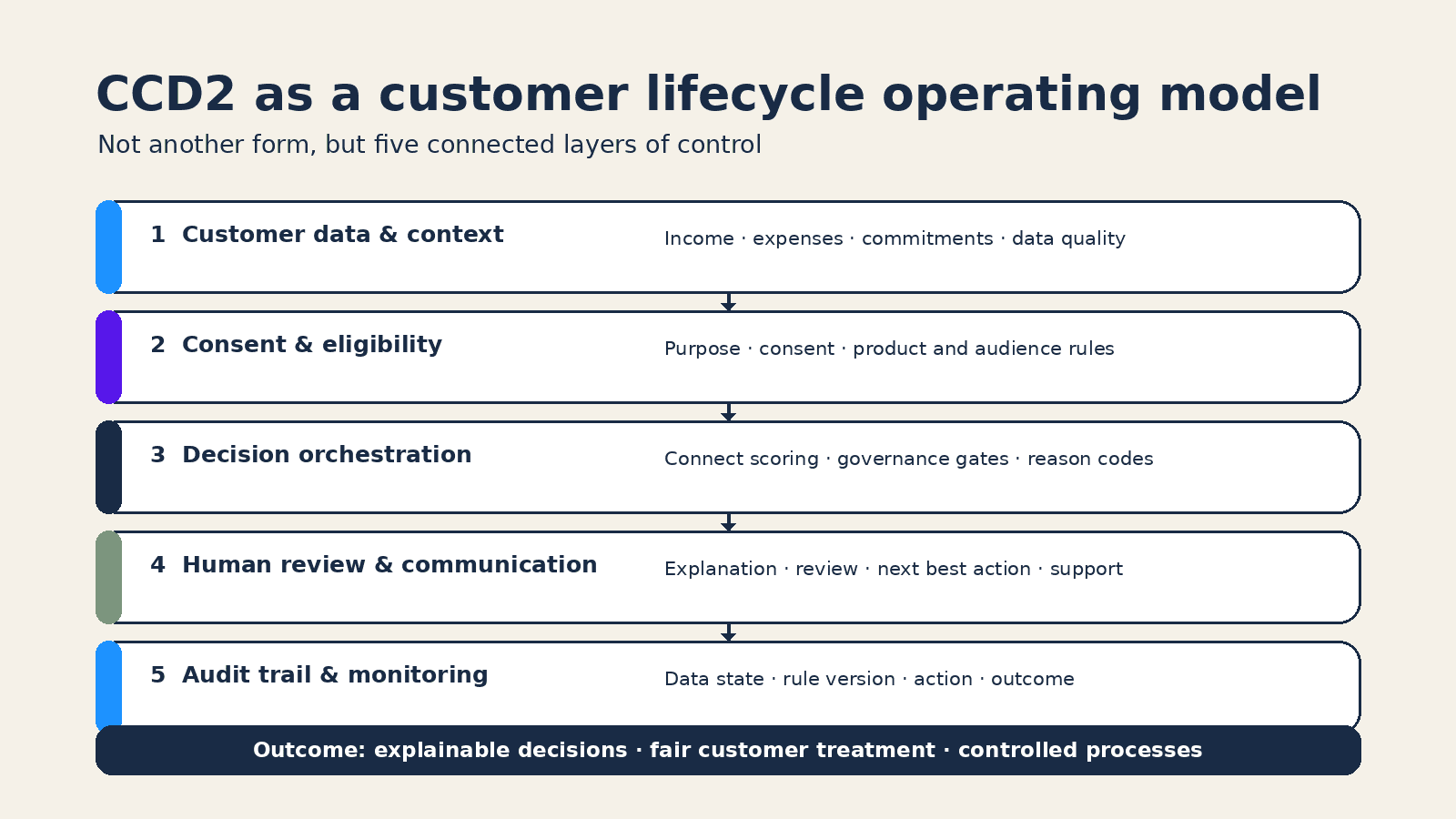
A five-stage operating model for the CCD2 customer lifecycle
The following model is suitable as a target architecture for the second half of the year. It does not replace legal interpretation; it translates requirements into governable operations.
Permitted context: Identity, product, channel, provenance, freshness and consent are assembled into a purpose-bound case context. Prohibited sources and data categories are excluded before a decision.
Governed decisioning: Core scoring and credit decisions remain in the accountable risk and lending systems. An orchestration layer checks policies, product eligibility, model and rule versions, required evidence, and stop or escalation gates.
Comprehensible interaction: Advertising, personalised-pricing notices, consent, pre-contractual information and status communications use consistent facts. Every delivery records content, time, channel and approval status.
Human review: Automated or disputed cases are routed to qualified employees with rationale, data context and a service deadline. The customer’s statement, review, outcome and communication return to the same evidence trail.
Early warning and treatment: Permitted signals trigger graduated support, from contact and clarification through reasonable forbearance to debt-advice referral. Outcomes and subsequent events improve rules and processes, not the risk model without control.
Acceleraid’s credible role
Acceleraid can act as a customer-intelligence, context and orchestration layer between existing systems. Its platform can bring together customer and transaction data, consent, lineage and role-based access, and on that basis model or orchestrate explainable decision outputs, lifecycle triggers, next best action and cross-channel activation (Acceleraid Platform; Acceleraid Data Layer).
For CCD2, the credible role is specific: assemble permitted data and consent context; orchestrate governance gates; trigger consistent customer communications; hand cases over to the accountable teams for human review; manage early-warning and treatment journeys; and model the events of that chain for an end-to-end audit trail. Which of these capabilities run as standard configuration and which are connected client-specifically to existing risk, lending and service systems is defined in the project. Acceleraid does not replace core credit scoring, legal advice or core lending systems. It helps embed their outputs into a controlled customer lifecycle.
The right opening question is not, “Which CCD2 checklist are we missing?” It is, “For every relevant customer moment, can we show which data was permitted, how the decision was made, what the customer saw, when a person took over and what happened next?” Closing that chain does more than reduce regulatory friction. It builds a better credit relationship.
Five takeaways
CCD2 is a lifecycle requirement: Advertising, pricing, consent, assessment, human review and treatment must work as one connected process.
Fragmentation is the real cost driver: Disconnected data, policies and channels make evidence slow, manual and error-prone.
Explainability requires operations: Provenance, versions, reasons, hand-offs and customer communications must be reproducible.
Human review belongs in the architecture: A review right becomes operational only through context, routing, authority and response.
Acceleraid complements the credit stack: Customer intelligence, governance gates, communications, early warning and audit can connect existing risk and lending systems — integrated client-specifically rather than promised as a blanket standard feature.
Turn CCD2 into a governed customer lifecycle. Talk to Acceleraid about a bounded pilot from permitted context to a complete audit trail.
Illustration: AI-generated. AI-assisted content: We use AI technologies and automated agents in the creation of our articles, including from Microsoft, Google, OpenAI, Anthropic and other providers. Topics, editorial direction and final approval remain with our team.
Further Insights
We use cookies 🍪
Strictly necessary cookies, such as for Pipedrive forms, remain active. With your consent, we also use Google Analytics for analysis and Leadfeeder for visitor identification. You can find further information in our privacy policy.
Decline
Accept all