CLM & CVM
The AI-Human Service Desk: A New Operating Model for Banks
A risk-based service model connects self-service, agentic processing and human leadership across every banking channel.
•
acceleraid Redaktion
8 min read

Many banks still organise customer service by channel and segment: bots for digitally confident customers, contact centres for voice and advisers for high-value relationships. That model fits poorly when the same customer checks a balance in the morning, reports a suspicious payment at noon and seeks help with financial hardship that evening. Work should be allocated according to the risk, complexity and circumstances of the task—not the channel or customer tier.
The AI-human service desk is therefore not another channel. It is an operating model that brings self-service, agentic processing and human judgement together through a shared case logic. Customers retain an understandable choice. Employees receive context and support. The bank defines which tasks can be automated, when oversight is required and where human leadership remains non-negotiable.
Let the case determine the service mode
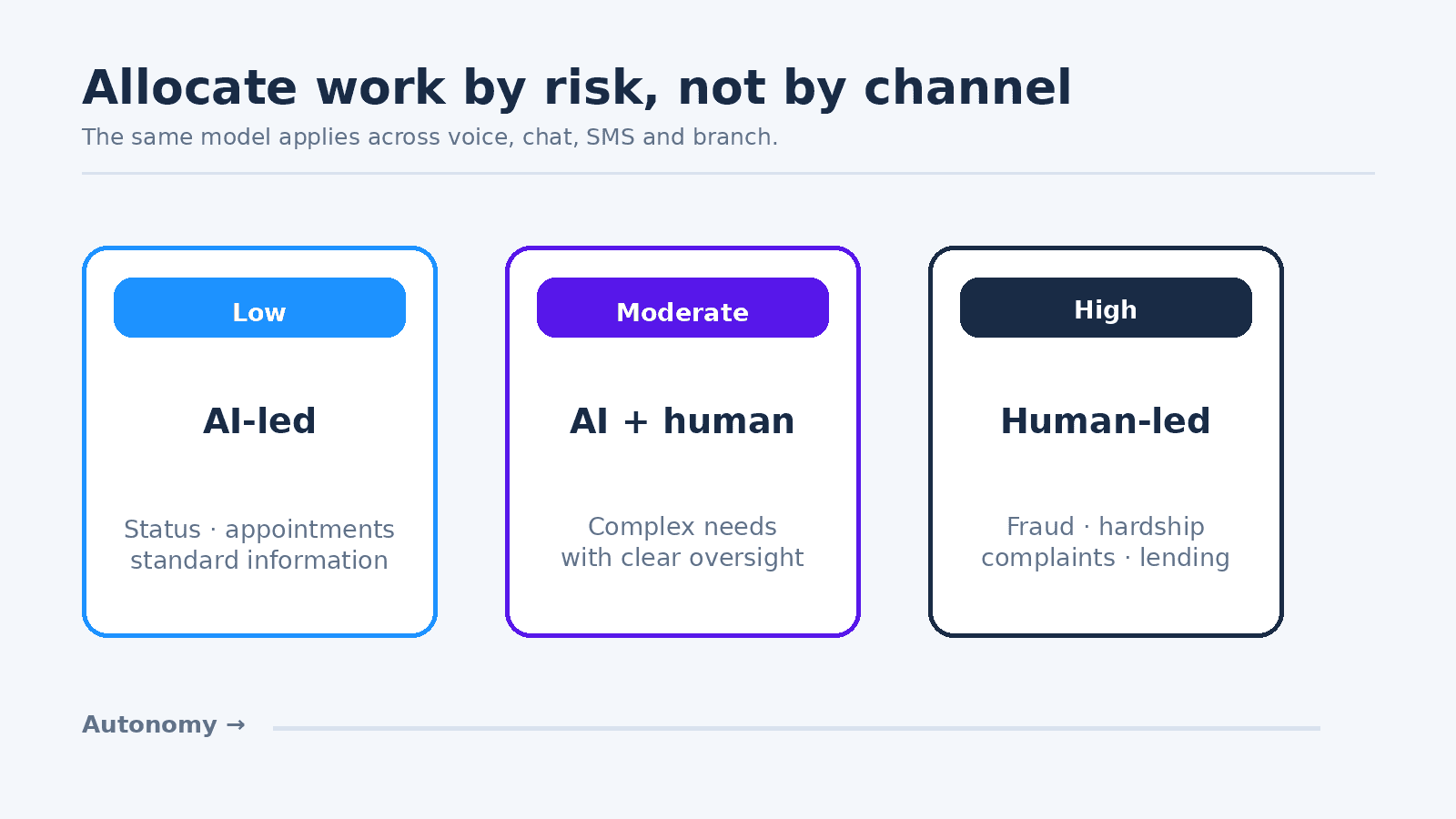
A practical routing model starts with three classes. Low risk covers standardised, reversible requests with a clear data basis: opening hours, status checks, card blocking after authenticated instruction or explanations of posted transactions. These tasks suit self-service when identity, authority and outcome can be checked deterministically.
Moderate complexity covers multistep processes that require context from several systems but can be prepared or completed within narrow rules. Agentic AI may gather information, request documents, create a case or explain options. A person oversees exceptions, approvals and low-confidence cases.
High stakes requires human leadership. Fraud, disputes, hardship, complaints and complex lending belong here. AI can summarise, retrieve evidence, maintain checklists and prepare language. It should not simulate empathy or decide matters that could materially affect rights, financial obligations or customer harm.
The classification applies across channels. A simple question remains simple on the phone; an escalated conflict remains high risk in chat. A private-banking customer may prefer self-service for a routine task, while a mass-market customer facing hardship needs qualified human support. Segmentation may shape service levels, but it should not replace risk logic.
The class is not static. An apparently simple request can move upward when records conflict, identity becomes uncertain or the automated path fails repeatedly. The service desk therefore needs continuous reassessment rather than one routing decision at the start. Every change should preserve context and record what triggered the escalation.
EricaAssist demonstrates the value of employee augmentation
Bank of America provides substantive evidence for the assistive part of this model. More than 18,000 service representatives use EricaAssist as a “human-assisted AI agent.” New generative capabilities deliver contextual guidance in under three seconds and reduce average call time by nearly one minute, according to Bank of America.
The division of labour matters. EricaAssist summarises why the client is calling, assembles relevant information and recommends next steps based on the employee’s role and client relationship. The employee remains central to the conversation: listening, understanding needs, explaining solutions and building the relationship. The figures come from the bank’s announcement and describe its own deployment; they are not a universal productivity benchmark.
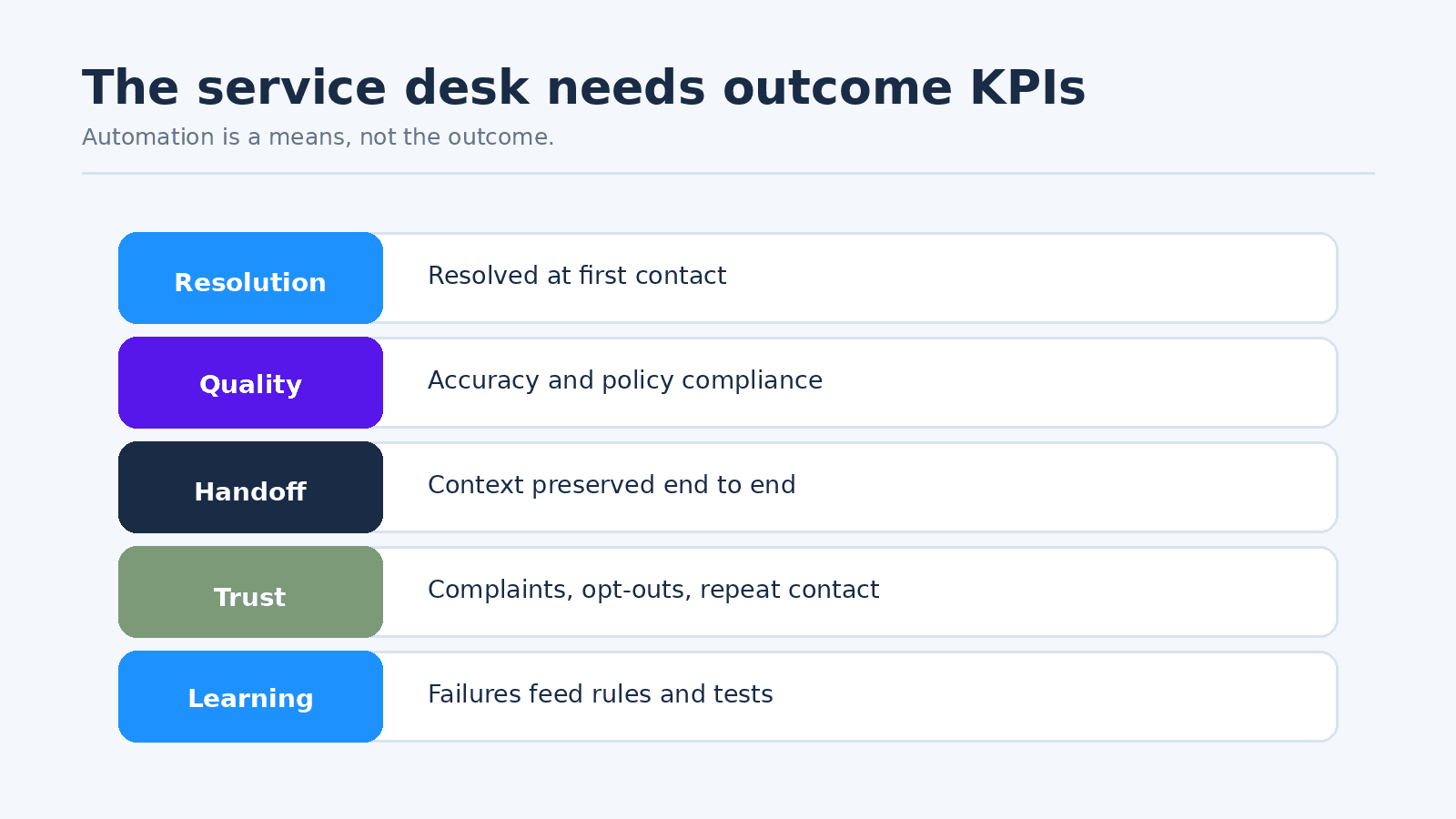
The pattern is nevertheless transferable. Good assistance removes search and documentation effort without obscuring accountability. It should distinguish suggestions from decisions, display supporting sources and allow employees to reject recommendations. Measurement should include first-contact resolution, repeat contacts, corrections, complaint outcomes and record quality—not handling time alone.
Trust requires choice and visible boundaries
Technical capability does not equal customer acceptance. Deloitte surveyed almost 2,600 US bank customers. Seventy-two per cent were concerned about sharing details of their financial situation with generative AI, while 64% worried about hidden bias. Only 46% trusted the accuracy of banking recommendations from such tools. Information on bank websites earned 79% trust.
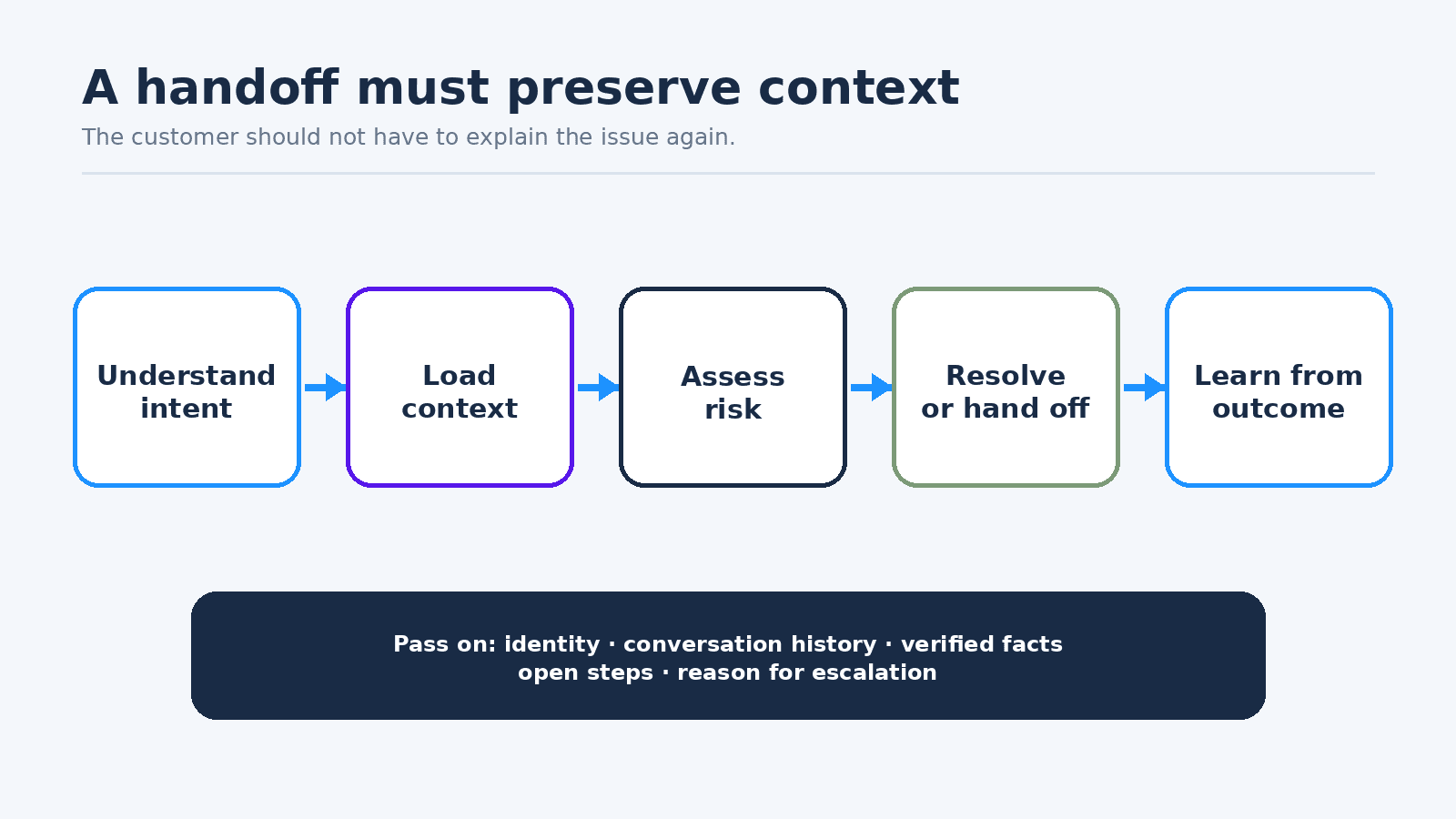
That gap is a design signal. Banks should state whether a customer is interacting with an automated system or a person, which data is being used and what the system is authorised to do. Human transfer must be easy to reach without making the customer repeat the request. The transferred context should include conversation history, completed authentication, attempted steps and the escalation reason—but only the data required for the case.
U.S. Bank is pursuing this direction. Using Amazon Connect Customer as a foundation, it is advancing generative, agentic self-service intended to give customers a 24/7 choice between self-service and human assistance across voice, chat and SMS, according to the joint AWS announcement. The announcement describes a direction of development, not evidence that every process is already available across every channel.
Choice means more than adding a “speak to an agent” button. Routing should recognise repeated failed attempts, signs of fraud, emotional distress, regulatory deadlines or conflicting information. Automation must not become an obstacle in those situations. Conversely, customers should be able to complete straightforward tasks without waiting for opening hours.
One case logic instead of three channel worlds
The service desk needs a common case record. It holds intent, identity status, consent, relevant events, applied rules, proposed steps, approvals and outcome. Voice, chat, SMS and employee desktops should not read from separate truths; they should use the same governed context. This prevents one channel making a commitment that another cannot explain.
An orchestrator sits above that record, but tasks should not be assigned solely through a language model’s judgement. Deterministic policies set boundaries: what authentication level is required? May the process be explained, prepared or executed? Which amount, product or customer condition requires human approval? Which deadline applies? AI can classify and interpret context; the bank retains authority through policy and permissions.
A clean handover is a product in its own right. It includes a concise, verifiable summary, linked evidence, open questions and the escalation reason. Employees must be able to distinguish what the customer said, what came from bank systems and what the AI inferred. After resolution, corrections should flow back in structured form: wrong classification, incomplete summary, unsuitable recommendation or unnecessary escalation. Human work then becomes a source of quality rather than an invisible repair shop.
Give every case an explicit state
A production service case should follow a visible sequence: intent recognised, identity checked, data access authorised, service mode selected, action prepared, approval obtained where needed, result confirmed and case closed. Each transition has an accountable actor and a permitted next action. A language model cannot skip a process stage merely because its wording sounds plausible.
For self-service, the bank must define what “completed” means. A polished response is not an outcome if the card remains active or the standing order is unchanged. The core system confirms the effect; the conversation explains it. If execution fails, the transfer should include the error and completed steps instead of forcing the customer to restart.
Agentic processing also requires temporary authority. An agent receives only the tools, data and time window required for the current case. Write actions deserve tighter limits than read access, while payments, product changes or external communications may trigger additional approval. Those temporary rights should expire when the case closes or is abandoned.
Organisation and governance must follow the journey
The pressure to change is tangible. In a Deloitte survey, 37% of participating US banking executives said they already used generative AI in contact centres, and another 37% planned to use it in 2026. At the same time, 77% cited integration of new technology with existing systems as a major modernisation challenge; data security and compliance followed at 67%. The Deloitte findings support an integrated operating approach rather than isolated bots.
Accountability should be organised around the journey. A combined team spanning service, product, operations, risk, compliance, privacy, technology and model validation defines the target design and thresholds. Each task class needs a named journey owner, approval authority and operational owner. Employee representatives and training teams should be involved early because roles, performance measures and escalation work will change.
BCG recommends that retail banks redesign core journeys, establish governance for human oversight and auditability, and create flexible operating models for continuous evaluation, testing and iteration. Its analysis of agentic AI in retail banking argues that quality must be measured at the production-system level, including routing accuracy, exception rates, latency and drift—not just at the level of an individual model.
That changes investment priorities. A better language model will not fix fragmented permissions, inconsistent customer data or an unclear complaint process. Banks should prioritise journeys whose outcome, policy, data access and escalation path can be governed. Pilots should include real exceptions and operate in shadow mode against human handling before customer impact is introduced.
Measure outcomes for customers, employees and control
A balanced scorecard combines four perspectives. For customers, track resolution, repeat contact, abandoned transfers, waiting time, complaints and perceived control. For employees, examine search time, documentation effort, recommendation quality, override rates and escalation workload. Operational measures should include cost per resolved request and end-to-end time, not merely shorter bot or call steps.
The control perspective adds misclassification, unauthorised actions, data-access breaches, bias indicators, model and prompt drift, and time to intervention. Results should be segmented by task class, channel and affected customer group. A favourable average can hide longer waits for hardship cases or systematic routing errors around particular language.
The goal is not the highest automation rate. It is the right mode at the first attempt: self-service when a task is clear and reversible; agentic support with oversight when several steps must be coordinated; human leadership when judgement, empathy and accountability matter. That is how a service desk can expand the bank’s capacity without pushing the customer out of the relationship.
Five takeaways
Allocate service work by task risk and customer situation, not by channel or customer tier.
Use AI for routine execution and preparation while humans lead consequential, emotional and disputed cases.
Give customers a genuine cross-channel choice and transfer context completely but proportionately at every handover.
Connect the case record, policy, permissions, routing and monitoring in one operating model rather than deploying isolated bots.
Measure customer outcomes, employee impact, end-to-end efficiency and control quality together—not automation rate alone.
Illustration: AI-generated. AI-assisted content: We use AI technologies and automated agents in the creation of our articles, including from Microsoft, Google, OpenAI, Anthropic and other providers. Topics, editorial direction and final approval remain with our team.
Further Insights
We use cookies 🍪
Strictly necessary cookies, such as for Pipedrive forms, remain active. With your consent, we also use Google Analytics for analysis and Leadfeeder for visitor identification. You can find further information in our privacy policy.
Decline
Accept all