AI & Banking
AI Demand: What It Means for Enterprise Software and Banks
Why AI will not replace enterprise software and why banks need a new layer for controlled intelligence.
•
acceleraid Redaktion
6 min read
In his essay “Nobody is talking seriously about AI demand”, Giovanni Cattani asks an uncomfortable question: where will the enormous demand for AI compute actually come from? His answer distinguishes bounded tasks that are eventually finished from unbounded tasks where better output immediately opens the door to more work.
This is more than a forecast for data centres. It is a thesis about which enterprise software will lose value, which software will remain indispensable, and which new layer banks now need to build.
Our twist: intelligence can be unbounded; authority cannot be.
Tokens are not a strategy
Cattani treats tokens as units of delegated time. In a bounded task such as preparing a tax return, producing a standard report or building a simple interface, the desired output is defined. Once a capable model performs the task reliably, demand gravitates towards the cheapest adequate option.
Unbounded tasks behave differently. Software engineering, research and trading have no natural finish line. More and better work may create additional insight, speed or revenue. Cattani therefore estimates that a substantial share of frontier-model demand comes from a small number of long-horizon, open-ended activities. His specific shares are explicitly estimates, not measured market data.
The capability trend behind his argument still matters. METR measures the task duration at which an AI agent is expected to succeed at a given reliability. This “time horizon” is defined by the time a human expert needs for the task, not by the agent’s actual runtime. Its evaluations mainly use clearly specified software engineering, machine learning and cybersecurity tasks. It is a useful indicator of progress, but not evidence that agents can already run arbitrary enterprise processes autonomously.
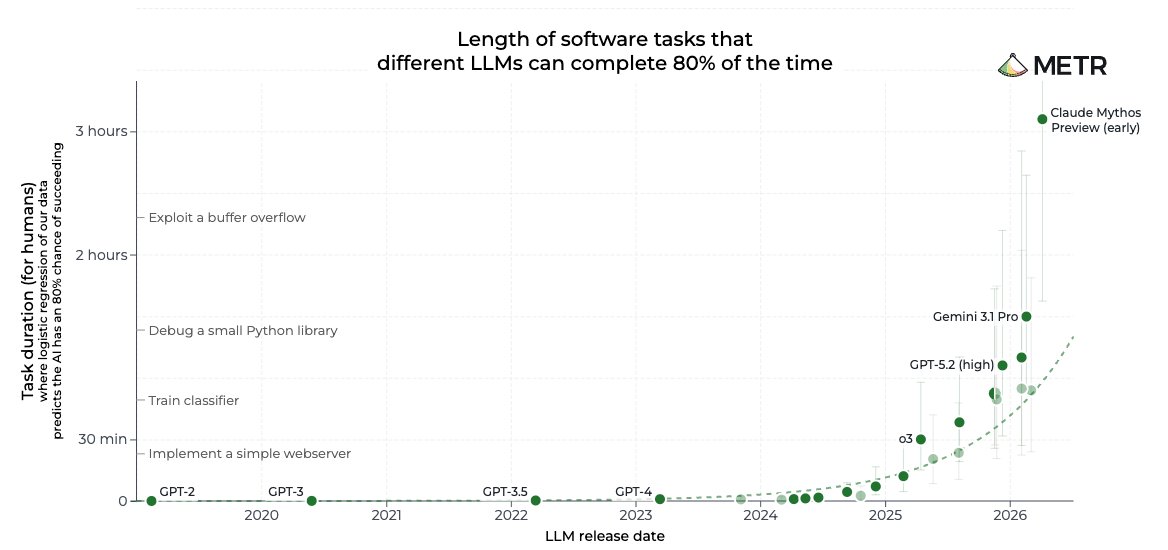
The METR chart used by Cattani shows the 80% time horizon of different models. The vertical axis measures how long a human would typically need for the corresponding software task. It does not show the percentage of total human labour already replaced. Source: Giovanni Cattani on X, based on METR Time Horizons.
The implication for companies is simple: buying more tokens is not enough. They must know where incremental intelligence creates incremental value and where it merely makes a standardised task more expensive.
Enterprise software will not disappear. Its value will move
The simplistic AI thesis says that agents replace applications. That misses the more important structural change. Enterprise software is separating into three value layers.
First: commodity execution. Standard text, summarisation, classification, straightforward code changes and tightly defined workflows will be performed by progressively cheaper models. Feature- and seat-based margins will erode. A vendor cannot sustain frontier pricing for an interchangeable function.
Second: systems of record and control. Accounts, contracts, identities, permissions, consent, policies, bookings and audit trails do not disappear. As more agents take action, a deterministic source of truth for what is valid, permitted and actually executed becomes more valuable.
Third: intelligence allocation. A new control layer decides for each task: Which context is permitted? Which model is sufficient? How much compute is economically justified? Which action may be executed automatically? When must a human take over? And how should the outcome inform the next decision cycle?
This becomes the strategic position in enterprise software. The largest model does not automatically win. The winning system is the one that best combines intelligence, context, cost, risk and authority.
Banks face an asymmetric portfolio
Banks have an unusually large number of bounded, recurring and regulated tasks: reviewing documents, classifying service cases, extracting information, drafting standard communications, preparing controls and reconciling transactions. The most expensive frontier model is often neither necessary nor economical. Smaller, specialised or open models may be sufficient, provided quality and operations are controlled.
Banks also have tasks with an open search space: adapting to evolving fraud patterns, understanding customer needs across the lifecycle, improving offers and channels, modernising complex software or simulating new products. Here, additional model capability can create real value because the next better answer is not already written in the process manual.
The key capability is therefore not a uniform AI stack that treats every task alike. Banks need a portfolio:
Task class | Typical examples | Economic logic | Appropriate control |
|---|---|---|---|
Bounded, low risk | Summarisation, extraction, drafting | Lowest cost at adequate quality | Automated quality thresholds |
Bounded, high risk | KYC step, customer notice, case decision | Reliability and evidence before model strength | Rules, dual control, audit |
Open, low risk | Ideation, software prototype, campaign hypothesis | Learning and speed | Sandbox, evaluation, budget limit |
Open, high risk | Fraud strategy, pricing logic, customer treatment | Potentially high value and high consequence | Limited authority, simulation, human gate |
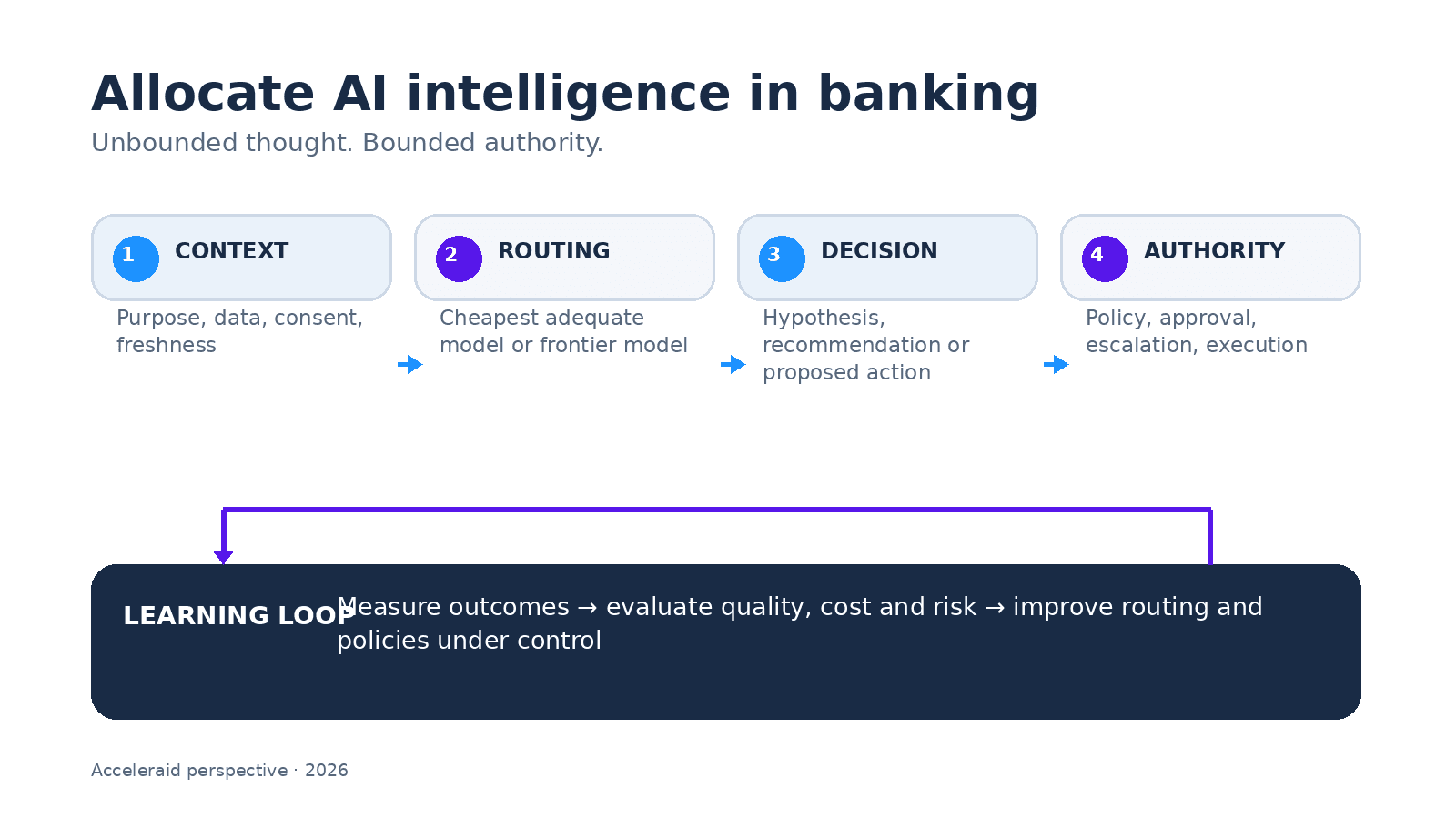
The banking twist: unbounded thought, bounded action
This is where banking differs fundamentally from many digital markets. AI may generate numerous hypotheses, run scenarios and search for better options. It cannot automatically turn every conclusion into a customer action, pricing decision or transaction.
Global supervisors are consequently discussing concrete boundaries. In June 2026, Reuters reported on proposals by the Financial Stability Board: financial firms should define clear limits on AI use and require human approval for high-risk actions, such as transactions above specified thresholds. Deloitte recommends agent registries, risk-tiered controls, distinct identities, traceable logging and continuous permission checks.
Governance therefore cannot remain a downstream compliance document. It becomes part of the runtime architecture.
For every proposed action, a bank must be able to answer:
Which customer, account and purpose are affected?
Which data, consent and policies were valid?
Which model and version produced the proposal?
Which authority boundary applied?
Who or which control system approved execution?
What outcome followed, and what is the system allowed to learn from it?
The most valuable AI platform in a bank is therefore not the one consuming the most tokens. It is the operating system for allocating intelligence.
What this means for software strategy
McKinsey argues that scalable AI value in banking requires more than models: it needs an architecture spanning engagement, decisioning, data and core technology, alongside a redesigned operating model. Santander describes its ambition as becoming an “AI-native” bank in which decisions, processes and interactions are powered by data and intelligent technology (Santander).
The practical implication is not to replace existing systems with one AI system. Banks should ask four investment questions:
Commodity first: Where is the cheapest demonstrably adequate model sufficient?
Frontier selectively: Where does additional intelligence produce measurably better decisions, faster development or new revenue?
Control permanently: Which data, policy, identity and audit systems must remain model-independent?
Close the learning loop: How do outcomes feed back without changing rules or models without review?
This is also where Acceleraid fits. It does not replace core banking, credit decisioning or regulatory accountability. It acts as a compliance-secure bridge between customer and transaction data and AI: providing permitted context, turning signals into controlled processes across marketing, sales and service, enforcing approval and escalation boundaries, and keeping outcomes and decision paths traceable.
Cattani’s essay starts with demand for tokens. For banks, the question ends somewhere else: who decides which intelligence is used for which purpose, and how much authority it receives?
Five takeaways
Bounded AI tasks will become commodities; adequate quality and low cost will matter most.
Open, long-horizon work can justify frontier models when incremental intelligence creates measurable value.
Systems of record, permissions, policies and audit trails become more important as agent use expands.
Banks must technically separate unbounded exploration from bounded authority.
Strategic advantage comes from allocating intelligence better, not from maximising token consumption.
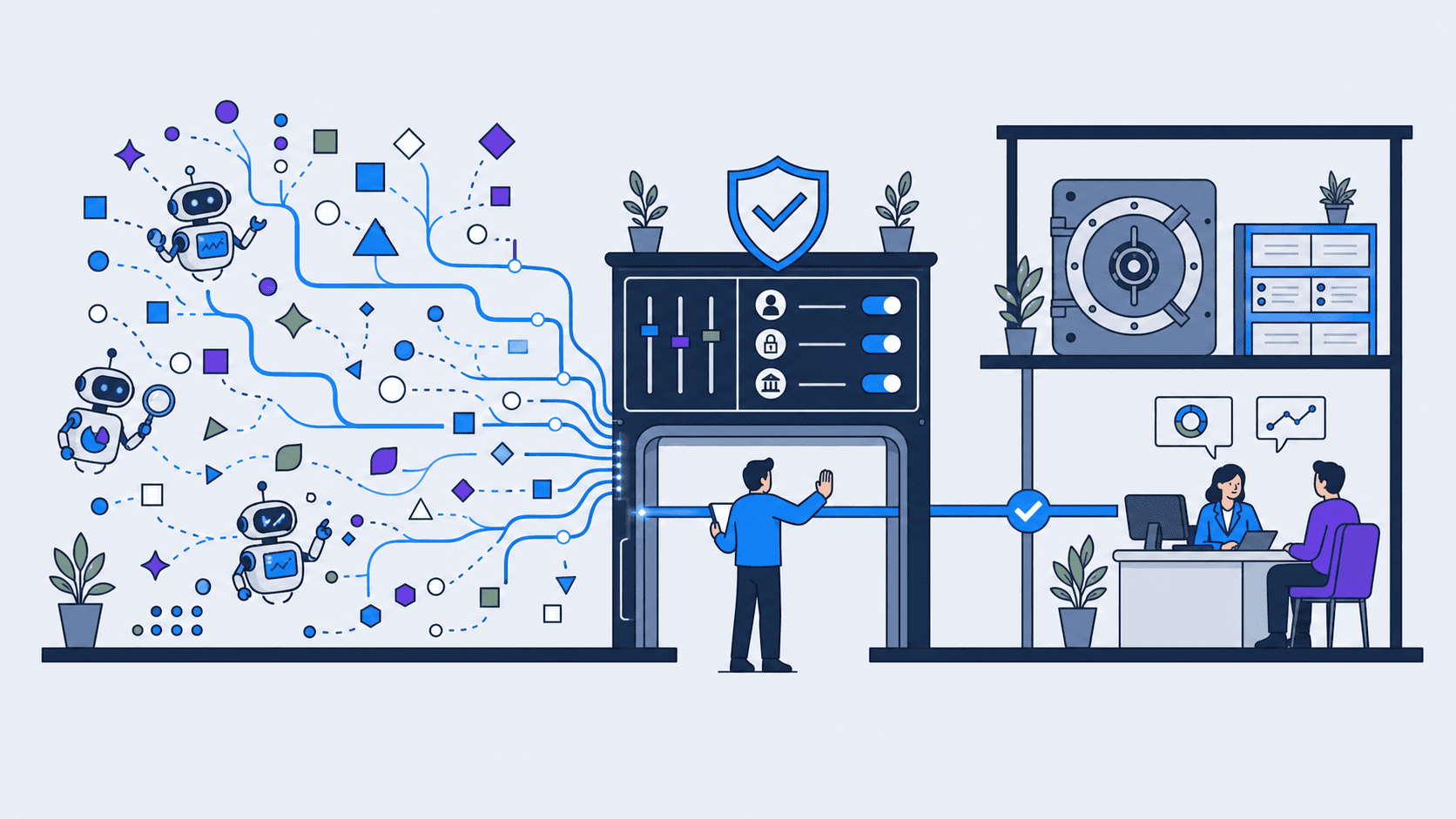
Illustration: AI-generated. AI-assisted content: We use AI technologies and automated agents in the creation of our articles, including from Microsoft, Google, OpenAI, Anthropic and other providers. Topics, editorial direction and final approval remain with our team.
Further Insights
We use cookies 🍪
Strictly necessary cookies, such as for Pipedrive forms, remain active. With your consent, we also use Google Analytics for analysis and Leadfeeder for visitor identification. You can find further information in our privacy policy.
Decline
Accept all